Far from being kitsch or sentimental, Ukrainian Lessons reads best when the author steps away from her journalistic position
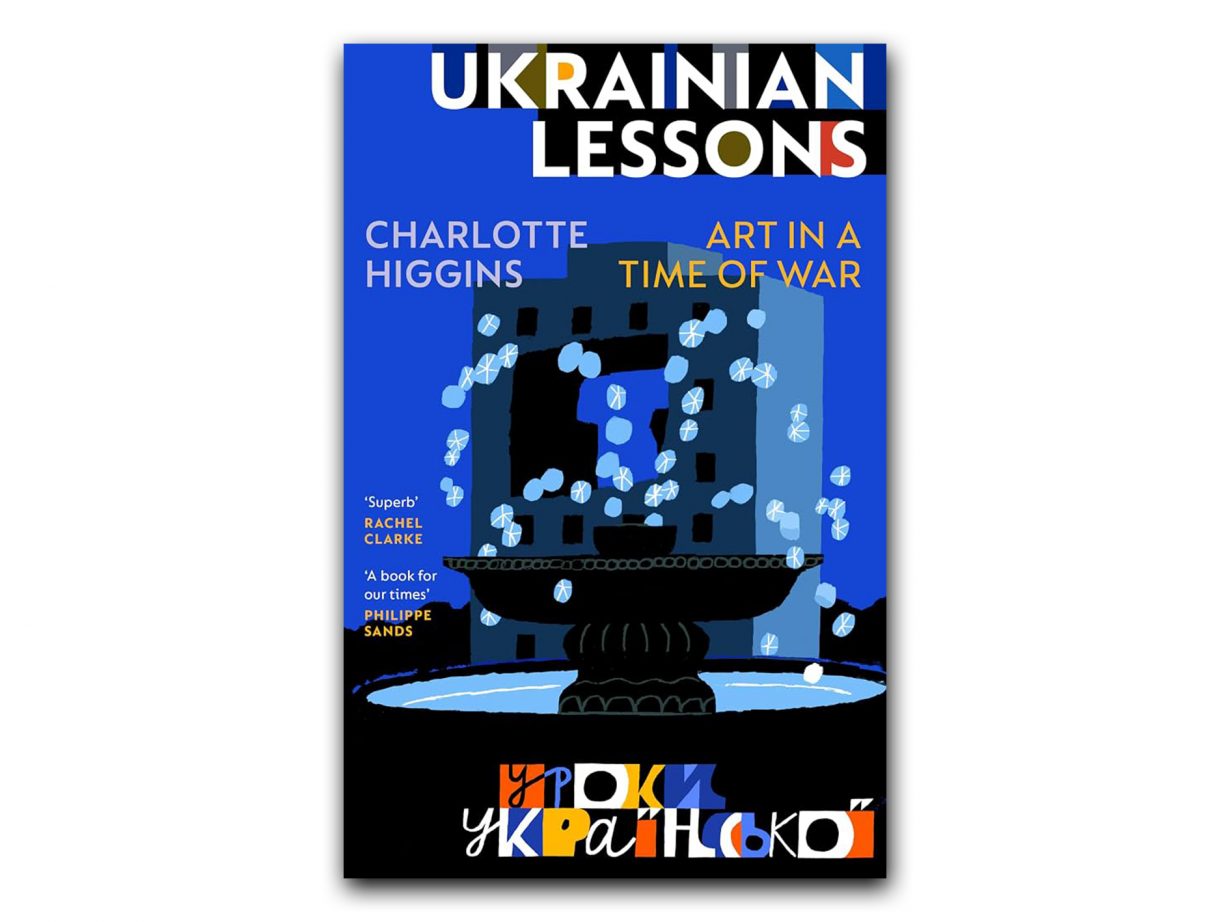
Contrary to the subtitle, Ukrainian Lessons is not a guide to visual arts in a time of war. Rather, it’s a travelogue of sorts, in which a British journalist and chief culture writer for The Guardian travels the country and meets writers, poets, film directors and artists. Charlotte Higgins didn’t have any personal connections or reasons to attach herself to the Ukrainian cause until visiting the 2022 Venice Biennale, where she met Pavlo Makov, a sixty-three-year-old artist exhibiting at the unofficial Ukrainian Pavilion. In Venice he showed a sculpture in which water flowed over a triangular-shaped arrangement of funnels fixed to a wall, its title, Fountain of Exhaustion, referring to the water shortage Kharkiv experienced ‘and maybe’, Higgins writes, to ‘a certain decay and decline that he had started to detect in western Europe, too’.
After the meeting, with no previous experience as a conflict-zone reporter, Higgins travelled to Ukraine to write a series of articles in The Guardian, but without a clear idea of what she was looking for. A classicist by training, Higgins is well versed in Greek and Roman mythology, through which she sees the war-torn country, to mixed effect. A recurring metaphor relates to Cassandra, the Trojan princess whose prophecies of her city’s destruction no one believed. Higgins finds among the various poets, writers and artists she meets in Ukraine, contemporary Cassandra-like figures, except it’s the West that ignores their anxious premonitions, whether it takes the form of poetry, essays or art. They are not always well known: there is Yuliia Kishchuk, a researcher who wrote an essay on the devastation of the Kharkiv forest region; Sasha Dovzhyk, an editor and curator, with her essay ‘Mother Tongue’ (2023) on the importance of Ukrainian language. And then there is Victoria Amelina, a poet and a writer who desperately tried to raise consciousness about the reality of the war, especially by collecting women’s stories in her book Looking at Women Looking at War (2025). Higgins describes a particularly tragic episode, in which Amelina travelled to Kapytolivka, a village in the Kharkiv region, to retrieve a diary of occupation kept by poet Volodymyr Vakulenko, who was executed by Russians in 2022. A year later, Amelina herself was killed in a café in Kramatorsk, a city on the eastern front, hit by a Russian missile.
Higgins relates dozens of histories, primarily of poets and writers, constantly comparing her own relative comfort to their discomfort, and feeling a degree of guilt. She even begins to learn Ukrainian, as she says, ‘Not as an act of solidarity, exactly, but as a marker that I was committed to returning’. And she does return, but it never feels like the book amounts to something greater than the sum of its parts. With every metaphor, every conversation, every new person brought into the picture, the reader gets more lost as to what these Ukrainian lessons are supposed to be about.
When she steps away from her journalistic position, though, the ‘lesson’ becomes clearer. Writing about Vakulenko’s mother, Olena Ihnatenko, Higgins is touched by her motherly love. ‘This is not something I wrote about… for The Guardian. Of course not: what I felt in that moment was irrelevant to the narrative. It seems mad to admit to all this, even now. Such feelings, such tides of sensation and inner images, are not spoken of, they are not respectable for a journalist. But it is the memory of this moment that I carry.’ Far from being kitsch or sentimental, and fleeting as these testimonies are, Ukrainian Lessons reads best as Higgins’s homage to the people she’s met.
Ukrainian Lessons: Art in a Time of War by Charlotte Higgins. Jonathan Cape, £22 (hardcover)
From the September 2026 issue of ArtReview – get your copy.