The book reveals how multifaceted approaches to health – political, social, cultural as much as medical – were often deemed dangerously progressive
It is de rigueur in contemporary nonfiction for the subject to be hooked to the writer’s personal history, a trend promulgated not least by Fitzcarraldo Editions, publishers of Loiseau’s interrogative compendium of five radical medical centres. This fealty to lived experience can often be navel gazing, but Loiseau’s introduction, a letter to his late mother, who with his father fought for socialised dentistry in the writer’s native Belgium, is a thing of beauty. The prose dances at moments (‘you are both the protagonist of this book and its phantom’), is precise and damning at others (writing, in reference to a hunger strike the mother staged in defence of publicly subsidised treatment, ‘your campaigning to save this system was as undesirable as the patients it attracted’) and gives the histories that follow an emotional undercurrent.
The subject, as much as the writer’s academic background in queer studies, lends itself to bouts of dense philosophy, but Loiseau is deft in his unpacking of the ‘anarcho-organicism’ that underwrote The Peckham Experiment and its focus on family health, or the break that French psychiatric clinic La Borde facilitated between Félix Guattari and Jacques Lacan (‘a schizophrenic out for a walk is a better model than a neurotic lying on the analyst’s couch’, the former spikily wrote). The often eccentric personalities, be they doctor or patient (though the divide wasn’t always evident), also provide plenty of respite. We start in Weimar Germany at the Institut für Sexualwissenschaft, in which ‘Einstein of Sex’ Magnus Hirschfeld conducted a study of the estimated 43 million variations of human sexuality he believed existed. Via South London and the Loire Valley, Loiseau takes us to Le Dispensaire des Femmes, established in late-1970s Switzerland to ‘challenge the politics of women’s healthcare’, and New York’s Community Research Initiative (CRI), run by South African doctor and ‘bathhouse-going, club-cruising faggot’ Joseph Sonnabend, which took on both the medical and gay establishment in its promotion of community agency during the AIDs crisis. What emerges is how multifaceted approaches to health – political, social, cultural as much as medical – were often deemed dangerously progressive. At a time when the economic model of care, the bio-political calculation that lies at the heart of modern medicine, dominates, Loiseau offers an important reminder of what else is possible.
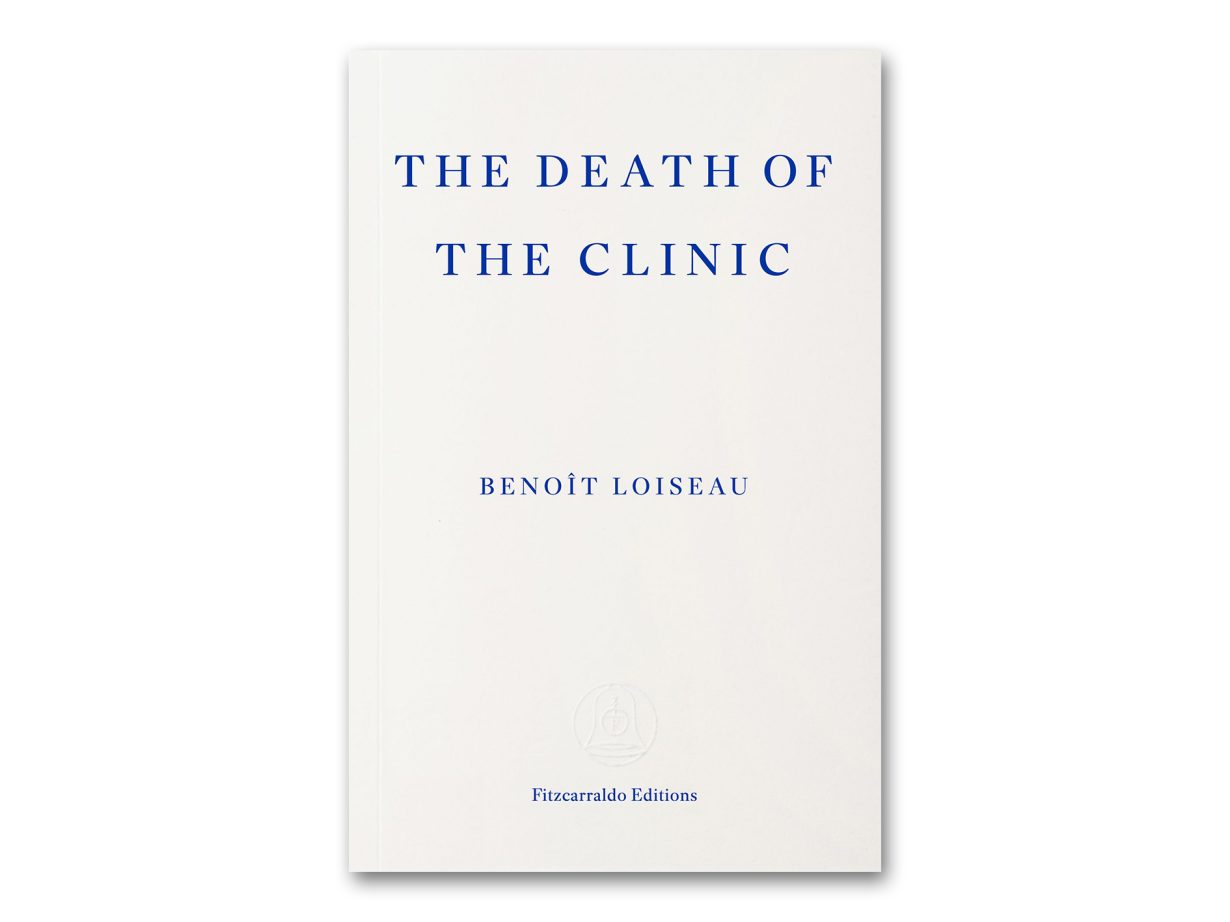
The Death of the Clinic: Radical Experiments in the Art of Medicine by Benoît Loiseau Fitzcarraldo Editions, £14.99 (softcover)
From the October 2026 issue of ArtReview – get your copy.


