The exhibition at Shanghai’s Rockbund Art Museum rethinks the legacy of socialist children’s palaces through works that explore discipline, play, resistance and the possibilities of self-invention.
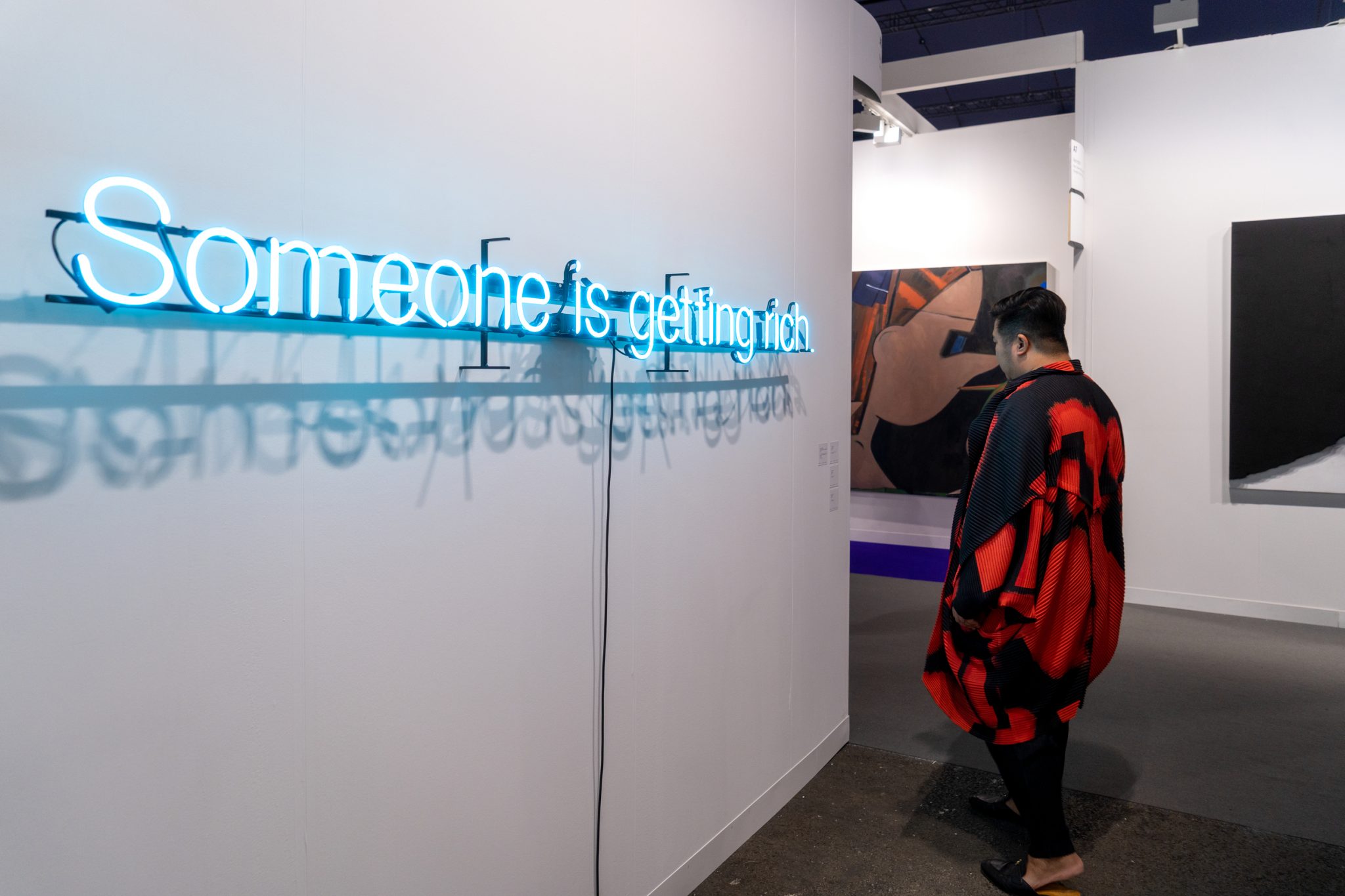
Youth Palace: or, some small acts of self-making begins with a tutorial on how to fend off an attacker. On a screen occupying an entire wall of the Rockbund’s first gallery, we watch self-defence lessons given by coaches in the arts of boxing, Muay Thai and jiu jitsu respectively. They demonstrate, among other things, the best ways to fall, to escape a choke or to dodge a punch. Pinned to the walls are self-defence kits, lanyards holding the likes of pepper sprays, stun guns and whistles. Puppies Puppies’s new commission, Defense (2026), transforms the gallery into a learning space, which, unlike conventional schooling, seeks to equip ‘students’ (aka the audience) with the knowledge and tools for resisting unknown, latent violence.
Youth Palace: or, some small acts of self-making riffs off ‘children’s palaces’, a type of youth centre that offered entertainment and afterschool lessons across the Soviet and the broader socialist world. In China’s case, these lasted well into the early 2000s before being phased out as children’s activities were gradually commercialised. Like their Soviet precursors, the first children’s palaces in China were formerly private, aristocratic sites, reclaimed by its socialist government to empower the proletariat class and build a modern, socialist public life. And these became places where millennials and early Gen-Zers like myself learned, for example, to sing and dance, watched puppet shows and played ping-pong. Youth Palace examines the legacy of this infrastructure, and how its model might be useful in thinking about the broader questions of being and becoming a young member of society today.
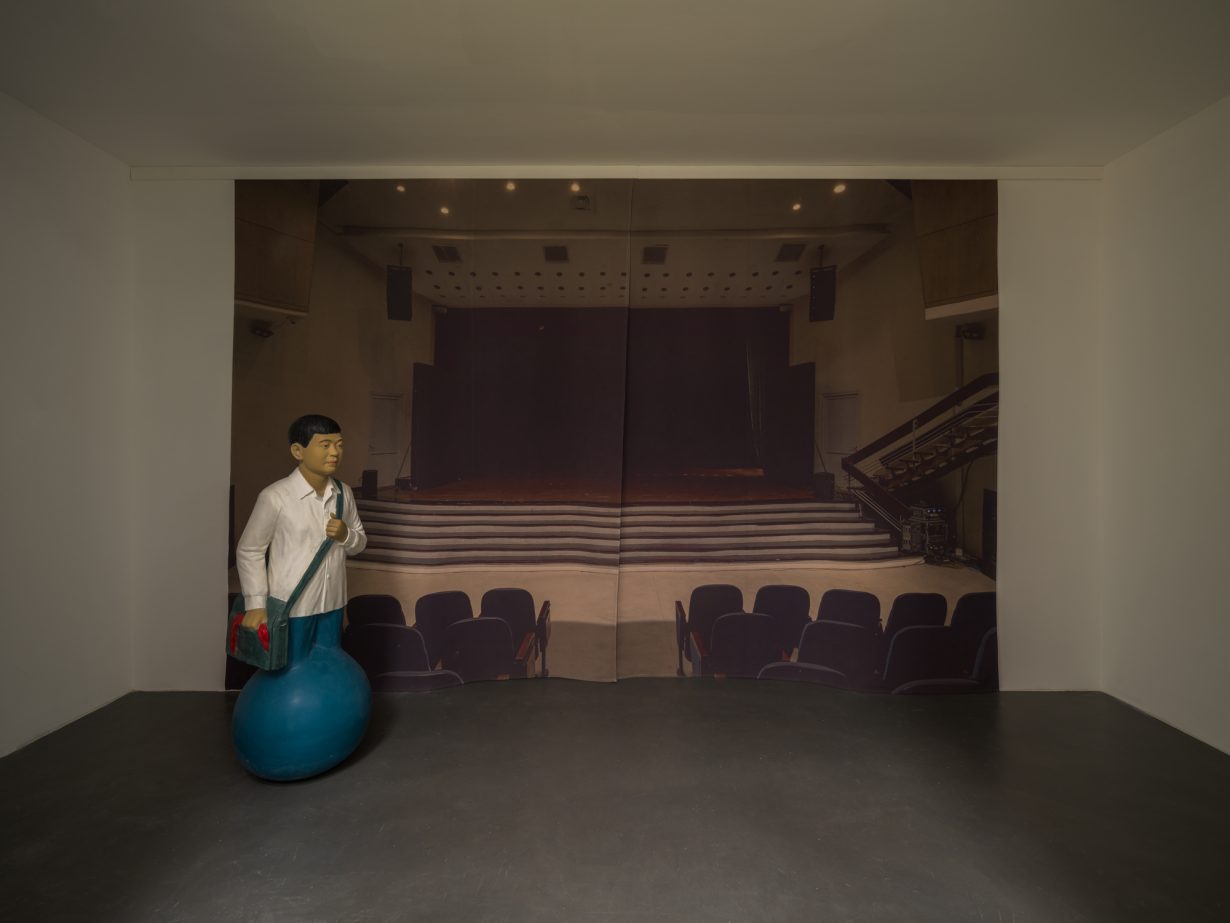
What follows is an exhibition that feels strongly Foucauldian, if equally nostalgic. In it, French philosopher Michel Foucault’s discussion of knowledge and identity – how both are shaped by methods of discipline imposed by social institutions ranging from schools to prisons – becomes a tool for interrogating this socialist legacy. In that vein, the show examines not just how children’s palaces enriched people’s lives, but also how spaces like these shaped identities, trained socialist subjects and screened the types of knowledge deemed suitable for learning. Vietnamese artist Nguyễn Trần Nam’s human-sized roly-poly dolls (We Never Fell, 2010), for example, demonstrate how the ideological work of an infrastructure can take place through interaction as much as representation. Scattered throughout the exhibition, the five dolls are modelled after toys found in the playgrounds of Communist Vietnam that represent different proletarian roles, from farmers to workers and students. Bouncing back from pushes and pulls of visitors they’re meant to show the resilience of the people. Though the metaphor also contains its own critique: if you push them hard enough they do fall; during my visit one doll is lying face down on the ground.
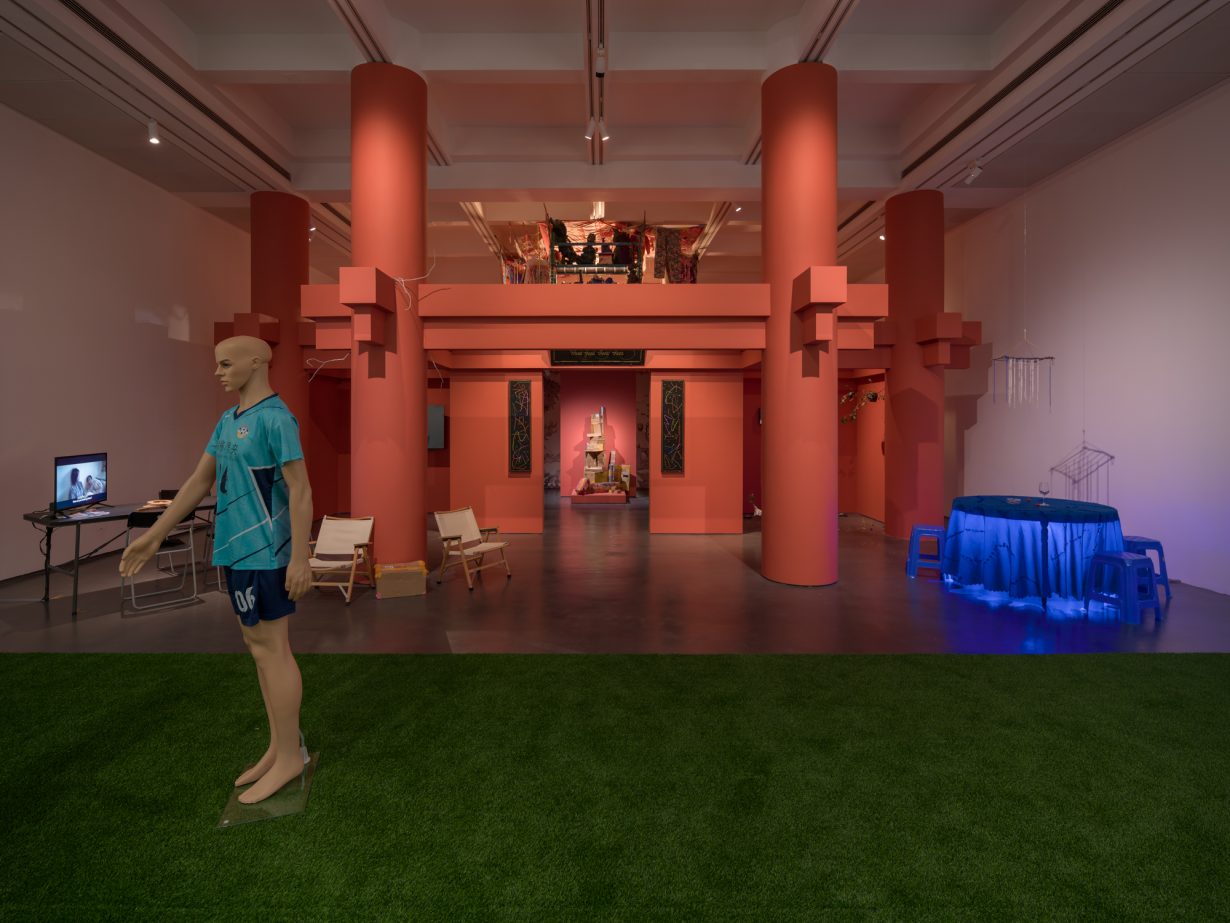
A children’s palace’s vision of a child is for it to become a productive member of the society. Though in today’s late-capitalist world, the promise of industry and progress has largely lost its charm. The section ‘Hall of the Useless’, organised by artist Ge Yulu, proposes to unlearn all that and explore other ways of being that may be more nurturing of young people today. In the section, Peng Xueying’s four-channel video Fake Moves on the Street (2026) sees her passing a football to passersby, creating moments of camaraderie with strangers; whereas Zhang Jiuwo’s video Fiasco: Troubles Never Come Alone (2022–23) simply shows her and a group of friends during a film workshop, where they performed plots generated by a board game, in footage that is barely edited. Here, unlike production, artmaking takes the form of play.
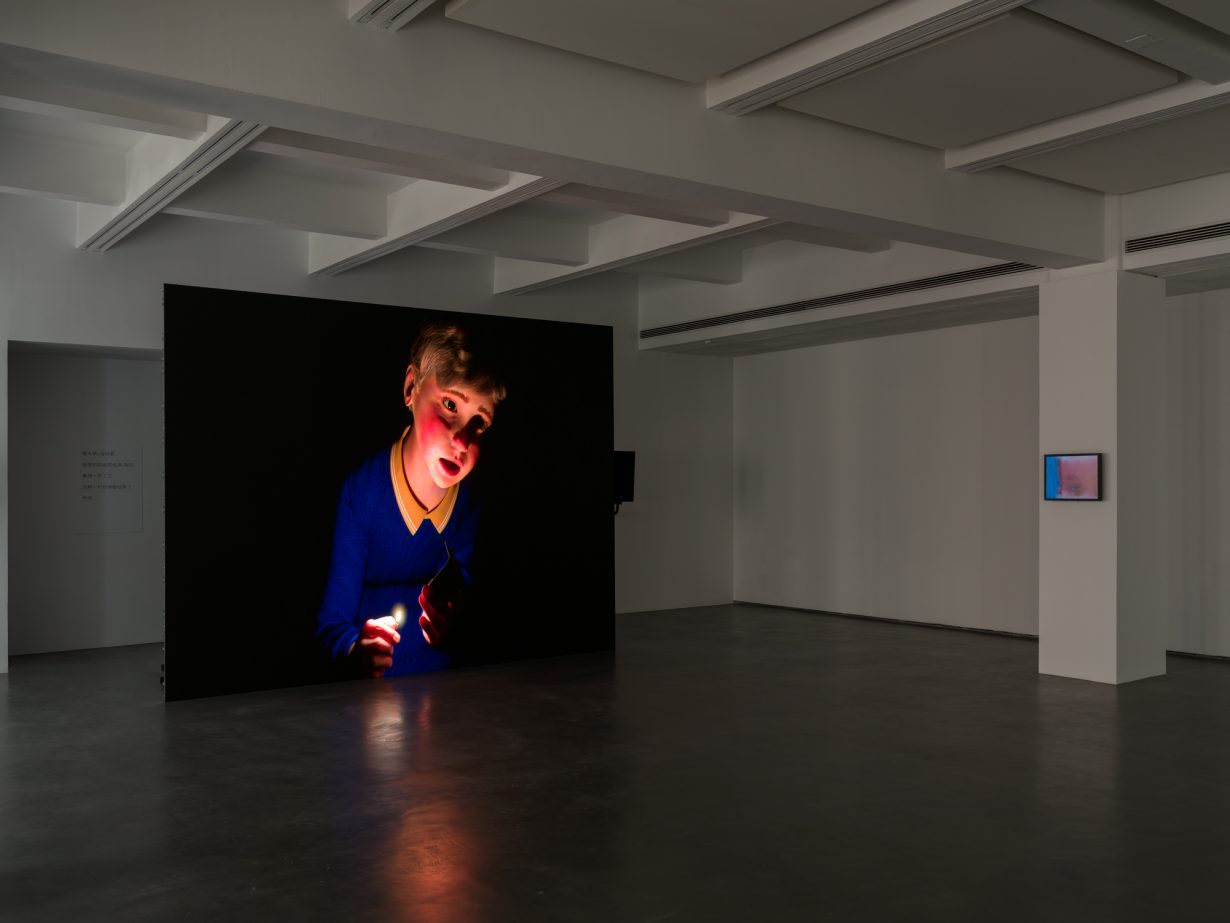
Also explored is the idea of children as an ideological vessel. Ludwig (2018), Diego Marcon’s looped 8-min video is set in what appears to be the belly of a boat, rocking on a turbulent sea. A CGI-boy lights up a match and voices his inner struggle via a dramatic aria in Latin (“Oh Lord am I exhausted / I feel so low and blue / I’d like to kick the bucket,” its translation reads), the flame eventually burns his fingers, and a cry of pain cuts off the absurdist melodrama. The loop then restarts, his suffering unending. The work appears as a corrective to any rose-tinted ideas of what it’s like to be a child, bringing to mind the broader literary trope of poor children: from Hans Christian Andersen’s ‘The Little Match Girl’ (1845) to Anton Chekhov’s ‘Vanka’ (1886), whose lives and identities, at a time when ‘childhood’ had yet to become a cherished stage of life, took different, malleable shapes.
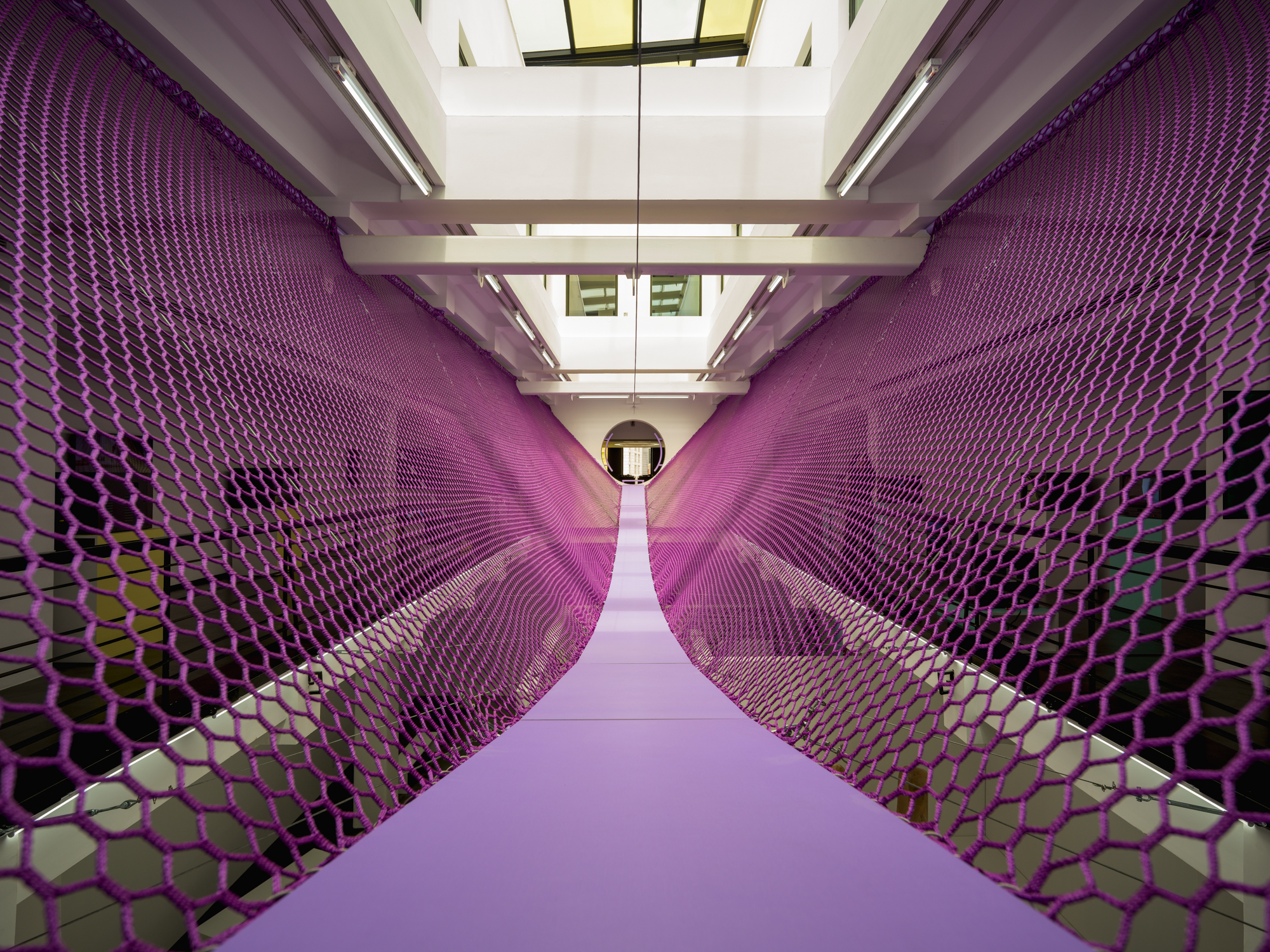
On the top floor artists Li Ming, Yang Junling and Lin Ke’s‘Friends or Friends of Friends’ is conceived as a children’s ‘secret hideout spot’, which feels like what art historian Wu Hung would call a ‘counter-monument’, where official monuments and narratives are occupied for other types of commemorations. At the centre, Li’s Path of the Brave (2026) recreates a typical feature of children’s palaces in China, an adventure-camp-type hanging bridge on which generations of youth would reenact and remember the difficult treks of the Civil-War era Red Army, gesturing at a body politics of imitation and becoming. Though what’s commemorated here are movements of a different kind. Surrounding the bridge is the trio’s joint work The Story of June 1 (2006–26), 20 videos recorded annually on International Children’s Day, when they would meet to engage in trivial or ‘childish’ acts: tossing toilet paper at the beach; carrying a large tree branch across a hilly field; loitering around in a warehouse. In this way, the artists insist on a freedom of self-invention even within a dictated or ‘official’ structure. At times, it may feel like the theme of the show – which carries with it such a specific and complex history – speaks louder than the works themselves. But the topic remains relatable and evocative. Youth Palaces is an imaginative project that shows us a model of social construction that is not without its own sense of utopianism, but nevertheless creates room for doubt and mixed feelings. In its reminiscent work there’s an optimistic reminder that new selves and new worlds can be built, and that the future can take many forms.
Youth Palace: or, some small acts of self-making is on view at Rockbund Art Museum, Shanghai, through 20 September