Yield Strength reveals the micro-tensions shaping resilience in the face of political and social pressures
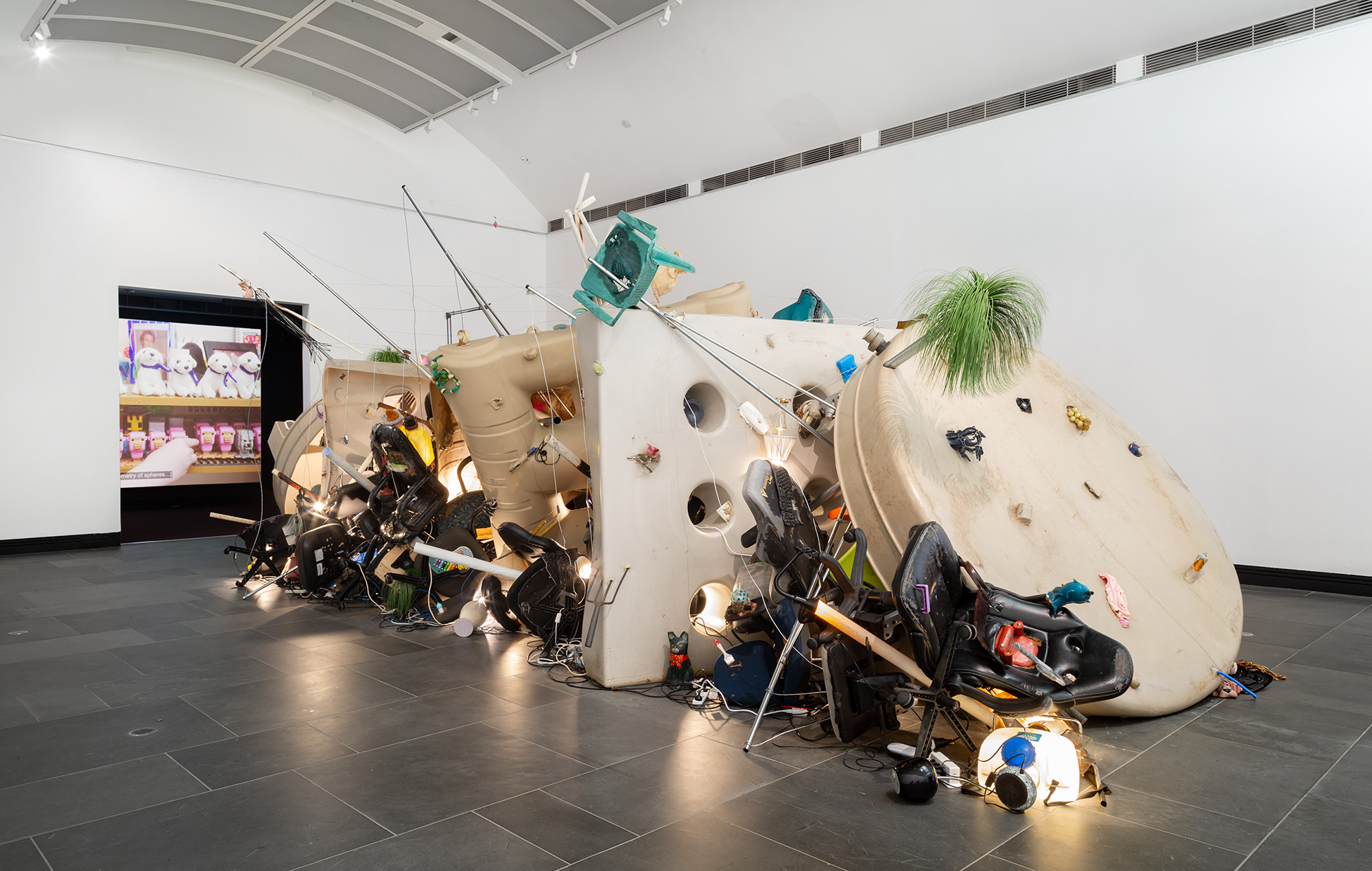
An industrial torch melted into an old water tank activates with a dull, rubbery click and, despite its apparent impotence, casts a harsh beam of light across the gallery wall. Erika Scott’s fused assemblage, Necrorealist Sunscreen (2026), is constructed from the discarded debris of contemporary life. Stretching 15 metres across a gallery, the work brings together disused, mass-produced domestic items, from childhood dolls and clotheslines to clocks and computer chairs, reassembling them into a single morphed entity.
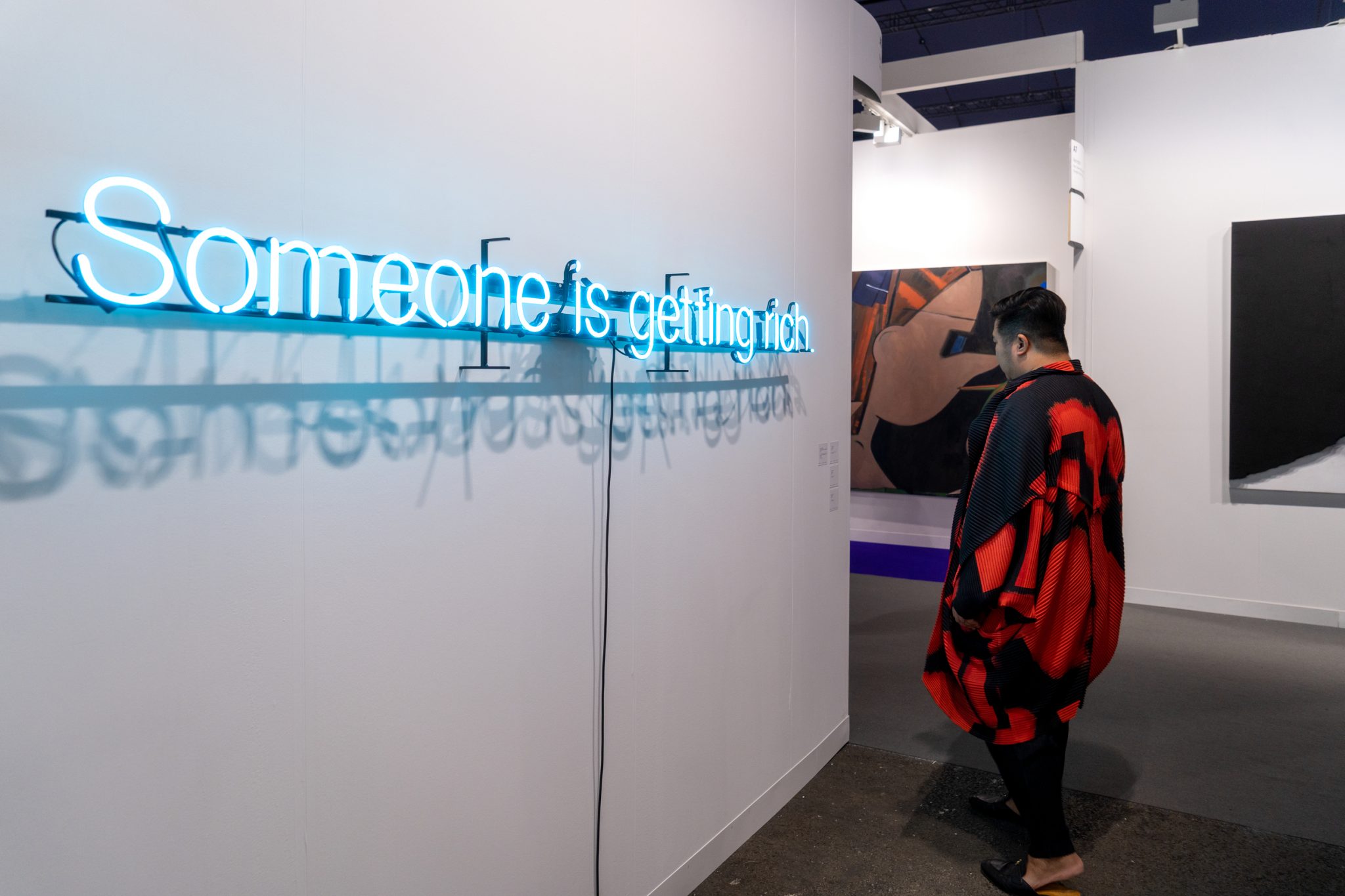
Scott is one of 24 Australian artists in Yield Strength, the 2026 Adelaide Biennale of Australian Art, curated by Ellie Buttrose (in her first curatorial endeavour since receiving the Golden Lion for National Participation at the 2024 Venice Biennale with artist Archie Moore) and exhibited across three venues. Taking place in a moment in which political and societal pressures are exposing cultural ecologies to be unnervingly brittle, the title is borrowed from an engineering term describing the point at which materials reach their stress limit and, under force, transform. Each work presented in Yield Strength strains at the very edges of formal possibility, while refusing to break. Scott’s fused but functional torch is just one of many works that defy pressure and survive.
In one of the first rooms, visitors encounter a large steel construction that obstructs the route through the gallery. Jennifer Matthew’s Ramp (2025) requires the viewer to choose a direction with no indication of what lies beyond. While its smooth industrial steel evokes minimalist sculpture, its co-opted farming materials position the viewer as little more than livestock. As an early intervention into the exhibition’s spatial sequencing, the work draws attention to the mechanics of exhibition design, in which the movement of visitors is mapped, funnelled and controlled. In Ramp, choice is revealed as a carefully managed illusion.
Such illusions occur throughout the exhibition, in which works appear as one thing from a distance, those first impressions dissolving as you draw closer. Kirtika Kain presents three works, two of which are largescale hessian pieces saturated with tar and embedded with stone, gold leaf and acrylic paint (Afterlight and Midnight, both 2025). From afar they resemble galaxies, their dark surfaces glinting with scattered gold. On closer inspection, however, the dense toxic materiality of tar as a medium becomes apparent. Kain has spoken about working with tar in connection to her Dalit heritage and familial ancestors who were condemned to labour with tar. Her artistic process is evidence of cultural survival, the works’ final monumental spans a testament to endurance and reclamation.
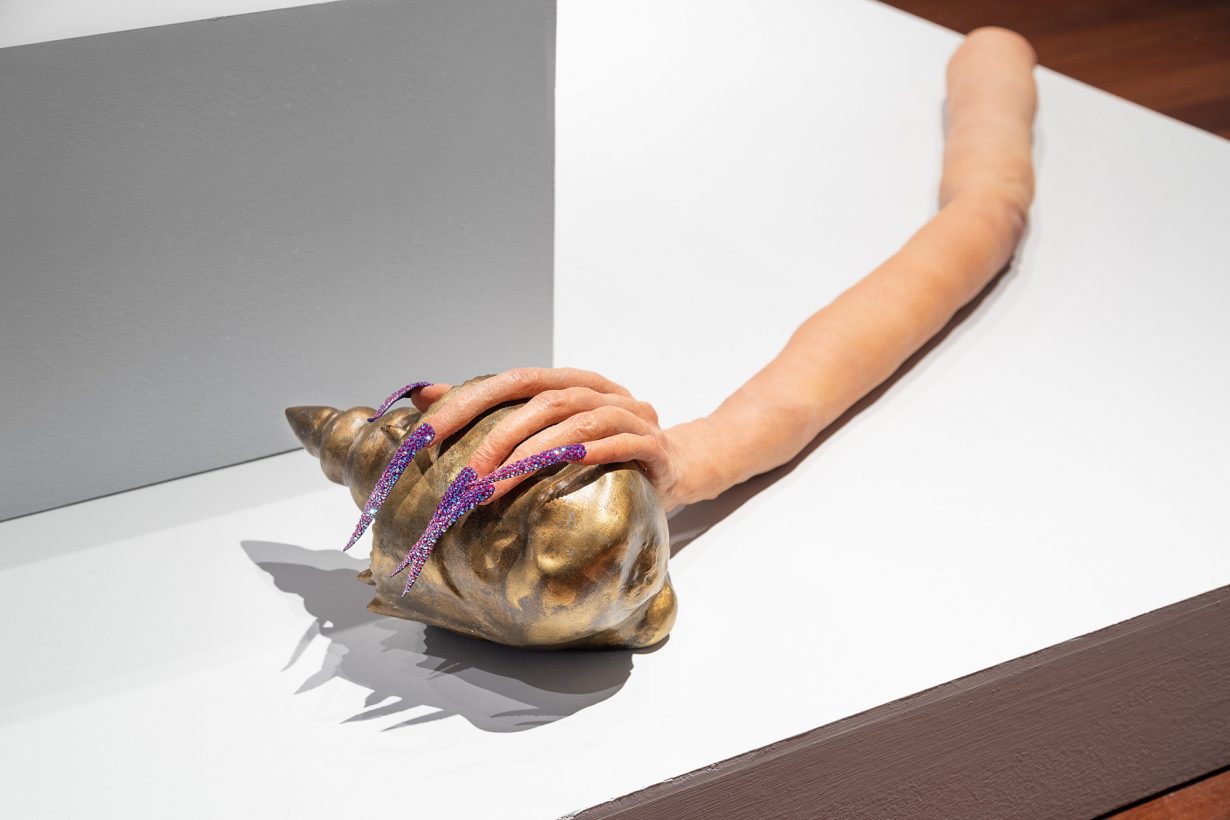
This idea of survival emerges throughout the exhibition, often with humour, as in Scott’s largescale sculpture. Nathan Beard presents installations across two sites featuring impossibly elongated silicone arms grasping 3D-printed heads of Thai Buddhas and durians (Ciceroni and Cicerone, both 2025). The arms twist and knot around the objects, their uncanny lifelikeness heightened by perfectly manicured, diamanté-covered nails. On closer inspection, these nail extensions mimic the form of the fon lep fingernail dance and are covered in Swarovski crystals drawn from a series of colour tints that are, to this day, termed ‘Siam’. Beard critiques the ongoing exoticisation of his mother’s homeland, Thailand, his monstrously decorative works exposing both the persistence of these fantasies and the endurance of cultural practices that survive despite them.
In the sticky humidity of the botanic garden’s conservatory, water slips over a series of clear plastic pipes, again by Scott. Stuffed with plastic debris, they read as core samples, exhibits of the present for generations to come. At the exit to the conservatory, a compacted stack of soil, Ground, Earth, Sand, Time, Space (2026), by Robert Andrew, slowly crumbles. A single string, pulled by a mechanism from the centre of the column, creates a slow micro-tension that gradually cuts into the stack and drives the column’s disintegration. Yield Strength is an index of such micro-tensions, exposing endurance in contemporary times as a balance between pressure and collapse.
The Adelaide Biennial of Australian Art, Yield Strength, is on view at the Art Gallery of South Australia, Samstag Museum of Art and Adelaide Botanic Garden, through 8 June
From the Summer 2026 issue of ArtReview – get your copy.