What the artist’s story of the Houari Boumedienne Agricultural Village in the Algerian Sahara might tell us about utopian practices today
In The Terminal Beach (2024–25), Anna Moreno’s 32-minute film documenting the Houari Boumedienne Agricultural Village in the Algerian Sahara, the narrator informs us that “I’m not photographing ruins”. Yet the site is a complex in decay – begun in 1979 as a utopian socialist housing project by Catalan architect Ricardo Bofill for Algeria’s ‘1000 socialist villages’ initiative, but soon abandoned – which many would designate a ruin, despite its 2008 population of 3,091. Rejecting that label suggests a general misunderstanding of built environments, including how so-called ruins double as living archives of contemporaneous value.
Moreno’s film bookends the Spanish artist’s trilogy, begun in 2017, pairing J.G. Ballard’s writing against the fantastical architectural initiatives promulgated early on by Bofill’s studio, the Taller de Arquitectura, which belonged to a 1970s-era coterie of young creatives known in Barcelonian history as the Gauche Divine (the Spanish ideological precursor to France’s Divine Left). The group fancied themselves capable of effectuating a social utopia, a popular aspiration in 1960s and 70s architecture, in what amounted to a superficial charade of enlightened leftist politics. The Terminal Beach notes this ideology in the narrator’s neutral tone without being didactic about the limboed fate of Bofill’s failed Saharan project, which in Moreno’s telling he claimed was “swallowed by the dunes”.
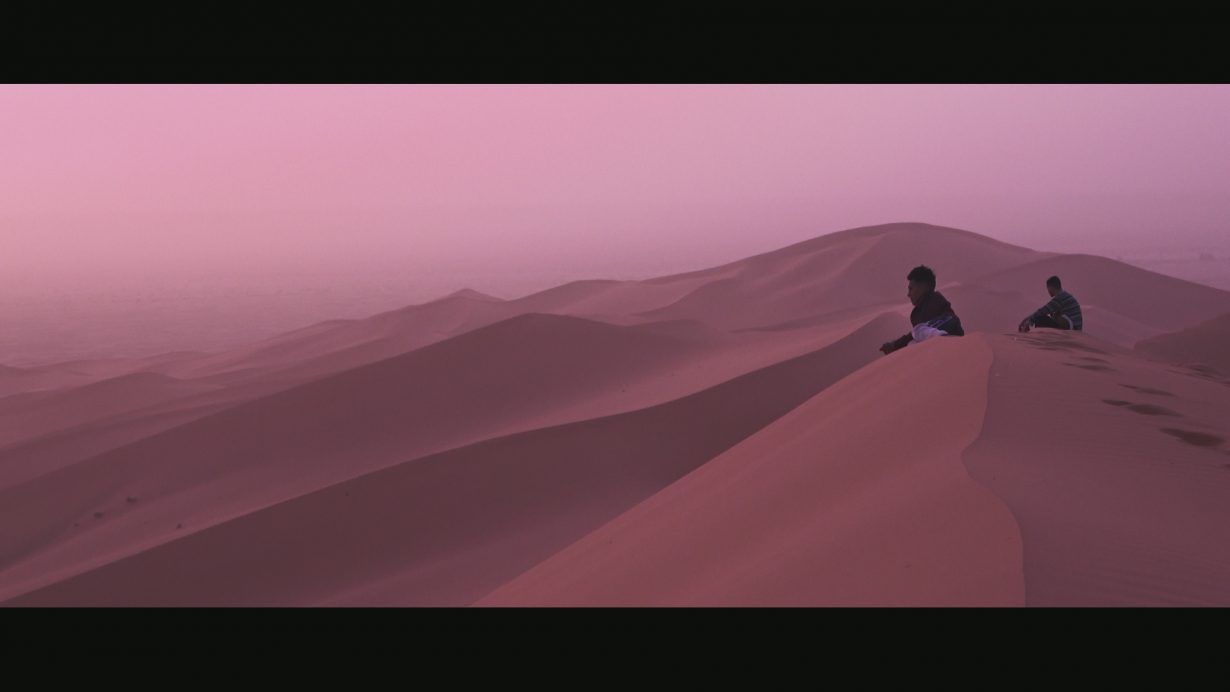
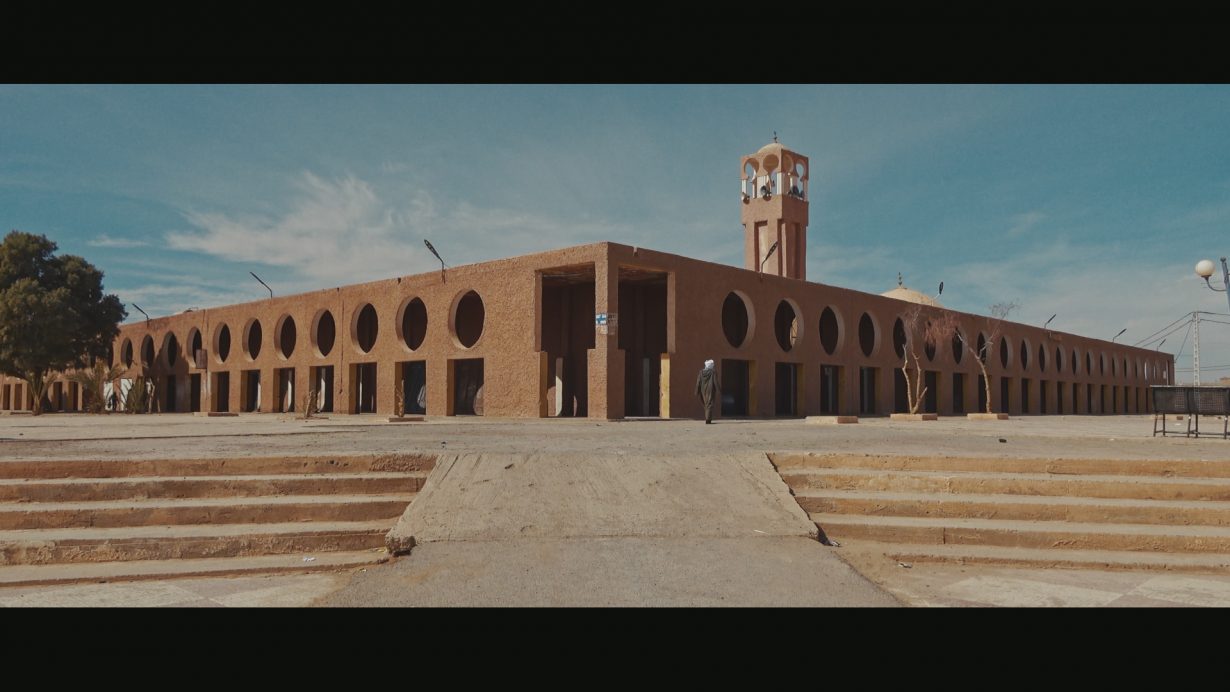
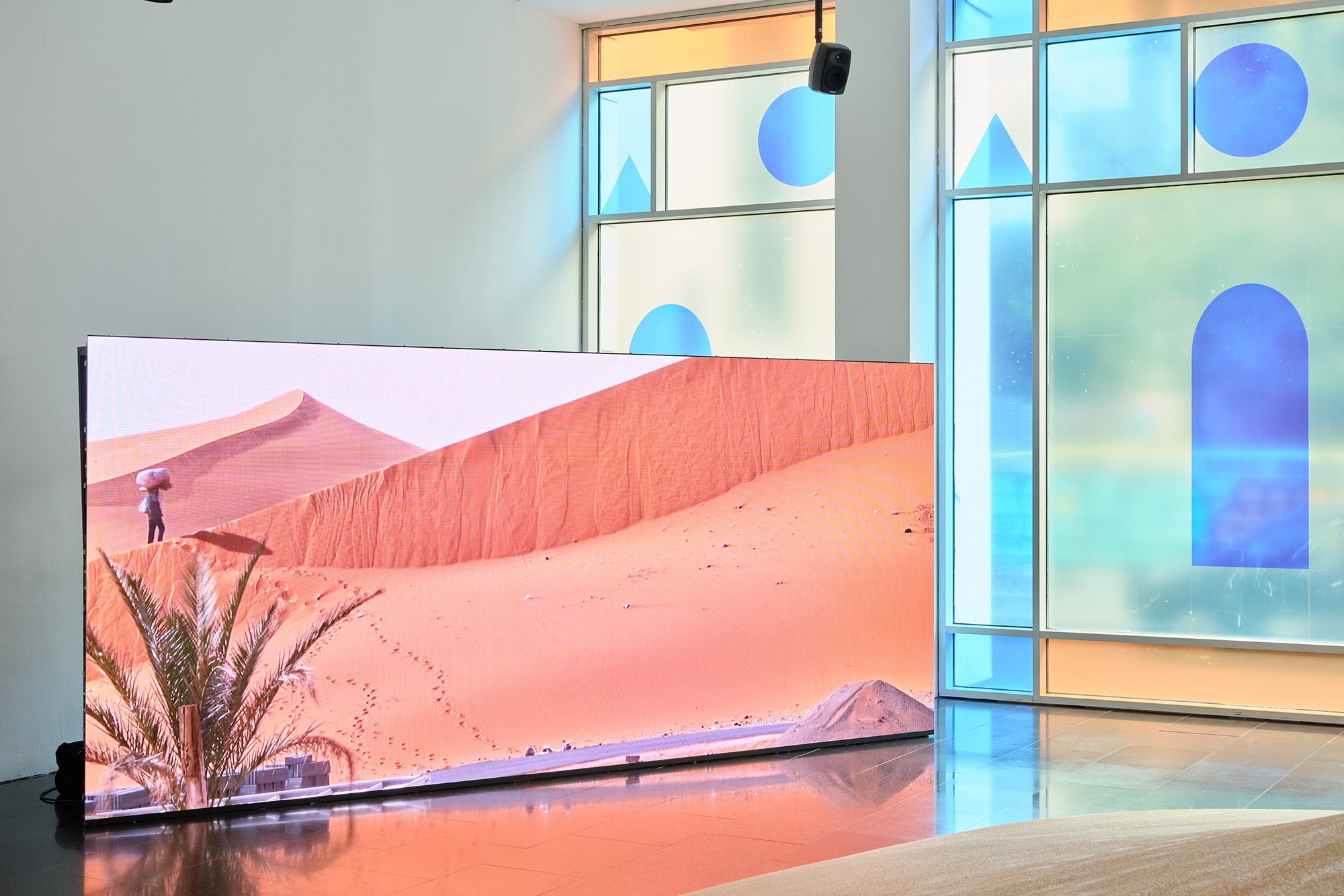
The film is featured on a large screen alongside two new works (both 2026) that could conceivably function as a single installation, with The Terminal Beach as its beating heart. In Untitled (Mercy), vinyl overlays on the gallery windows mimic the settlement’s architectural aesthetics, repeating its geometric forms in the same blue and terracotta colours, and an untitled sloping sculpture, installed mid-space, resembles its sand dunes. A Question of Re-entry, mounted on the wall opposite the film, expands the historical context, pairing old Super 8 footage of Bofill’s other utopian architecture projects with video of Moreno on a motorbike, her own Super 8 camera in hand. The artist’s filming in The Terminal Beach is rhythmic, idling in ten-second shots punctuated by activity. We linger on blazing orange dunes at purple dusks, or a building’s sun-bleached facade, its open design exposing skeletal interiors. These sequences are interrupted by views of residents: a man drawing in the sand, or children attempting to barter with the filmmakers in Arabic dialect and French.
The Terminal Beach corresponds to Ballard’s 1964 short story of the same title, where decaying buildings of a former nuclear test site decline alongside the protagonist’s health, and makes an apt conclusion to Moreno’s trilogy. The reference reframes Bofill’s perception of an architectural utopia as nothing more than science fiction – a project to fulfill his personal fantasy. Per Jean Baudrillard, the Divine Left’s empty yet self-congratulatory preoccupation with utopia ushered in neoliberalism, and the coveting of stardom as creative hyperprofessionals without the effort of serious thought. Seeds of this mentality are again cropping up among today’s cosmopolitan creatives, from critic Dean Kissick’s rejection of politics and vague advocacy of utopian communities to philosopher Luce deLire’s call for a ‘surreal utopia’ in which hot sex and communal singing are framed as radical. Both authors fly the banner of intellectualism while offering no substantive framework for a utopia, echoing the Gauche Divine’s philosophy that concluded, for one thing, in a forgotten village. Moreno, here, demonstrates that built environments assume a life of their own, and her consideration for generations of people affected by those who customised their political-to-creative ratio is equally convincing that political persuasions inherently inform artistic acts.
The Third Twist at MACBA, Barcelona, through 28 September
From the September 2026 issue of ArtReview – get your copy.