“We dedicate the pavilion to our ancestors who, despite the brutal presence of Russia, managed to preserve our Latvian identity, language and culture, as well as the possibility to dream about the future.”
ArtReview sent a questionnaire to artists and curators exhibiting in and curating the various national pavilions of the 2026 Venice Biennale, the responses to which will be published daily in the leadup to and during the Venice Biennale, which runs from 9 May through 22 November.
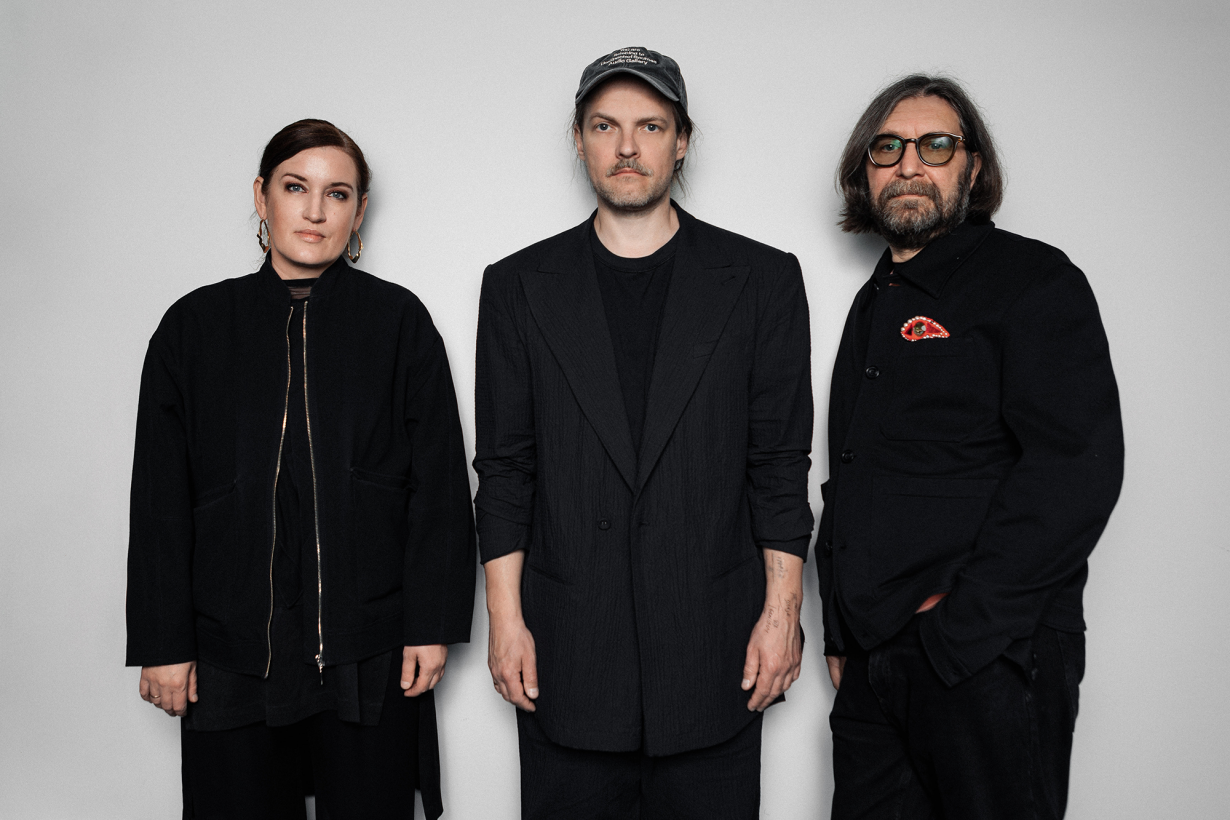
Bruno Birmanis and Mareunrol’s are representing Latvia; the pavilion is in the Arsenale.
Celebrating Visions. Versace partners with ArtReview to share stories from the 2026 Venice Biennale.
ArtReview Tell ArtReview what you plan to exhibit in Venice. What has influenced or inspired you?
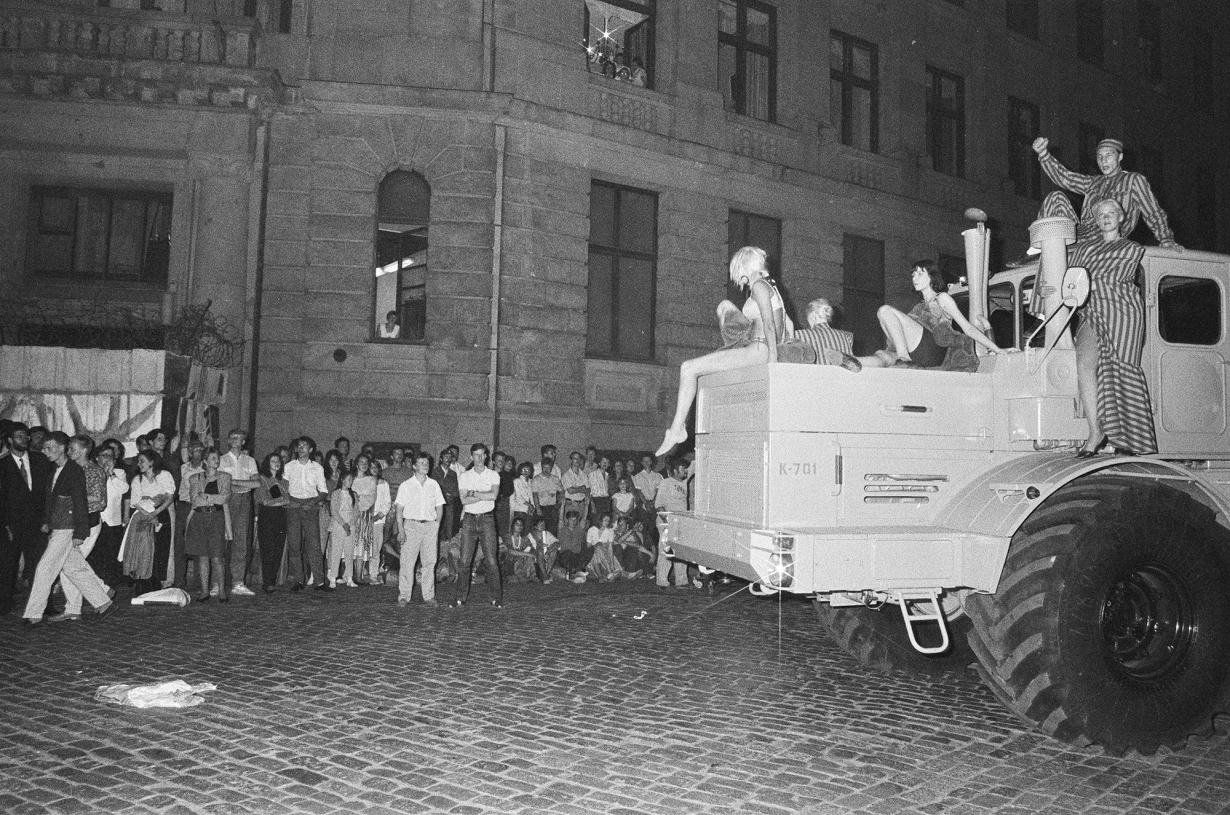
Mareunrol’s Our story is fundamentally rooted in memories of Latvia in the 1990s, vividly characterised by the avant-garde fashion event of that time: The Untamed Fashion Assembly (UFA), conceived by our collaborator Bruno Birmanis.
The primary inspiration comes from our childhood – from memories of the restoration of independence, from the traumas left by the Soviet era and the process of overcoming them. These are memories of the first time that, as students, we travelled to fashion competitions, events and study programmes organised by Western countries. It was our first time seeing the striking contrast between the place we come from and the Western world, which we had not yet experienced in the 50 years of paralysis during the Soviet period. It was a moment when a country that had just restored its independence was gradually experiencing the transition towards a free-market economy.
Two months after Latvia regained its independence [1991], the UFA event took place. It became something like a manifesto of freedom. We drew inspiration from the rich archive of photographs compiled at the time by Birmanis, now under the care of the Latvian Centre for Contemporary Art, as well as from video recordings of the event, particularly from the video archive of the British cameraman and artist Henry Stein, who had arrived at the event by bus with students from Central Saint Martins and members of the UK press.
However, our project is not intended as an archival space or a nostalgic exhibition. Rather, it is a space of relationships and dialogue that unfolds in the present through the past, while looking towards the future. The installation can be understood as a reflection on a pivotal historical moment and the courage and naivety of the utopian intentions that came with it. In the pavilion we address all of this through the visual codes and elements of a fashion show backstage. Within this framework we include our reflections on space and time, on memory and our relationship to it, on dreams and intentions, on possibilities and relationships, and on joy and pleasure.
Bruno Birmanis Each of us threads together our experiences and sensations in a single tapestry: the living fabric of life, which for the artist becomes the very grounds of creative expression. A significant period of my own life – one marked by intense experience and adventure – is connected to the Untamed period. It continues to serve as an anchor for me and my work.
AR In what ways (if at all) does your work relate to the theme of the Biennale exhibition, In Minor Keys?
BB It certainly resonates. Everything to which the exhibition is devoted is viewed through this prism.
The reality is that the very idea embodies the minor: the backstage as metaphor, utopia as a fragile construction, freedom as a childlike yet courageous act of faith.
Untamed Assembly is not merely a retrospective look at the explosion of the 1990s. It is a narrative about how history is formed in hushed tonalities before it becomes a resounding anthem.
M The curatorial theme of the Biennale exhibition, In Minor Keys, was announced relatively recently, while the vision for our pavilion was already developed a year ago. Nevertheless, there is a strong resonance between them. Although our story may appear loud and theatrical, we wanted to focus on what is essential, fragile and emotional – on the nuanced range of stories and feelings that formed this assembly.
We would like the pavilion to be experienced almost like music: not just to tell a story but to shape how it is felt. The overall composition of the installation integrates multiple stories and directs attention towards elements that may previously have seemed marginal. In this sense, we certainly feel that our pavilion aligns with the conceptual vision of In Minor Keys.
AR Why is the Venice Biennale still important, if at all?
BB It would be disingenuous to claim it is not significant, given that I am part of the team shaping a national pavilion.
I believe that precisely because of its scale and resonance, the Biennale constitutes a territory of play and freedom for diverse experiential expressions. In this respect, it resonates with how fashion weeks – largely driven by commercial imperatives and ostensibly seeking to move beyond traditional pragmatism – become increasingly extravagant, while only a handful of truly distinctive artists manage to produce work that carries substance.
M The Venice Biennale remains one of the most significant and high-profile art events in the world. It offers an opportunity to communicate something meaningful to the international art community on a global stage. However, at the moment, it also seems that the Biennale has become something of a battlefield within the cultural sphere. As a result, the idea of the national pavilion has become increasingly politicised.
The unexpectedly late announcement of Russia’s participation was received with shock. Shortly before the opening of the Biennale, we and other participants were placed in front of this fact with almost no opportunity to respond. For many societies in Europe these issues may appear distant or abstract, but for us as Latvians they are not.
The European Parliament has officially declared Russia to be a state sponsor of terrorism and the International Criminal Court has issued a warrant to arrest the Russian president for alleged war crimes. They invaded Ukraine more than four years ago already, devastating and destroying its culture, heritage, churches and infrastructure. It is deliberate terrorism every day, a danger to democracy and to everything that is beautiful and true. Displaying the message of this state contributes to its normalisation within the international cultural sphere. This is unacceptable and contradicts basic ethical and moral principles.
For many small countries the Biennale remains extremely important. Within the dense cultural landscape of Europe, it offers Latvia the possibility to communicate its perspective internationally and to foster understanding and empathy regarding our historical experiences and present concerns.
AR What role does a national pavilion play at a time of increasing confrontational nationalisms? Is it about expressing difference or commonality?
M Today we are perhaps more compelled to speak about differences, about the unique nuances that have developed through specific historical contexts. At the same time, these contexts also reveal a shared human experience. The idea of national pavilions is inherently connected to questions of national identity. The question is how each country chooses to present that identity: critically, or through more conventional forms of patriotism.
The current geopolitical context inevitably brings questions of confrontational nationalisms to the foreground. The Biennale’s decision to accept Russia’s participation raises these issues to a particularly sensitive level. Because of this, the theme of nationality has become even more significant for us as the artists representing the Latvian pavilion this year. In some sense we dedicate the pavilion to our ancestors who, despite the brutal presence of Russia, managed to preserve our Latvian identity, language and culture, as well as the possibility to dream about the future.
If we look back at Latvia in the 1990s as a newly independent country emerging from 50 years of Soviet domination, nationalism in this context takes on a very different meaning than the imperial nationalism of large powers. Our country has experienced what it means to be forced to adopt another nation’s identity and language. For this reason, we understand nationalism as a fundamental right of a people to exist, to cultivate and protect their cultural values, language and traditions. At its core, this idea is ultimately about humanity, the ability to accept difference and mutual respect.
BB A pavilion becomes a true envoy of national culture and its contemporary expressions only insofar as it is distinctly perceptible to the broadest possible international audience. That, indeed, is its role.
AR Who, for you, is the most important artist (in any discipline) that your country has produced?
BB Ilmars Blumbergs. Scenographer.
M Typically, one would mention Mark Rothko, Vija Celmins, Raimonds Staprans and Daiga Grantiņa. However, Latvia has produced many talented, world-class artists. It is difficult to list them all.
AR What is something you want people to know about your nation that they might not know already?
BB LATVIA
M We have a unique coastal landscape with vast, unspoiled beaches where you can be almost completely alone in the wide-open space. A conversation with nature has always been important in the traditions and stories of Latvians.
AR Given that you are exhibiting in a national pavilion, is there something (a quality or an issue or attitude) that distinguishes the art of that nation from that of others? That makes it particular? Are there specific contexts that it responds to? Or do you think that art is a universal language that goes beyond social, political or geographic boundaries?
BB My experience tells me that art is indeed a universal language. Its bearer, however, is the human being and this is where nuance begins.
In any case, today’s generation is undoubtedly far more prepared to listen than it was thirty or forty years ago.
AR What, other than art, are you looking forward to seeing – or doing – while you are in Venice?
BB I am often in Venice. My grandfather studied there, and I grew up surrounded by Venetian watercolours. The city brings me into alignment; it reconciles me with the present.
M To sit on a bench by a canal, or in a small bar, and enjoy a Cynar Spritz.
AR Could you give us a brief overview of your average working day while creating your presentation in Venice?
M We take the children to school and then go to the studio, where we spend the whole day working in a regular daily rhythm until the evening. Sounds pretty boring, but it’s not.
AR Can art really change the world?
BB For the world to change, it must first be ready for change. And in such a moment, art undoubtedly exerts influence upon it.
M Art affects the world. It exists not only in the object itself, but also in the space between the artwork and the viewer, and later in the viewer’s mind and soul.
The 61st Venice Biennale runs 9 May through 22 November 2026