At Amant, New York, the collective articulates the subtle counterpoints between flux and stasis
CFGNY – a New York-based collective made up of Daniel Chew, Ten Izu and Tin Nguyen – is known for its research into what it calls ‘vaguely Asian’ aesthetics. In counterfeit wearables, cardboard installations and porcelain sculptures, the group has considered how ‘bootleg identities’ emerge from the iterative relays of international commerce. Puddles into Pond extends CFGNY’s exploration of multiple authorship in a series of installation-based works made collaboratively with friends.
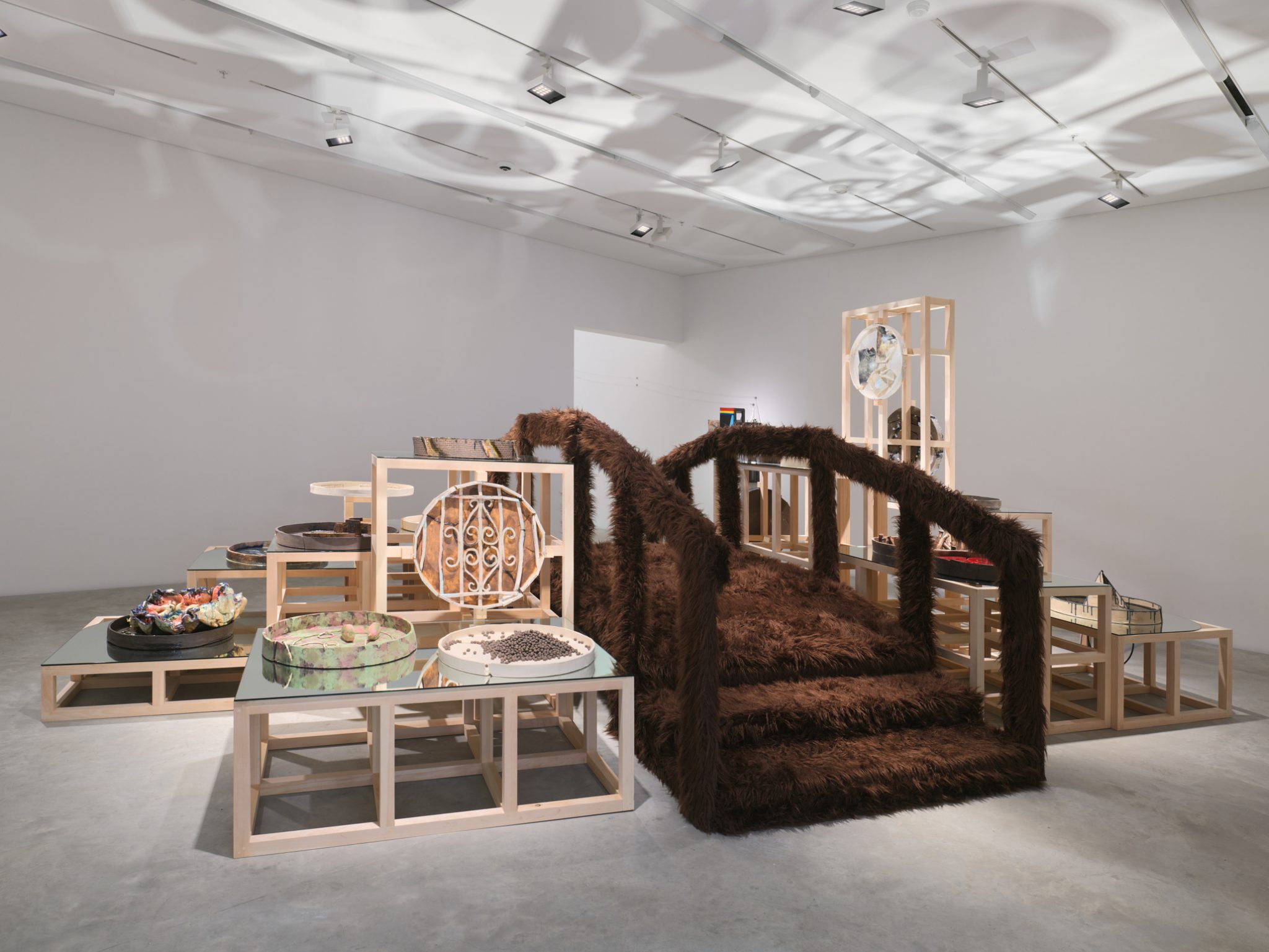
Stepping into the first gallery, the viewer is immersed in a taxidermised simulacrum of nature. In two interpolated works, Landscape Composition and Fuzzy Bridge (all works 2026), the material textures of earth, animals and trees are reshuffled and petrified as a faux-fur festooned bridge surrounded by vitrified clay vessels and a mirror pond on poplar supports. The scenery gestures to the impressionistic plein air paintings of the Beijing-based Wuming (‘No Name’) collective, whose apolitical practice was considered subversive during the stifling climate of the Cultural Revolution. Instigating a likewise cloistered sociality, CFGNY invited 13 friends to visit their studio individually to sculpt and paint on circular ceramic tiles. In Landscape Composition, these saucers are displayed on reflective pedestals, like lotus leaves floating in water or clockfaces unmarred by demarcations of seconds, minutes and hours.
Each tile is its own discretely authored microcosm. Diane Severin Nguyen’s composition sports clay headphones and a sculpted cord all painted a pink-tinged camo, perhaps in oblique reference to her recent performance War Songs (2025–26), which used the format of an anti-Vietnam War concert to explore music’s capacity to exceed geopolitical boundaries. Meanwhile, artist sgp’s pyramidal construction bubbles black ink within ceramic confines, like the Eye of Providence peering from a one-dollar bill. Yet Landscape Composition’s celebration of collaboration is limited, refusing to cohere a single dialogue from a collection of individuals. Perhaps the borderlines drawn between artists are intended to create incubation spaces for individualised expression; after all, the Wuming collective demonstrated the potential of minor counter-sites to contest the homogenising tendencies of culture at large.
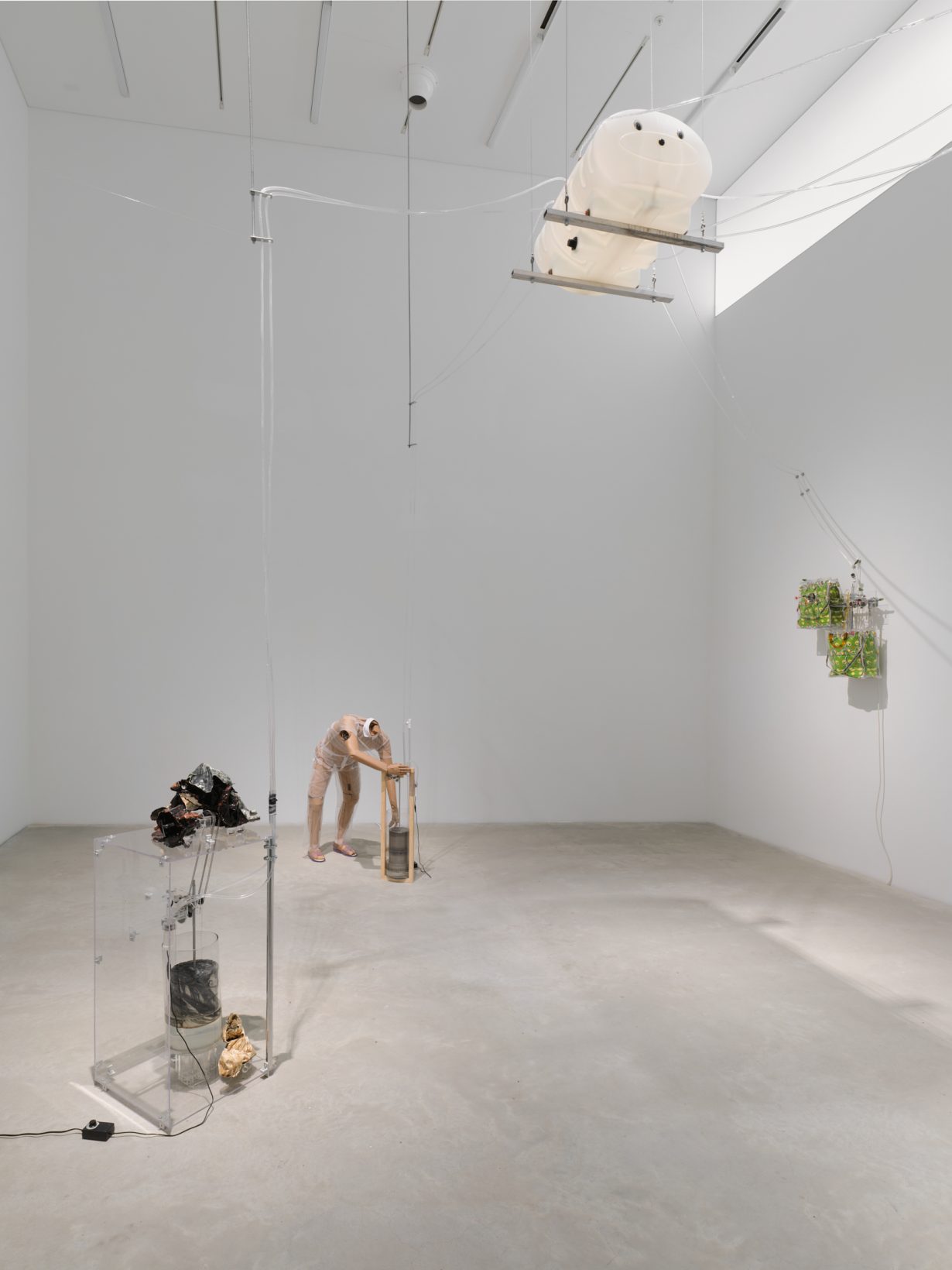
By contrast, in the next gallery, System (Five Times) presents an emphatically integrated and time-bound network of five water clocks that take on outlandish forms: monolithic tower, cardboard mannequin, vinyl bag emblazoned with cartoonish caterpillars. Gurgling and dripping out moments, the timepieces are keyed to distinct rhythms – including 1×, 1.3× and 3× standard time – that might evoke the differing tempos inhabited by individuals, cultures and industries. It’s a zero-sum game, where the clocks draw liquid from and return it to a central tank suspended near the ceiling and decorated with saccharine googly eyes. The slender clear pipes that circulate fluid from centre to periphery and back recall intravenous tubes, as though the constellated chronometers are the vascular system of a hybrid organism. Then again, we might just as readily understand the spidering network to represent expansive itineraries that fuel cultural convergence – globalised trade, immigration and even currency. While the curatorial narrative suggests that System (Five Times) resists the standardisation and commodification of the day, the vasiform lattice in fact seems to underscore that our world runs on the circulation and subdivision of circles and spheres: clocks, coins, the earth itself.
System (Five Times) is presented as continuous with Landscape Composition and Fuzzy Bridge as a study in codependence, but it operates more as resolution or riposte. The galleries vibrate in tension, the first sketching a portrait of in-group isolationism – ‘puddles’ – while the second actualises the dilute cross-cultural exchanges of an interconnected ‘pond’. In continuity with CFGNY’s complication of originality and belonging, this ambivalent model of two contradictory social strategies articulates subtle counterpoints between flux and stasis, competitive confluence and constructive insularity.
CFGNY: Puddles into Pond is on view at Amant, New York, through 16 August
From the April & May 2026 issue of ArtReview – get your copy.
Read next Whitney Biennial 2026 Review: The Revolution Will Be Cute