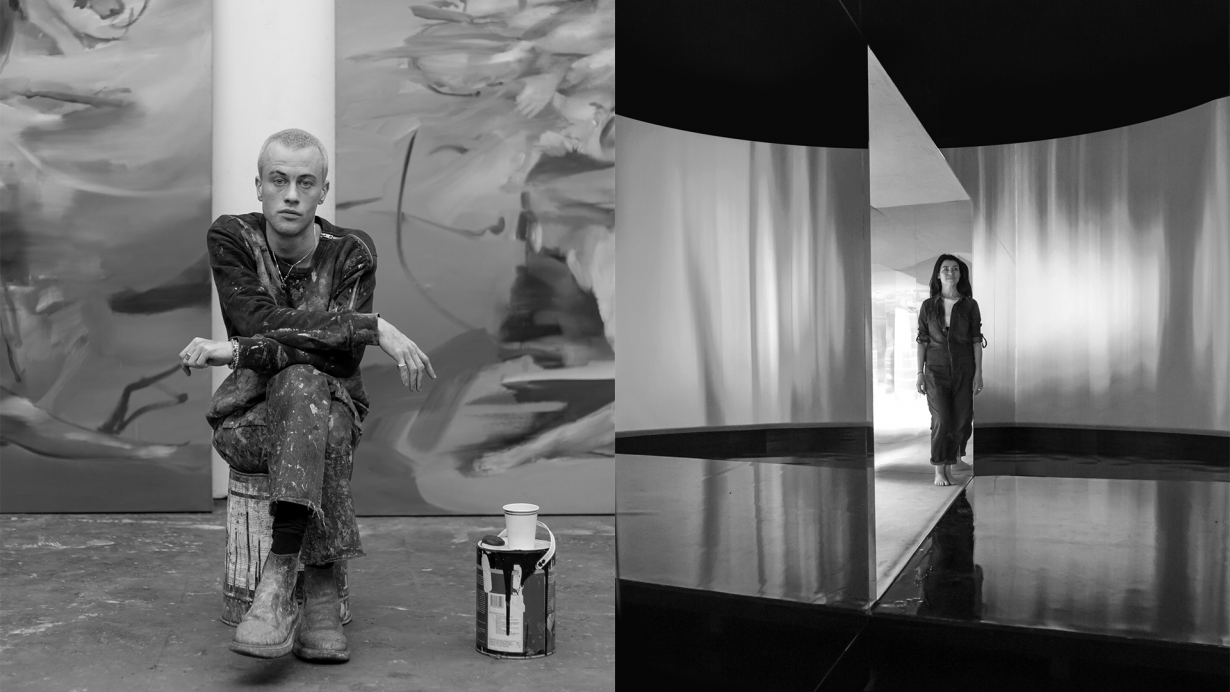
Join ArtReview and Ursula on Tuesday 6 May for a conversation with Es Devlin and George Rouy
ArtReview and Ursula magazine have teamed up to host a series of talks on the first Tuesday of every month in the Wine Bar underneath the Farm Shop in London’s Mayfair. Staged as a series of intimate conversations and more, set in a relaxed and casual bar, the series will allow audiences a insight into the inspirations, working methods and passions of some of today’s key visionaries from artists and thinkers, to filmmakers, designers, philosophers and architects. The events will span creative thinking and how it evolves to match our times. The series is a celebration of traditional conviviality, to be experienced live by those present rather than remotely, on screen. The talk will take place in the restaurant, where food and drink can be ordered throughout the evening.
Time: 6.30pm welcome drink, 7pm event start
Ticketed event: £10, which includes a welcome drink
Next event:
03 June: Martino Gamper and Max Lamb
About Es Devlin:
Es Devlin views an audience as a temporary society and invites public participation in communal choral works. Her practice ranges from public sculptures and illuminated installations at the Victoria & Albert Museum, Serpentine Galleries, Imperial War Museum, Somerset House, outside the Tate Modern, Trafalgar Square and the Lincoln Center, to kinetic stage designs at the Royal Opera House, National Theatre and Metropolitan Opera, as well as Olympic Ceremonies, Super-Bowl half-time shows and monumental stage sculptures for large-scale stadium concerts. Devlin is a fellow of the Royal Academy of Music, a recipient of the Eugene McDermott Award for the Arts at Massachusetts Institute of Technology (MIT), and visiting professor at the University of Oxford.
About George Rouy:
British artist George Rouy’s dynamic and signature use of the human figure, vexed with desire, alienation and crisis, speaks to the extremities of our time; portraits of identity in a globalised and technologically driven 21st Century. Focused on the relationship between interior landscapes and the body in motion, Rouy’s work presents us with a new language confronting the human body with bold and subversive energy, transformation and flux. Shapeshifting from unified, ambient subjects made strange and alluring through their sparse and enduring symbolism, to fever dreams of androgynous and gestural forms, charged with lurid flashes of pigment and passages of abstraction, Rouy’s work brings to sharp focus recurring themes: the face as a mask, the individual as a mirror, the self as a shadow.