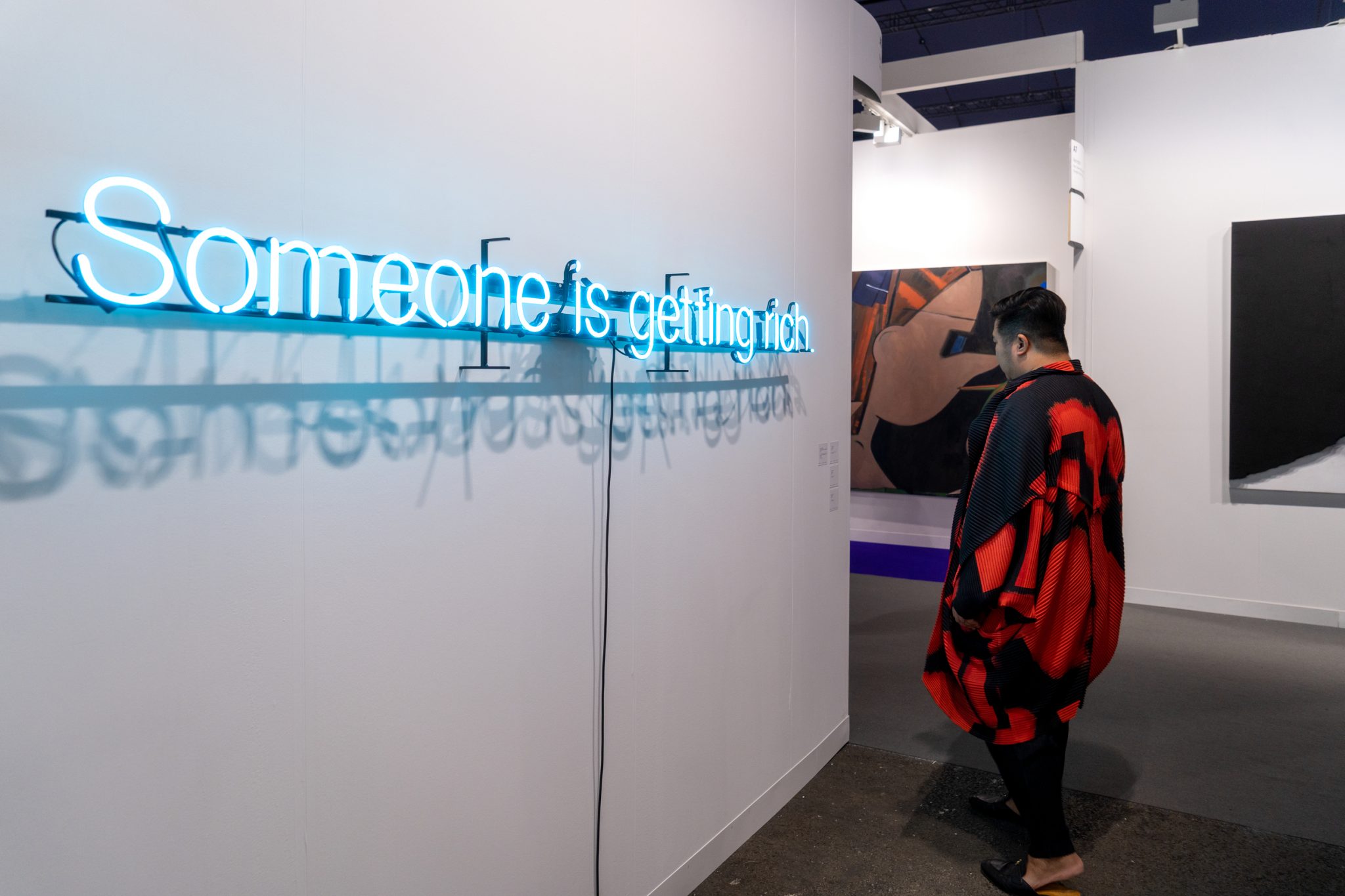
The annual award supports emerging British artists through a yearlong programme of exhibitions and events
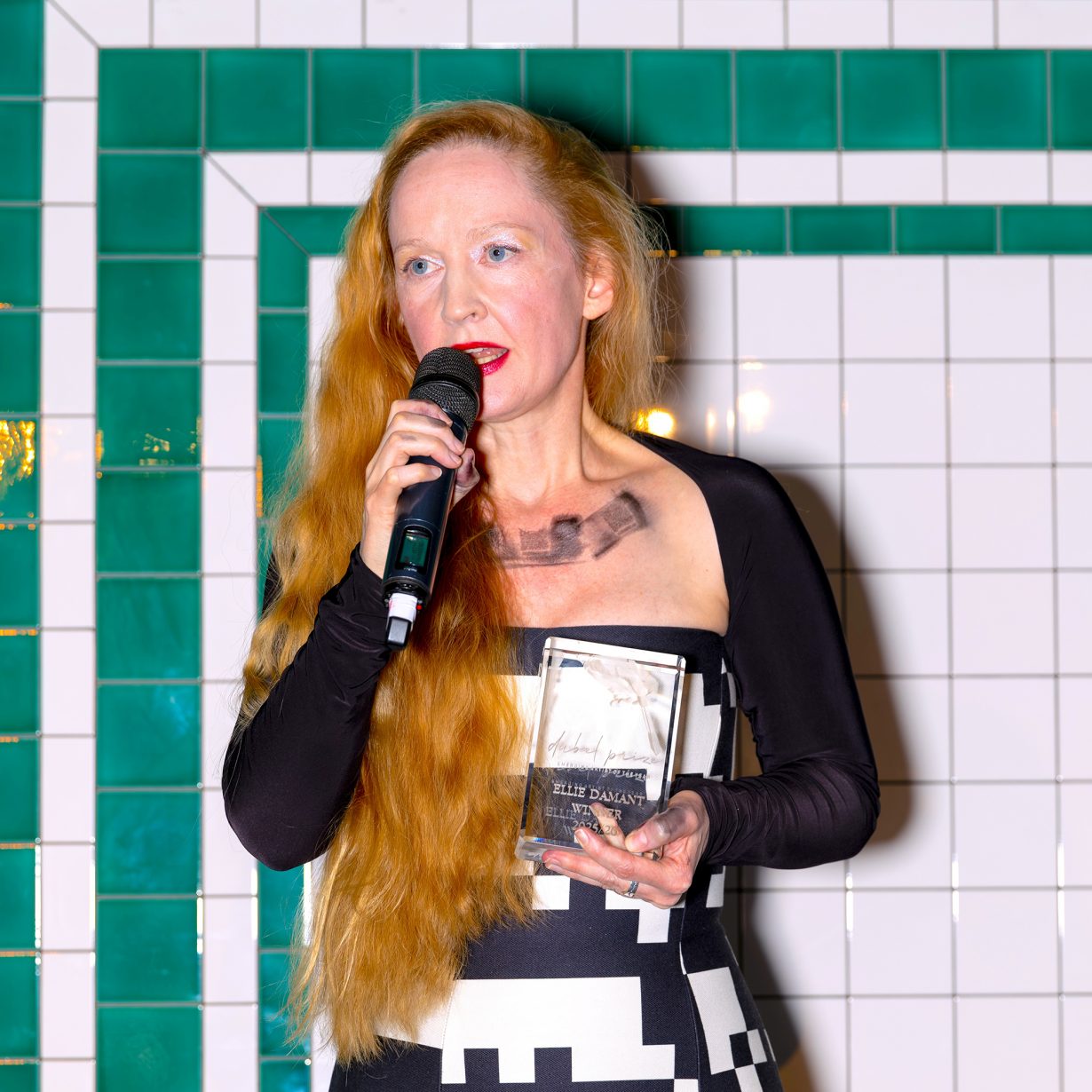
Earlier this year, Ellie Damant was named winner of the 2025/26 Dubel Art Prize. The annual award supports emerging British artists through a yearlong programme of exhibitions and events, before a judging panel selects its Emerging Artist of the Year. Alongside a £20,000 award, the winner receives exhibition, publishing and gallery opportunities intended to support the development and visibility of their practice. Trained in fine art and human anatomy at Oxford, Damant uses painting as a form of inquiry, examining how identity, meaning and value are constructed, with recent work focusing on money and commodification.
ArtReview Why do barcodes appear so often in your work, and what drew you to them as a symbol of exchange?
Ellie Damant Scanning a barcode reminds me of the ‘phantom-like’ value Marx describes in Das Kapital (1867), which fleetingly appears. So capturing ‘value’, visually, manifested as a barcode imprinted onto a face, as in B Priceless (2022): it’s a form of resistance from inside the system, signalling a priceless quality precisely because it is on a unique human individual. I began painting barcodes across my own face as Le Gal Tender, a performance character who mirrors the polarity of bull/bear markets. From there the barcode became a recurring lens for examining social/monetary power across different systems and figures, always haunting the image.
AR You have described painting as a form of philosophy. How do you prevent the philosophical ideas behind a work from becoming too illustrative or didactic?
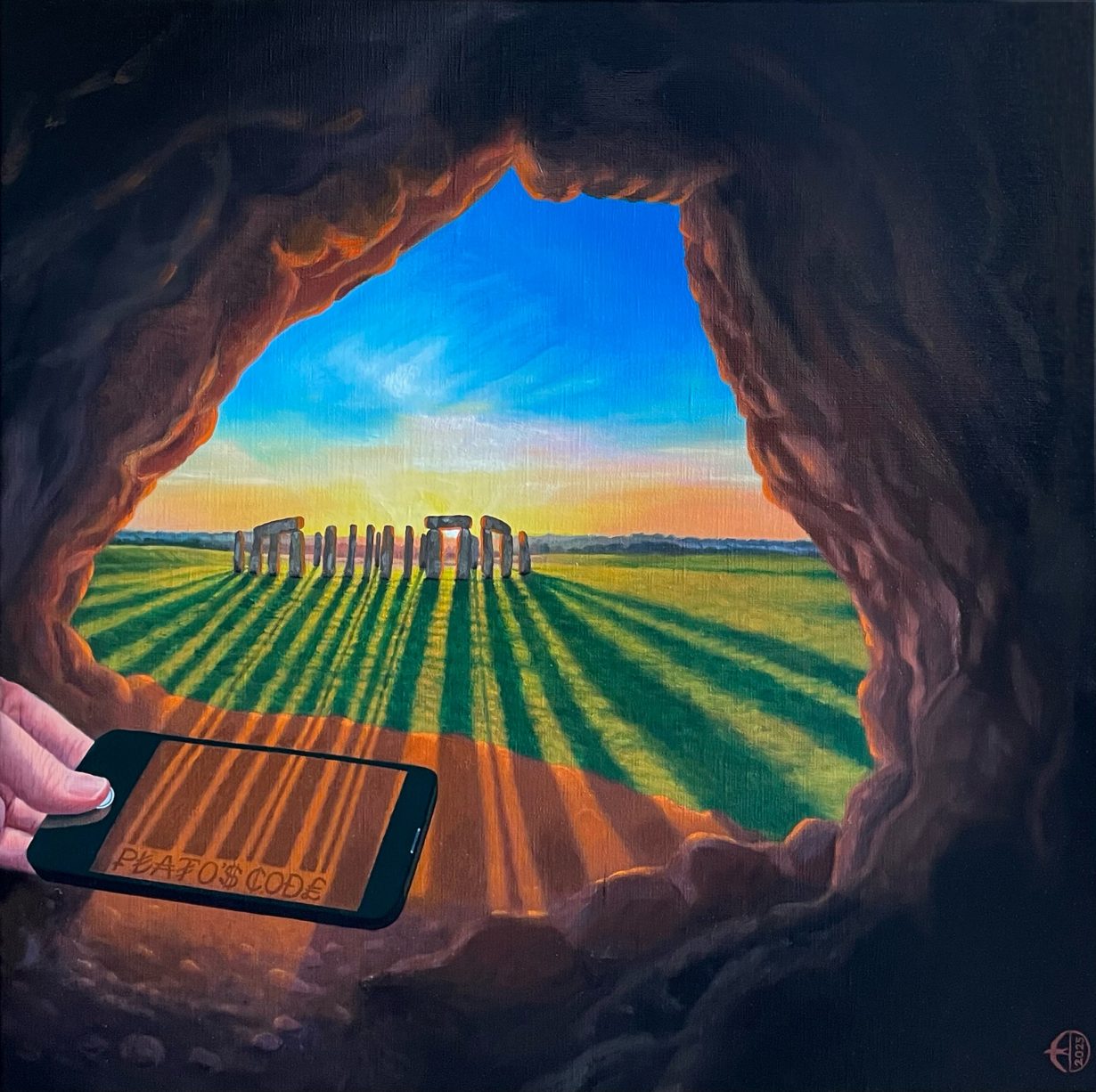
ED When I take established philosophical positions and aesthetic conventions, part of the process of reinventing these is to contort them by testing their limits. I aim for the clarity of the image to contrast with the instability of the ideas. By placing extremes of wealth, power, voice or the present and infinite in the same frame, I leave space for viewers to decide where they stand, or to reject the spectrum altogether. In the landscape painting …But Eternity Cannot Be Sold (2024) I paint the phrase ‘money is time’ in market ticker tape across the top of the canvas. The painting sets the human idea that time equals money against the sky’s reply: ‘but eternity cannot be sold’. A viewer can decide how they value their own time, perhaps choosing resistance to either polarity with their response. In Plato’s Code (2025) I began with the allegory of Plato’s cave and approached it through Merleau-Ponty’s emphasis on bodily experience as a ground of truth. In this painting, Stonehenge casts a shadow that becomes a barcode on a phone screen; this is to contrast an ancient world without this technology with the profit-driven distortions of the present, while also recalling that trade itself has ancient origins. When looking at this painting we see it as a mediated image via a phone, an almost ubiquitous experience now. This places the viewer in the position of reflecting on the nature of reality for them, and also our collective contemporary online experience through these devices.
AR Figures including Kim Kardashian, Mark Zuckerberg and Elon Musk appear in your paintings as contemporary icons of value and power. What led you to choosing these individuals in particular and what makes portraiture a useful way of examining the systems they represent?
ED Each of these figures represents a different form of contemporary power. Kardashian turns visibility and the curated self into economic force; Zuckerberg’s platforms represent one of the most extensive monetisations of personal data; Musk embodies a scale of wealth and influence almost without historical precedent. Together they personify systems of visibility, data extraction and technological influence. By combining symbolic and art-historical visual languages, the portrait can operate simultaneously as representation, icon, satire and philosophical proposition, leaving the contradictions open for the viewer.
AR Your paintings often borrow from religious art and art history. What interests you about placing contemporary figures within those traditions?
ED What interests me is that these traditions and the contemporary value-creation systems of social media and celebrity culture all participate in meaning construction. Placing a contemporary figure inside older visual languages lets me compare and challenge the different systems contemporaneously. In Salvator Verbi Liberae (Saviour of Free Speech) (2025), Elon Musk replaces the figure in Leonardo’s Salvator Mundi (c.1499–1510), linking the richest living individual with the most expensive painting ever sold. The frame references Musk’s purchase of Twitter, while a barcoded planet Mars appears as an absurdist commodity in the corner. The work examines how extreme wealth reshapes structures of value creation.
AR Are you interested in what has replaced religion as a source of belief and meaning?
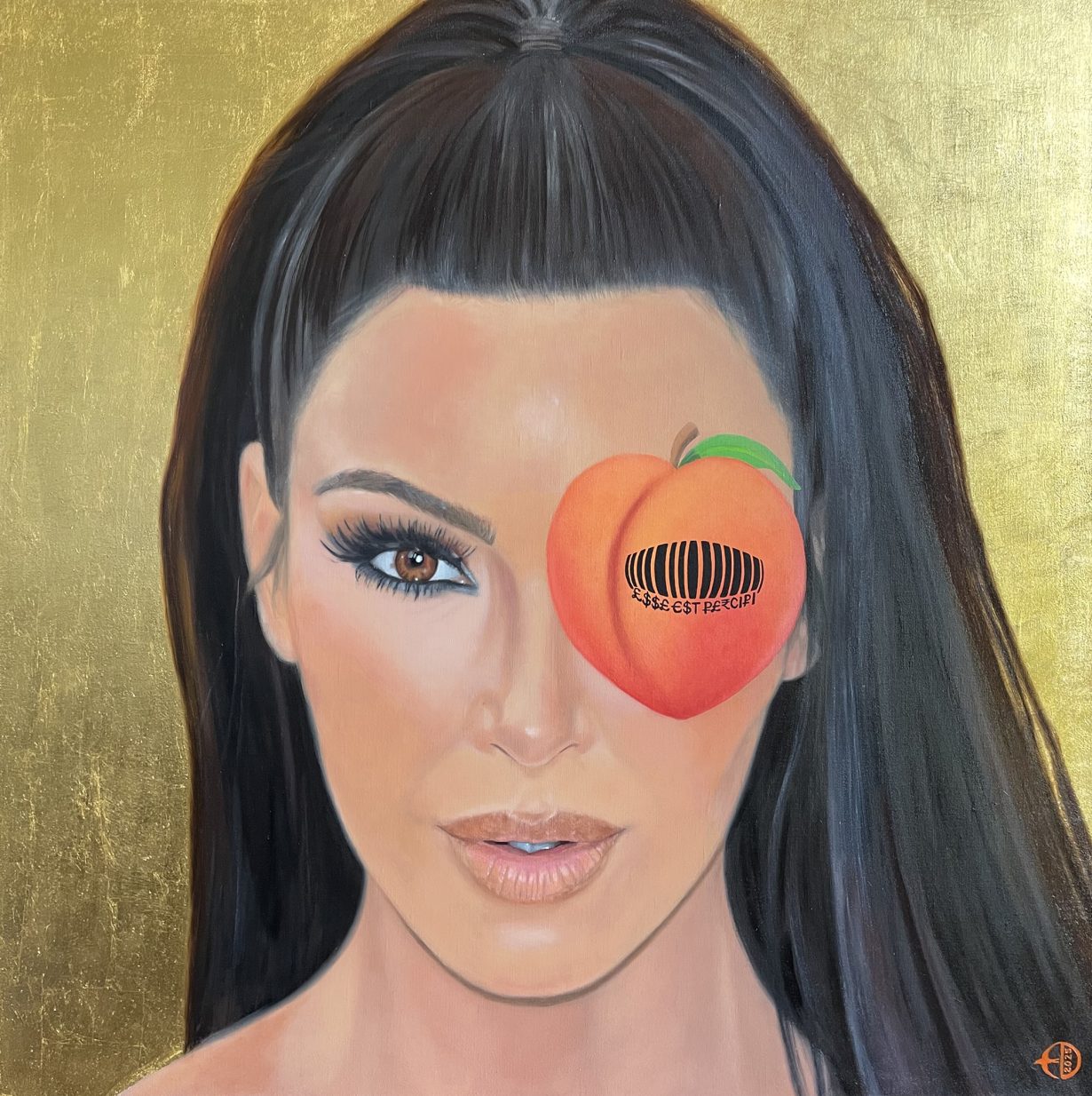
ED Religion being replaced remains debatable. What interests me is the almost religious devotion of current consumer culture. Brands seek value through celebrity endorsement, attaching a celebrity’s aura to commodities rather than arguing for their commodity’s quality. Influencers function like saints. In Golden Kim (Esse Est Percipi) (2025), the gold background places Kim Kardashian within the visual tradition of icons. The work is named after George Berkeley’s claim that ‘to be is to be perceived’, an observation he made in the eighteenth century that feels newly pointed in a culture where social media can make invisibility feel close to non-existence.
AR How have social media and digital technology changed the way we understand value, identity and power?
ED Social media began as a community of sharing but has become more extractive. What concerns me is the concentration of power in a few companies that map, predict and shape behaviour before conscious choice is made. What’s at stake is individual agency. Mark Zuckerberg in Own Thyself (Temet Nosce – Know Thyself) (2025) appears as a figure wherein this new frontier of data control is concentrated, a frontier that will increasingly shape democracy and freedom. The work sets data ownership against individual sovereignty, leaving the tension unresolved.
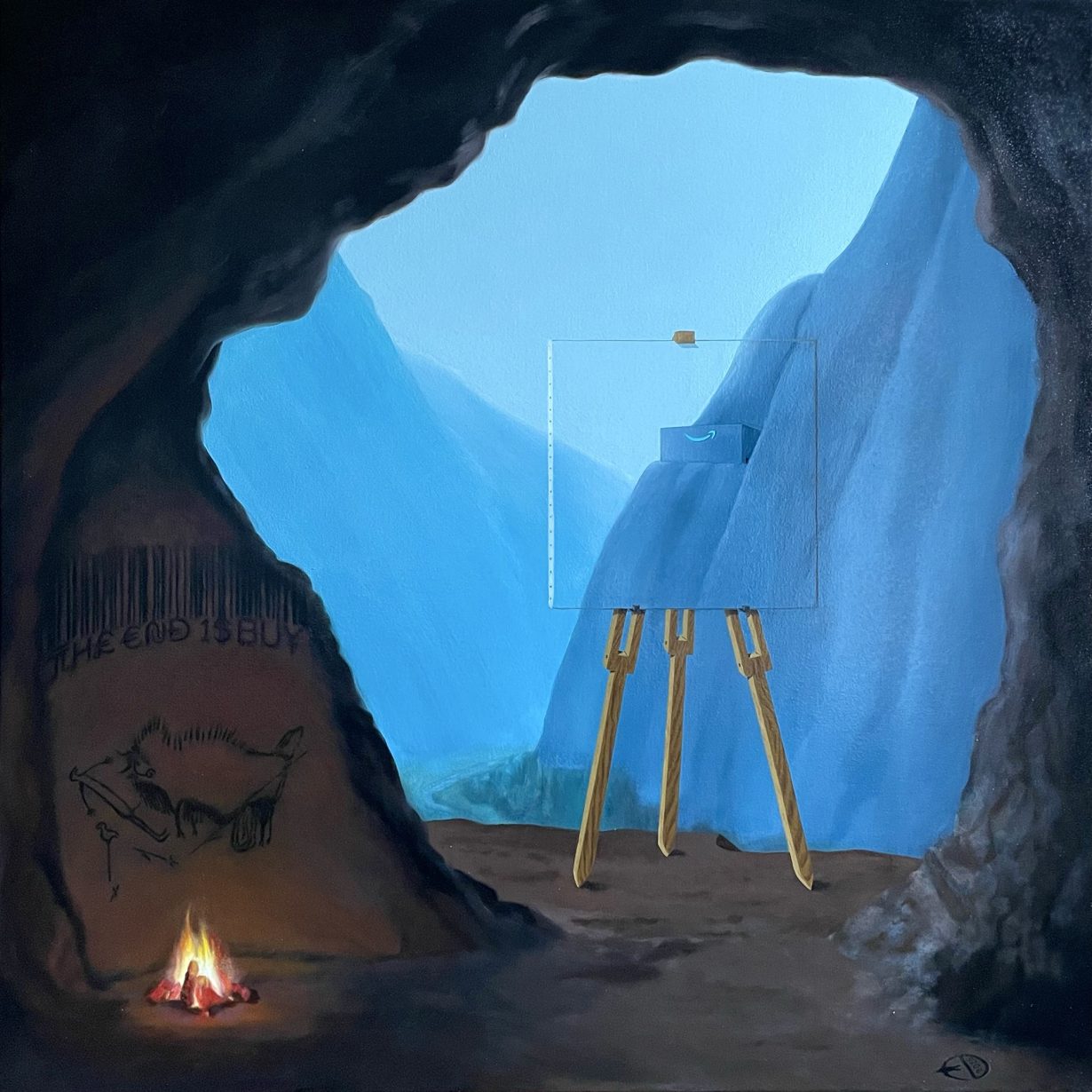
AR Humour and wordplay run through titles such as The End Is Buy and Consumer. What role do they play in the work?
ED Humour and wordplay layer contradictory meanings while leaving space for playful new interpretations and associations. In The End Is Buy (2025), the phrase ‘the end is nigh’ becomes a joke about consumption. Magritte, one of the highest-selling artists of the twentieth century, is drawn into the visual pun, while the bird-man and aurochs from Lascaux recall human origins and, for me, the possibility that art and belief offer a third way through the dilemma of life and death. Consumer is darker. The serial killer Jeffrey Dahmer’s consumption of bodies is contrasted with a consumer culture that demands infinite growth from finite resources. In this painting the police height chart actually presents the statistics of the National Readership Survey’s social consumer grades.
AR How will winning the Dubel Prize affect what you make next?
ED Winning the prize has given the work a wider platform and focused attention. It helps confirm that my exploration of markets, digital systems, value, belief, power and embodiment resonates beyond the studio.
My next works will extend the enquiry into questions of truth, justice, systems of power, money and value. I expect to abstract and evolve further value symbols and continue using poetry as I have in Everything I Ever Wanted Is Here Before My Eyes (2025). The philosophical method will remain central: a dialectical approach allowing new ideas to emerge through the process of painting, so layered meanings can form in conversation with the viewer.