At Goldsmiths CCA in London, Alice Hattrick considers the containers we make for the crip experience
When Flare-Up at Goldsmiths Centre of Contemporary Art in London opened in May, a headline on the BBC News website read ‘Disabled man “rotting” on a hospital ward – despite being fit to go home’; that is Ravi Mehta, whose local NHS board stopped his 24-hour home support. Another tells of Lucinda Ritchie, an influential advocate for and user of Eye Gaze Technology (which allows users to control devices through eye movement), who was forcibly moved between hospitals and nursing homes, rather than her adapted home, over months. ‘This is akin to torture,’ she recorded from hospital. ‘What is the point of my life?’ It wasn’t so long ago that the UK Labour government proposed life-threatening cuts to Personal Independence Payments, effectively pitting disabled people against one another in a battle for a slice of these diminishing resources. Special educational needs and disability provision in UK schools is also in crisis.
What should this remind us of? That disability is a condition produced through systems of care, labour and institutional time, not identity – ‘being disabled’ – alone. Flare-Up is framed explicitly through the lens of ‘crip’ theory (popularised by critical disability studies), but this is not to say all the artists whose work is on show identify with disability or chronic illness directly. An individual experience of illness is occasionally made explicit, but the exhibition succeeds precisely because it treats the experience as systemic. Flare-Up (its title taken from a term specific to chronic illness – the kind that doesn’t so much come and go as gets a lot worse sometimes and occasionally isn’t quite as bad) also reveals the limits of the ‘crip group show’ as a container for this complexity. Institutions don’t usually bend to crip time. What happens when they attempt to?
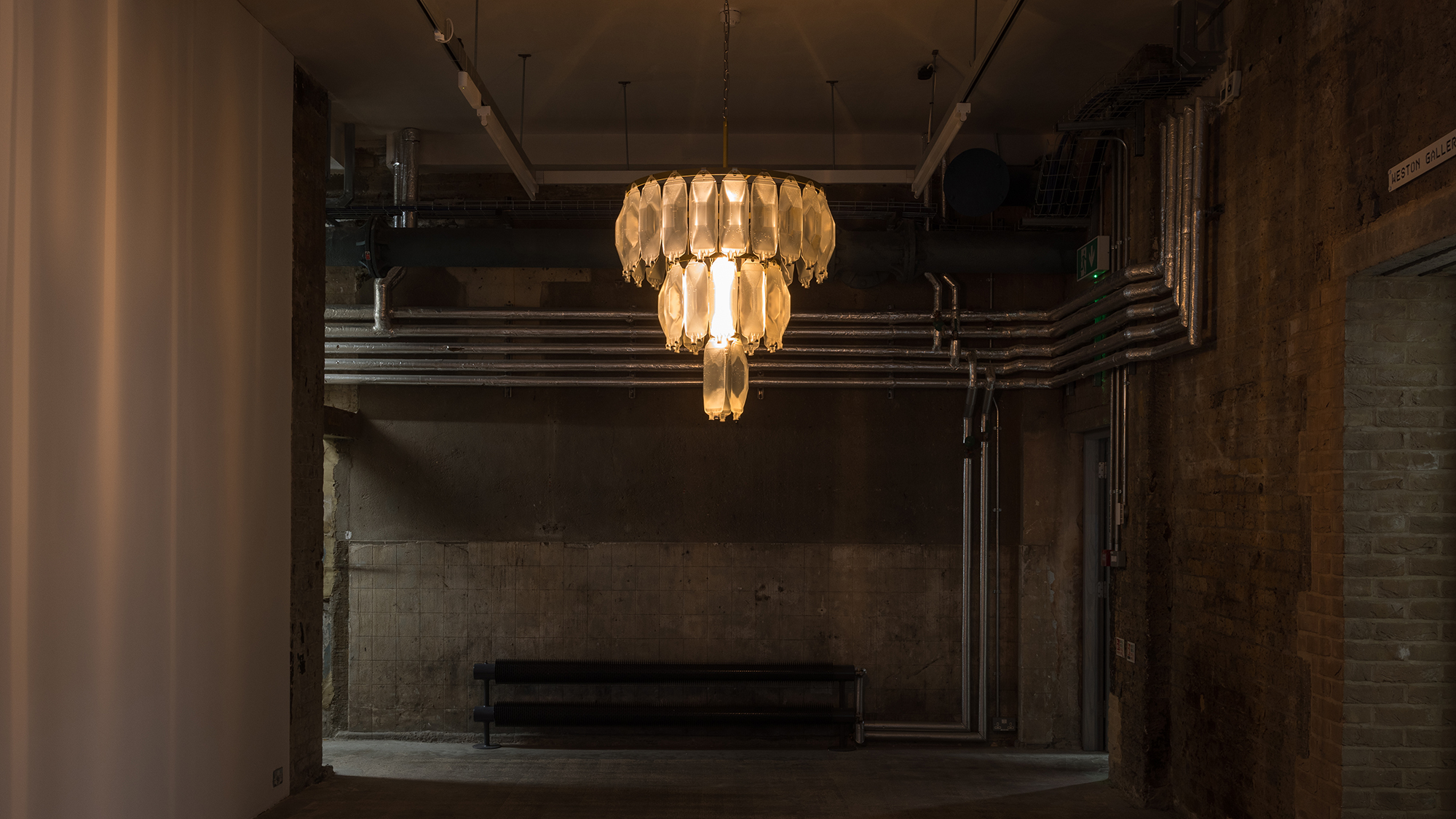
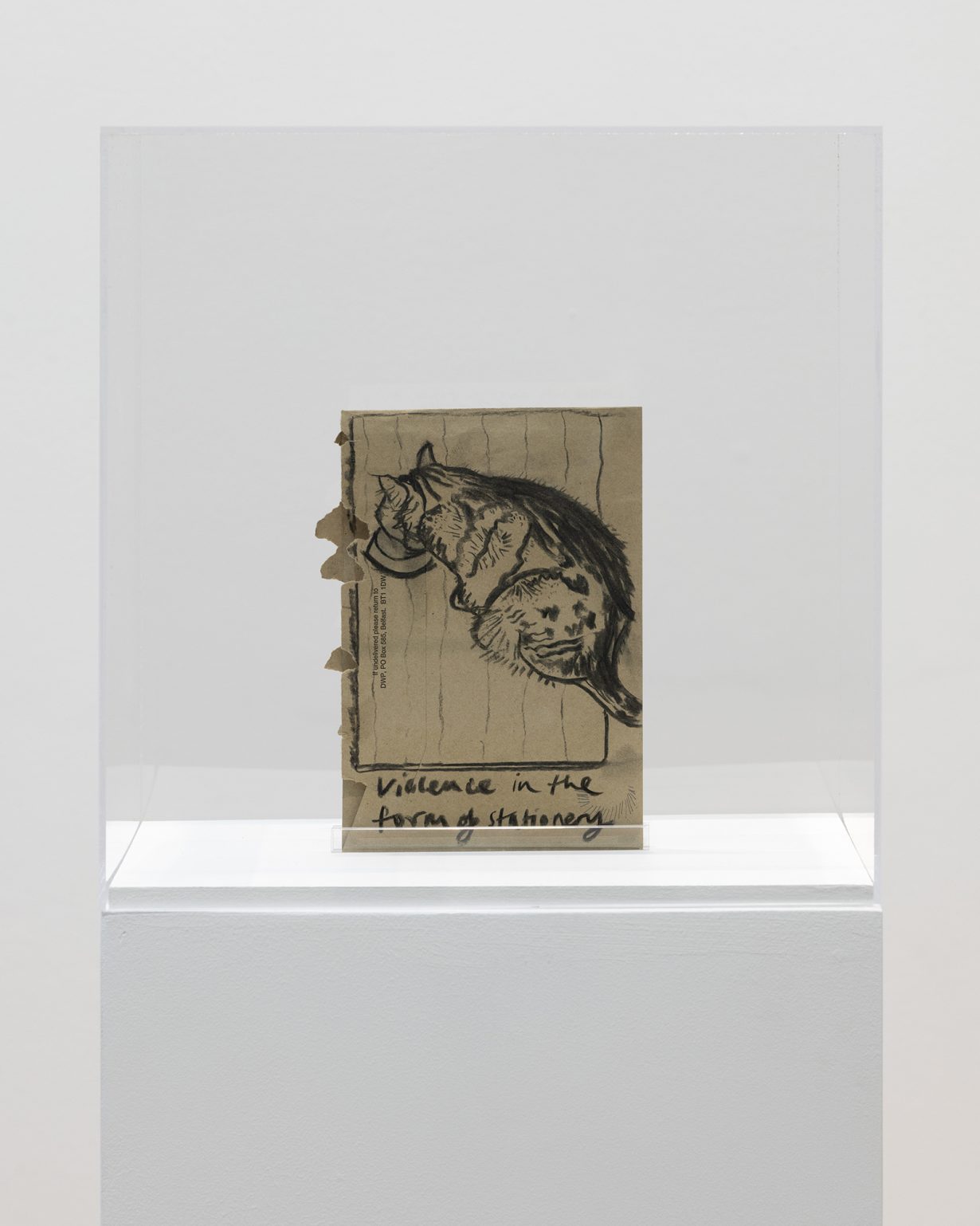
The exhibition, curated by Mariana Lemos and Natasha Hoare, includes artists from the UK, Ireland, USA and France. The context of the UK is notable when both the arts and our healthcare systems are underresourced. Abi Palmer’s Chic Slug (2024) greets you at the entrance, a sculpture of shiny jesmonite and plaster slugs hanging as they do when copulating, like a slimy Christ on the cross. Slugs, like disabled people, long despised for consuming precious resources, treated as pests, are here made ‘chic’, twirling like a disco ball. Irish artist Avril Corroon’s installation Sublet Glory (2026), meanwhile, evokes the damp temporality of social housing: dehumidifier water suspended in IV bags hang from a chandelierlike structure. The chandelier suggests aspiration rather than inherited wealth, the exhausted fantasy of upward mobility leaking yellow light. In Violence in the Form of Stationery (2018), Bella Milroy’s charcoal drawings on opened Department for Work and Pensions envelopes are displayed in vitrines on plinths. Some seem hurriedly torn open, perhaps in panic, or urgency. The empty envelopes, decisions of a review or notice of an appointment removed, also suggest the inevitably of receiving another one, in another time, forever. The repeated violence of a letter through the door, of being at the mercy of a state system, contrasts with Milroy’s drawings and writings: the softness of a dog, a cat, a pencil mark, the daily life that persists.
––
This feels like a good point to say, I don’t know how to manage this act of criticism. There is so much mixed up for me – the shame of illness, of internalised ableism, too many feelings around intimacy and distance, because of illness, because of death. I don’t like this uneasy feeling of being both a part of and apart from this group of flared-up artists. I’m struggling.
––
Downstairs, the basement gallery lends an atmosphere of dingy closeness made for exploring intimate connections. Jamila Prowse’s videowork Flare: the muted outline of a body in bed as a camera flash overtakes the scene (2025) speaks to the precarity of living interdependently: photographs with captions and audio descriptions reveal the way the washing-up piles-up if her carer is not at home, the way her body is made undesirable through neglect (not being able to bathe), the social housing both Prowse and her carer depend on, and exterior factors that mean she has to leave her home temporarily, sofa-surfing with chronic illness. Narration over a photo of Prowse’s arm at a hospital – out of focus, as if the camera doesn’t want to capture the scene – outlines the difficulty of making art in hospital time, a problem Lizzy Rose, whose Sick, blue sea (2018) screens here too, also encountered and depicted during her long stays. “I think of Lizzy turning her endoscopy into art,” Prowse narrates. The two artists – connected, we discover, by the doctor they shared – never met. Rose died in 2022 waiting for a small bowel transplant in the wake of the COVID pandemic. Flare becomes, in Prowse’s narration, “a prayer for her safe passage… finally free of the physical barriers that bind us”.
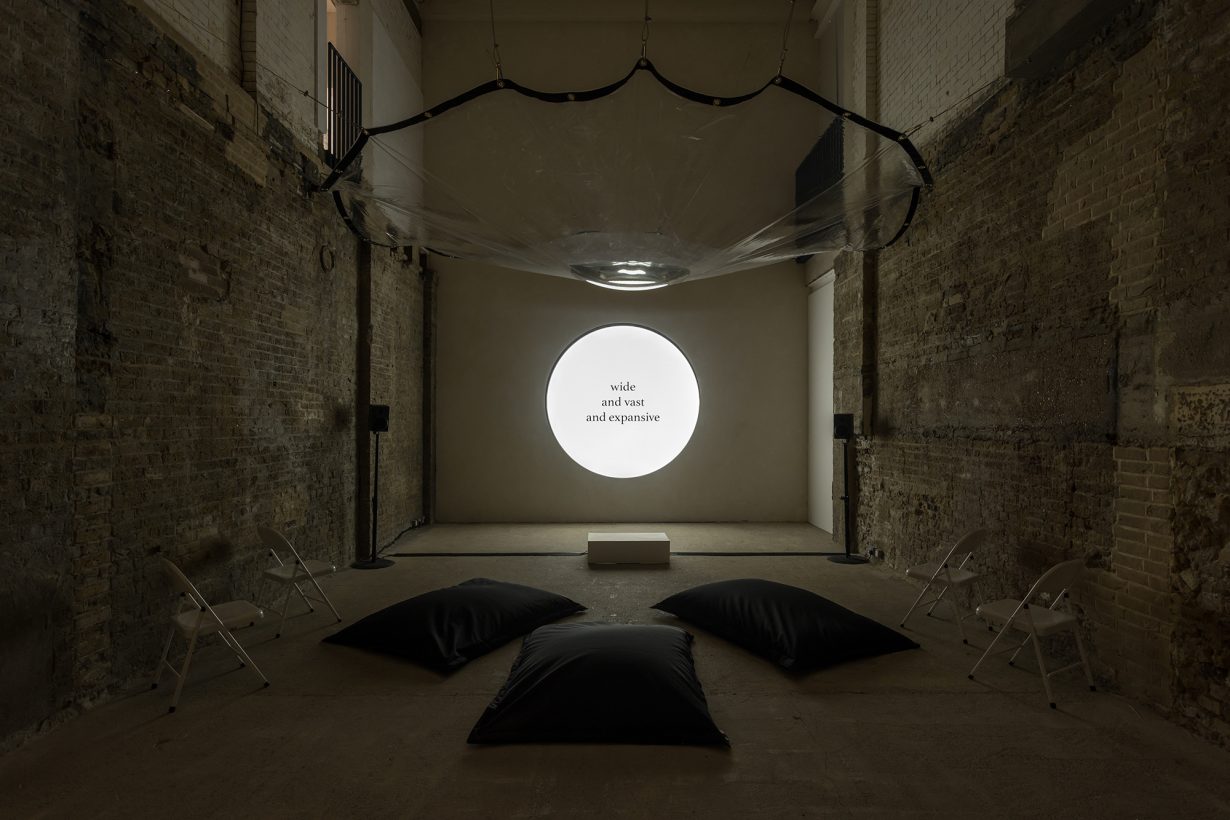
Rose’s legacy is cared for by friends, including Leah Clements, whose new commission Pure Joy (2026) loops on the half hour, with BSL interpretation on the hour. The audio installation explores transcendence through near death experience. A voice describes the sensation of a body that is not left so much as floats up and expands outwards, and the revelation that ‘love is all there is’. Above, light leaks through a transparent tarpaulin holding a small body of water.
Derek Jarman’s painting Act Up (1992) works the demand into red, magenta and purple. Jarman wrote his book Chroma: A Book of Colour – June ’93 (1995) in what he described as ‘an absence of time’, while losing his sight due to complications related to AIDS. Jarman wrote the chapter on red while on a hospital drip, scrawling in the dark at four in the morning, ‘until sleep blissfully overtook me’. Benoît Piéron’s Pillbox of Dungeness Seed Bombs (2018), meanwhile, packages plant-matter collected from Jarman’s Dungeness garden into indigestible pills, each categorised by the colours in Chroma. Piéron has described how his body had become a public space through the invasion of medical imagery and procedures since childhood. Here, the artist prepares a now-public space for the body.
––
This hospital is vast, maybe trying to contain too much.
––
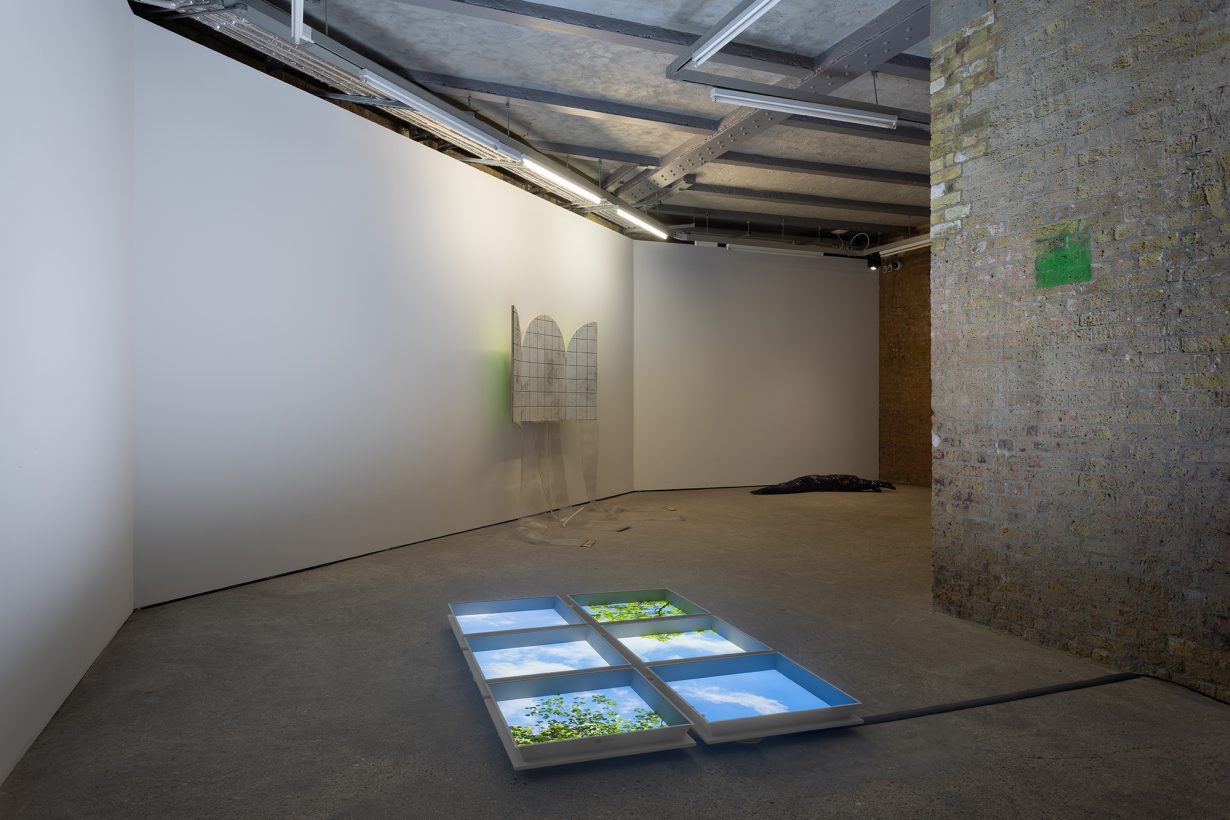
Hospital art is notoriously bad. In the absence of windows, vivid images of nature abound, pasted all over the walls of basement waiting rooms. No day and night, just lost time, basement time. American artist Carolyn Lazard physically inserts the hospital room into the art institution in the form of LED panels fitted into square ceiling-frames typical of hospital wards. Into the Wild Blue Yonder (2025) depicts trees and blue sky in bucolic, saturated colour, and plants the LED frames in a grid on the floor. Jesse Darling’s sculpture The Cleansing of the Temple (Luke 19:46) (2024), by contrast, is all smeared, stained white bathroom tiles in the shape of an altarpiece, displacing the vulnerability of bodily experience onto damaged structures and devotional imagery.
––
Does a stammer flare-up? Does deafness?
––
Access is built-in to many of the works, with Milroy describing the drawings in audio on headphones. In others, access becomes plural. In Christine Sun Kim’s four-screen video Close Readings (2015), for example, multiple deaf viewers describe the same scene, refusing the fallacy of a singular accessible experience. JJJJJerome Ellis’s book project The Clearing (2021) explores the intersection of stuttering, or disfluency, and Blackness through typographic representations that drip and flow around the page with accompanying audio narration and score. The work deserves more space and time than this context allows.
Flare-Up brings to the fore all the unpaid, invisible labour of accessing care and work, which these artists, indeed all disabled people, still have to do themselves, battling the institutions that refuse to bend. I was glad to see this all this work together – so much of it is excellent, and so too are the dialogues between works. It is also distinctly capacious, and risks trying to hold too much in one space. Equally, I worry that this is the only context available: crip artists shown primarily with other crip artists. No one is just crip, after all. Several continents are missing. Even from a UK context, where is Donald Rodney, and where is madness? Little of the work is sexy or gross (endoscopy aside). I want to see this work in other contexts, beyond an explicitly ‘crip’ lens, to make other connections beyond illness, beyond barriers.
I guess what I’m asking for is less but also more. I still think about Rose’s Total Parenteral Nutrition sculpture Intravenous Living Salad (2018) all the time. Her death feels almost as fresh as it did four years ago. I told you, I am too close and not close enough. I want to feel consumed.
Flare-Up is on view at Goldsmith’s Centre of Contemporary Art, London, through 16 August


