Feeding the AI rush, datacentres are everywhere now. Jenny Wu connects the architectural vacuity of the server farm to a longer history of ‘dirty’ work
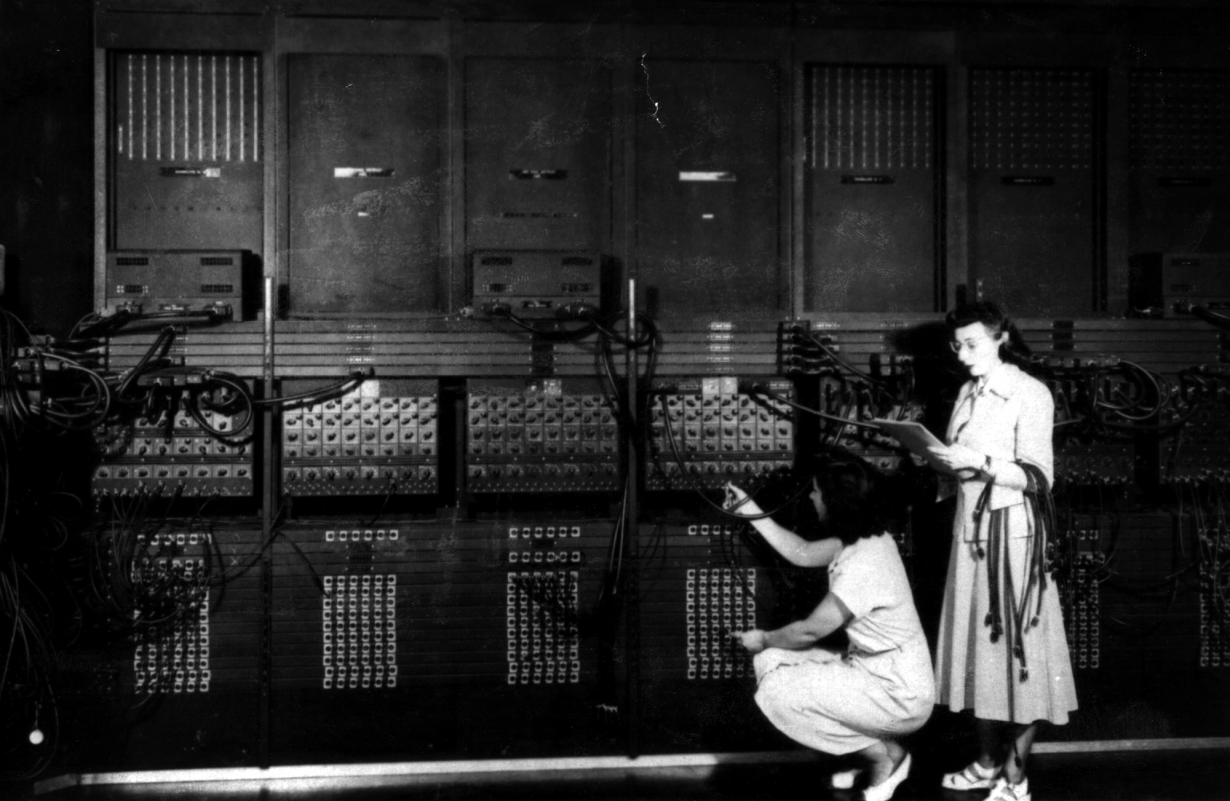
In 1946 a journalist for The New York Times reported enthusiastically from the unveiling of the world’s first general-use computer – the Electronic Numerical Integrator and Computer (‘Eniac’ for short) – in Philadelphia. ‘Those who witnessed the demonstration entered a 30-by 60-foot room. The computer took up most of the space,’ T.R. Kennedy Jr wrote. ‘The Eniac has some 40 panels nine feet high’ and ‘not a single moving mechanical part’ but, instead, tens of thousands of vacuum tubes, ‘several miles of wiring’ and many blinking pink lights. Its purpose: to speed the calculation of artillery firing and bombing tables for the US army.
‘Let us imagine a city that is only based upon data,’ the architecture firm MVRDV proposed in a four-channel video installation presented in the late 1990s at the Stroom Centre for the Visual Arts in the Netherlands. ‘A city, that wants to be described only by information. A city, that doesn’t know any topography, no context.’ Today datacenters live like hermit crabs in our cities. Epsilon Communications, Digital Realty and DataBank each operate ‘carrier hotels’ renting out server space to other businesses from a 24-storey art deco skyscraper in Manhattan that once belonged to Western Union, back when it was a telegraph company. CoreSite, AT&T, AWS and Netflix are tenants of One Wilshire, a 30-floor former law office in Downtown Los Angeles. Elsewhere, datacentres such as Bahnhof Pionen White Mountain in Stockholm inhabit repurposed Cold War bunkers. The reasons for adaptive reuse are often pragmatic and have to do with whatever preexisting communications and security features come with the building: Western Union left cable conduits for telegraph wires that now house fibre-optic cables; the servers at Pionen enjoy a shelter dug into a 30-metre-tall granite hill, behind doors that are 40 centimeters thick.
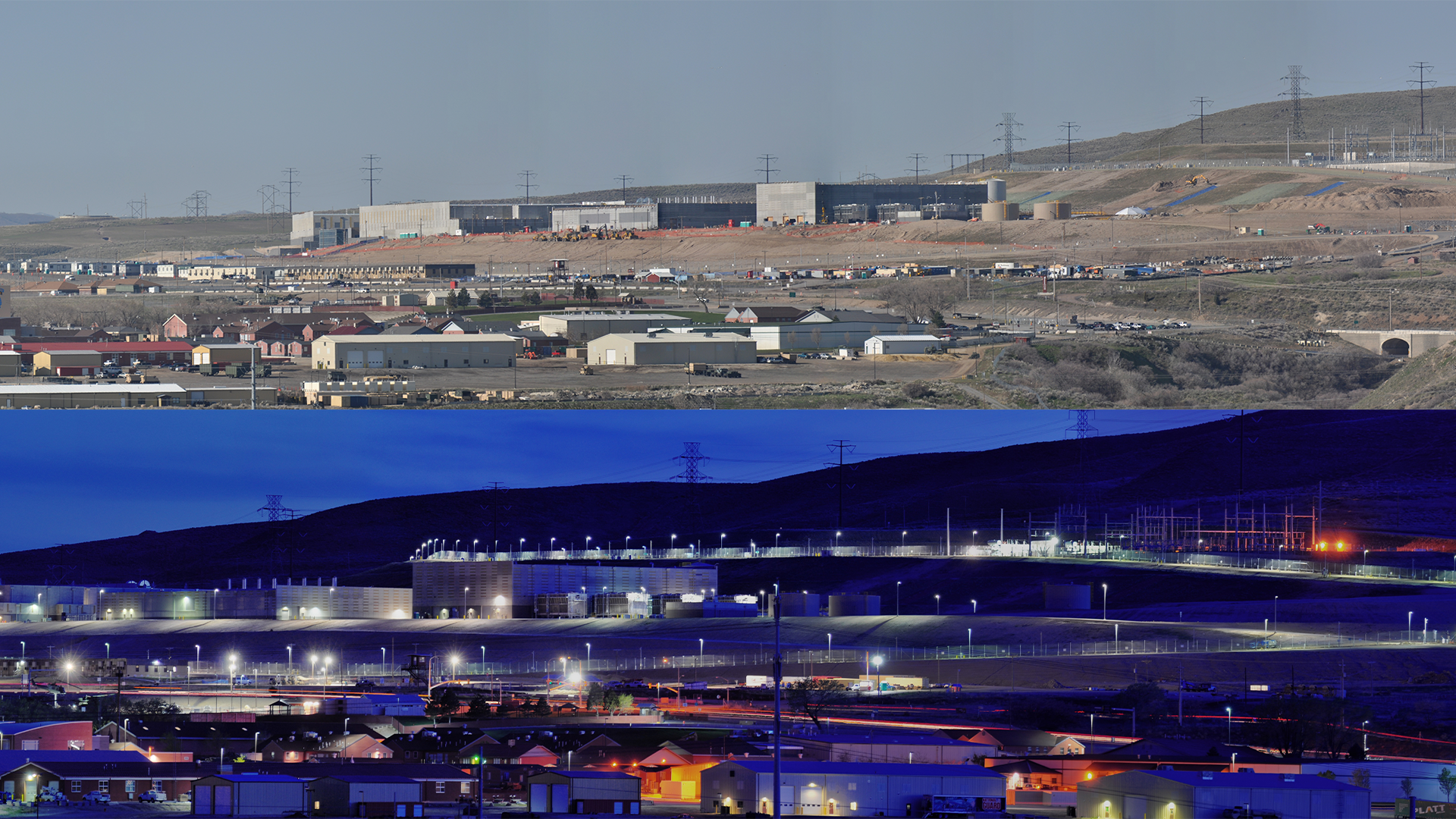
Datacentres are at once, as architecture critic Niklas Maak wrote in 2022, ‘the most important new building typology of the twenty-first century’ and ‘meant to be the opposite of architecture: saying nothing, betraying nothing’. The ones in the countryside are bland and seemingly ahistorical shells tasked with encasing and temperature-controlling what we assume are more interesting government secrets and salacious personal emails. One can compare the edifices of Amazon, Apple, Google, Microsoft, Meta et al to warehouses and hangars, or the US National Security Agency’s sprawling, white-walled data-storage facility in Bluffdale, Utah, photographed by Trevor Paglen in 2012, to a remote airfield. But we call interconnected computers ‘server farms’, Maak points out, ‘as if a server rack were something like a digital cow’. Unconsciously, then, these structures point to another, bygone typology: the nineteenth- and twentieth-century industrial slaughterhouse.
Consider Le Marché et Les Abattoirs de La Villette, the livestock market and public butchery on the outskirts of a rapidly changing, post-Haussmann Paris. Its 55-hectare campus was meant to quarantine the city’s unsavory sights and smells and included stables for cattle, sheep and pigs; three grand halls designed by a student of the renowned French architect Victor Baltard; and siloed chambers where animals were killed and their carcasses dressed. Construction was completed in 1867 in time for the Paris World Expo, and the building stayed in operation until the 1970s, processing millions of animals a year.
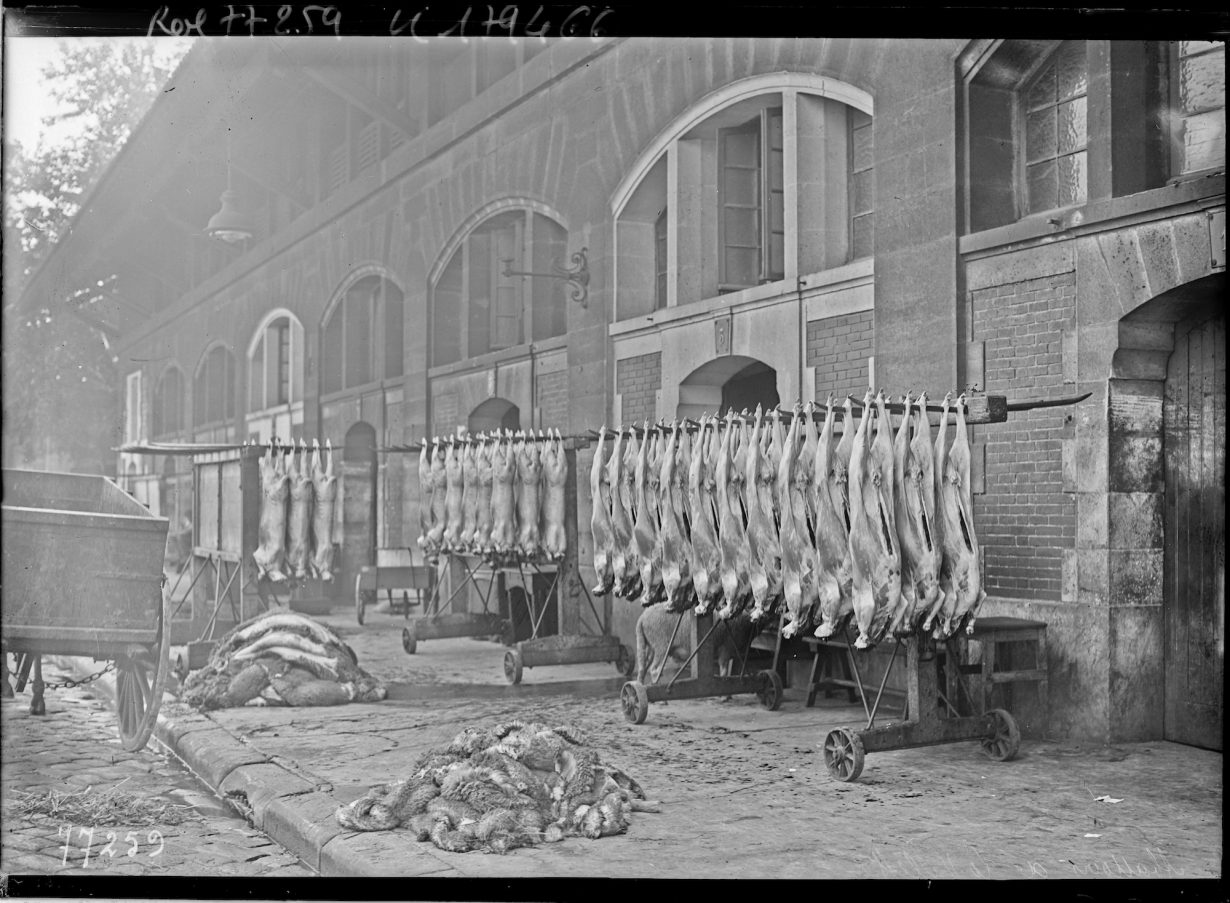
According to historian Dorothee Brantz, writing in 2001, moving slaughter – which, prior to the French Revolution, fell under the purview of the guilds and, after the guilds’ disbandment, was performed unsupervised in the street – to a concentrated area on the outskirts of town allowed the state to excise notions of ‘dirty’ labour from the ‘softened’ sensibilities of the bourgeoisie. The philosopher Georges Bataille foreshadowed this critique in 1929 when he argued passionately in the pages of the surrealist journal Document, beside Eli Lotar’s photographs of La Villette – rows of hooved legs leaning stiffly against a wall; a slab of furry flesh discarded on the wet ground; bare-chested workers lumbering around a cow carcass – that the city-dwellers of his day, owing to their prudishness towards the slaughterhouse, ‘sont réduits à manger du fromage [are reduced to eating cheese]’. Modern datacentres, too, are known to conduct ‘dirty’ acts, guzzling water and electricity and belching noxious gas, while going about the business of killing by facilitating the largescale computation that allows companies like Anduril, Lockheed Martin and Palantir to develop autonomous and AI-enhanced military systems. They get away with it in part by sequestering their activities in facilities with inexact addresses, in rural regions and exurbs and on the upper floors of urban buildings conceived by others before them – that is, by renouncing their claims to architectural prestige. By saying: don’t look at me.
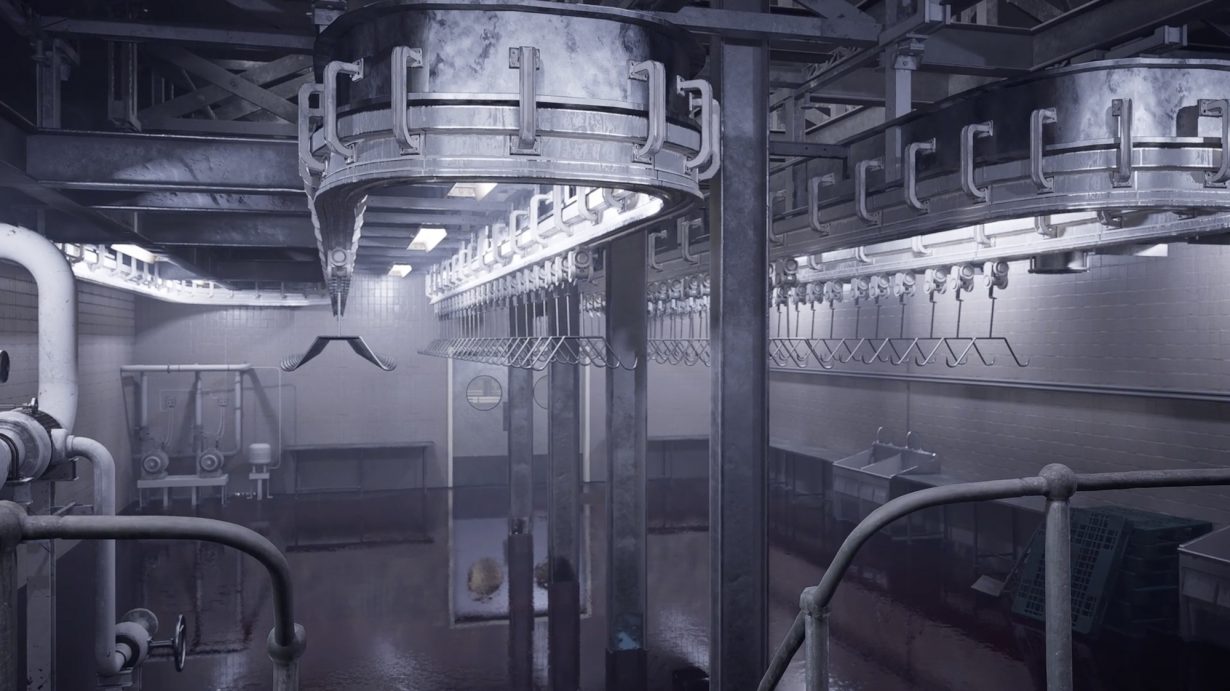

Ironically, by storing records of internet users’ queries and purchases, datacentres allow private companies to look at us. The types of for-profit surveillance they enable reduce human beings to what Maak calls ‘mere information objects’, and the city to what anthropologist Shannon Mattern calls an ‘algorithmic assemblage’. In 2023 Aria Dean presented a videowork titled Abattoir, U.S.A.!, which she made using Unreal Engine after researching the Union Stockyards in Chicago – a less-regulated and more technologically innovative contemporary of La Villette and the subject of Upton Sinclair’s novel The Jungle (1905), which exposed the unsanitary and exploitative conditions within the meatpacking industry. Dean’s work can be read as an eerie simulation of this extreme – though wholly imaginable – degree of objectification. The viewer, experiencing the setting in first-person, shuffles through a surreal passageway with curving walls towards a metal pen, where death is administered in flashes of amber light, and wakes up swaying on a meat hook in the cold-room of a twenty-first-century slaughterhouse. The room is brightly lit, the hooks are clean, the tiled walls are spotless, the blood on the floor looks like strawberry jam and an instrumental cover of the 1967 pop song I Think We’re Alone Now is playing sweetly in this sleek storage facility quite befitting of our time.
Despite widespread demonstrations of growing disillusionment with Big Tech – in East London, for instance, the since-approved proposal for a 5,200-square-metre datacentre designed to support high-frequency trading in the city’s neighbouring financial district drew protest from a coalition of local community and heritage groups for much of the summer, while in New York, the governor recently issued the US’s first statewide pause on the construction of hyperscale datacentres, and self-proclaimed Luddites have been gathering in Tompkins Square Park as part of an extended celebration of their collective decision to shift offline – the sheer mass of tangible infrastructure that advanced computing requires in the material world, among bloody, fleshy animal and human life, still manages to awe and infuriate, all the more so because the mess is hidden away. In a sense, the corporeal metaphors – the references to nervous systems, brains and veins we invoke to describe computer networks – and the uncanny resemblance between rows and rows of servers and battery cages for animals in factory farms remind us that the Cloud is not airborne, that information is not free. The challenge is to avoid, in our lexicon and imagination, treating the datacentre like the slaughterhouse of Bataille’s day – which is to say, regarding it as ‘maudit et mis en quarantaine comme un bateau portant le choléra [cursed and quarantined like a cholera-infested ship]’. If we do, what goes on inside them will stay obscured, not because of the architecture but because we’ve averted our eyes.
Read next Spectral Architecture: How to Make Prisons Disappear…