The latest edition addresses the current crisis of technological mediation
‘Our digital existence has led to a crisis of sensitivity’, claims the exhibition text that opens the Guangzhou Image Triennial 2025. It’s a crisis ‘favoring the mediation of images’ and ‘depriving us of direct contact with nature’, the text continues. Founded as the Guangzhou Photo Biennial in 2005, its latest edition, the third since its rebranding in 2017, is positioned against this crisis of technological mediation in which we are increasingly out of touch with the physical world. It aims at opening up ‘new forms of attention’ and perception through works by over 50 artists and artist groups, spread over four of Guangdong Art Museum’s 21 galleries, that attempt to help us understand our connection with the material world, and salvage the medium from becoming little more than digital mediation.
While the exhibition text cites a cadre of 11 theorists (from ‘ecosophers’ such as Felix Guattari to neo-materialists like Bruno Latour) to explain its mission, what the show boils down to is a materialist turn in imagemaking: an emphasis on what images are over what they show or represent, resisting what Siobhan Angus, in her Camera Geologica, calls ‘photography’s desire to transcend its material origins’. Amélie Labourdette’s A Pure Spirit Grows Beneath the Bark of Stones (2021–22), for example, is a series of photographs of fern fossils, showing delicate leaves and veins preserved in rocks. Though their forms resemble early specimens and decorative patterns from the fern-fevered Victorian-era, printed in coal-based Piezography ink, they also encourage us to read them as minerals rather than pictures: a trace of the plant on its way of becoming coal. Chen Xiaoyi’s A Star Atlas from Hengduan’s Core (2022) is a photograph presented as a physical object. Framed within the panels of a wooden folding-screen, the photograph depicts a mountain range at night, where lights from mines and excavation sites glow in pitch darkness. Here the format of the image is built into the story it tells: the folding screen’s function to divide and hide becomes a metaphor in which images can conceal instead of reveal the truth – in this case, the labour and extraction that takes place beneath the pretty lights.
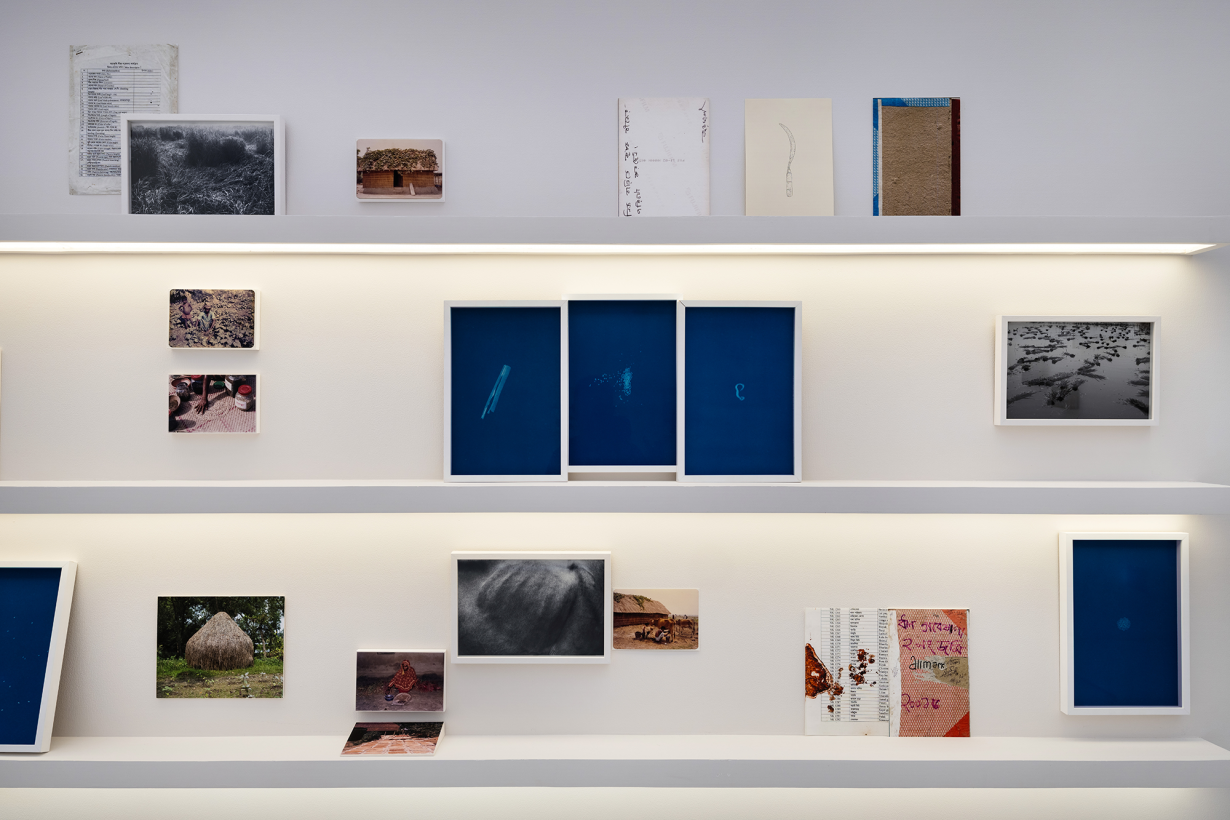
Of course, foregrounding the materiality of images does not automatically overcome the problem of mediation. To establish an ‘ecology of sensitivity’ is to be cautious about photography’s own flattening effects. Sean Cham’s Eastern Promise (2024–26) series pictures him reenacting the performative poses of Chinese coolies in colonial photographs of ‘racial types’, excavating the corporeal experiences of these people turned into portable objects of the Western gaze. Though not all the work shows that photography as a medium can be salvaged. Bangladeshi artist Munem Wasif’s Seeds Shall Set Us Free (2017–21) is an arrangement of objects in three vitrines: photographs of farmers in rice fields and closeups of starved bodies, cyanotypes of rice, drawings of farming tools and snippets of records from local grain-banks. A wall text tells us that as a British colony, Bengal (now split between Bangladesh and India) was ordered to prioritise cultivating cash crops such as indigo and jute over rice, which, alongside the British military’s grain hoarding, contributed to a 1943 famine that killed millions. What emerges from the display is both a narrative of many fragments, showing the grain as a source of subsistence, knowledge and control, and a sense of the gaps between them – the inability of any one of these elements to elucidate truth. It’s a powerful work that takes seriously photography’s inadequacy – even positioning against – when it comes to providing depth and understanding beyond its mediation.
The exhibition’s last section – which explores the rippling effects of material extractions and their environmental impacts – reads either like an elevation or a detour to the exhibition’s theoretical musings. Works on view touch on oil drilling, mining and the undersea cables that support today’s (digital, if you make the conceptual leap) world. In this vein are Abraham Onoriode Oghobase’s photographs of Nigeria’s contemporary landscapes with twentieth-century diagrams of mining facilities superimposed (Metallurgical Practice: Landscape, 2019), or Liu Yujia’s film on oil extraction in northwestern China, depicting a landscape near ruination in the face of increasing industrial structures (Black Ocean, 2016). Though surprisingly none of these works engages with digital photography’s own material footprints – from the lithium mining that powers the battery industry to the data centres that feed today’s generative AIs. What’s at stake is a different kind of ‘sensitivity’: not of our literal senses, but an attention to our treatment of nature as mere resource, a view that paved the way for the larger issues of landgrab, extractive capitalism and colonial ecocide. If this final turn to environmental issues shows us that ‘aesthetics’ and ‘perception’ are indeed political matters, it is strange to find the politics of photography left out of the picture.
Guangzhou Image Triennial 2025 Ecology of Sensitivity is on view at Guangdong Museum of Art, Guangzhou, through 5 May
From the Spring 2026 issue of ArtReview Asia – get your copy.