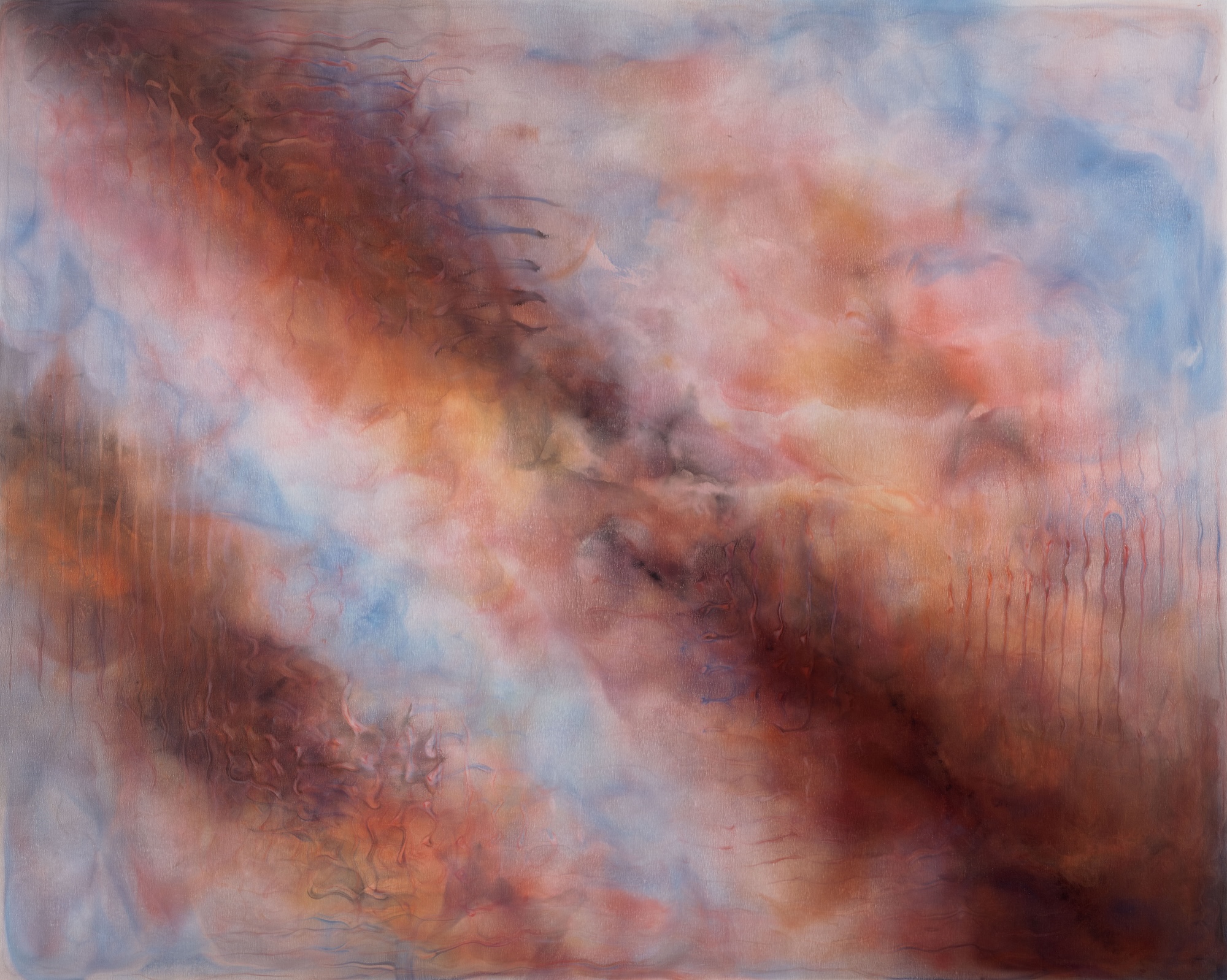
The artist’s canvases record the shapes created by hundreds of notes like a musical score, but the closer you get, the less gestural they appear
The first time I encountered Oliver Beer’s work, he was standing facing the corner of the room in an old boiler factory on the outskirts of Paris, singing. His voice was soft, but at points the sound would swell, ringing out sonorously. He was pitching to the resonant frequencies of the space, the nodal points at which an acoustic vibration matches the natural rate of oscillation produced by the dimensions of an enclosed place, causing standing waves, as if the room were singing back to you.
That was at Thaddaeus Ropac’s Paris Pantin gallery in 2013. Beer’s work has been animated by the idea of resonance ever since. Recently, however, he has found more storied crevices to sing into. In 2024 he took a group of singers – including Rufus Wainwright, Mélissa Laveaux and Japanese soprano Michiko Takahashi – into the Font-de-Gaume cave in the Dordogne, the site of over 200 prehistoric paintings, in order to sing their earliest musical memories – mostly nursery rhymes and other traditional songs, recomposed and collaged by Beer into one continuous composition – to the elaborately painted and engraved walls. That journey became first a film, now a record, which plays from a turntable in the middle of the gallery in Ropac’s Mayfair premises, providing a near-constant soundtrack to canvases hung on the wall. As you view the paintings, you hear these plaintive voices, backed only by a deep, thick drone that sounds like an organ pedal, but that turns out to be just another voice, quietly murmuring the resonant frequency of the cave.
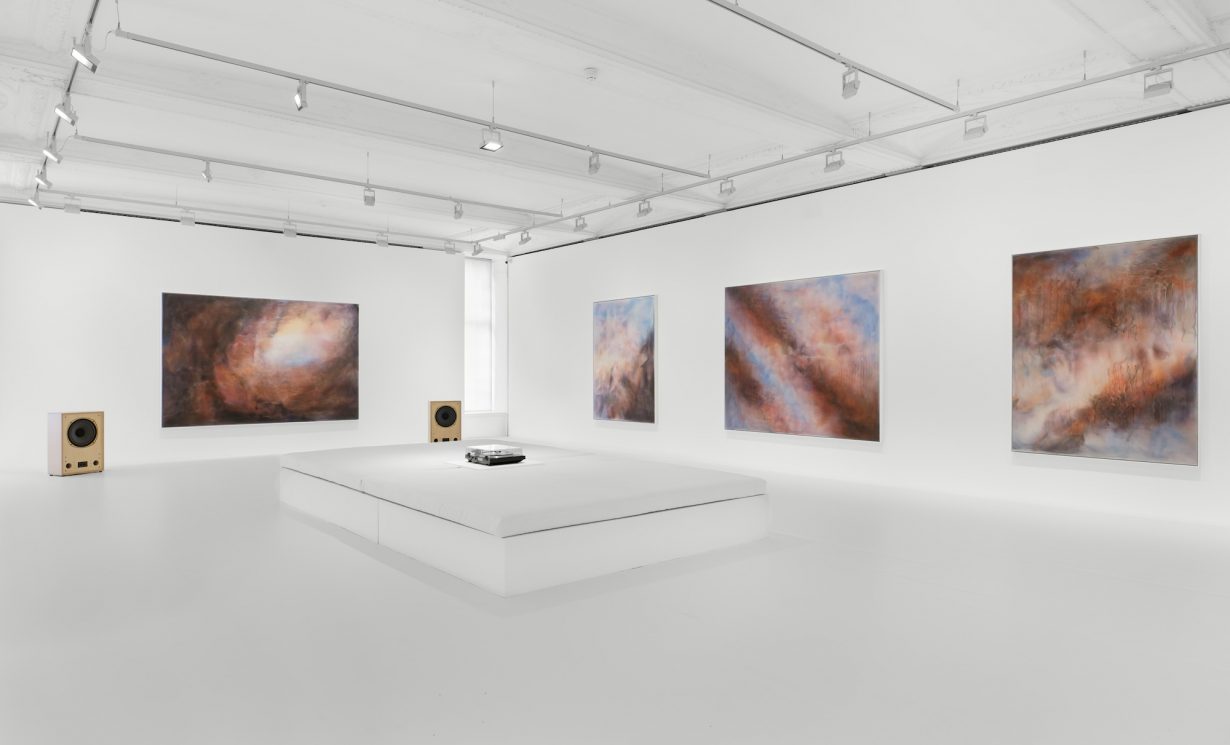
At first glance, Beer’s Resonance Paintings (all referenced here are from 2026) resemble the very wispiest of Romantic cloudbursts: we could be deep inside one of Turner’s storms or John Martin’s hellfire, zoomed in so close as to obliterate any surrounding context. Works like Resonance Painting (Are You Even Real) explode in crystal blues like a Raphael sky. Resonance Painting (The Time Has Come Today) blushes with a vivid, almost pornographic pink like the distended bodies of fallen sinners in a painting by Rubens.
The closer you get, the less gestural Beer’s works appear. Resonance Painting (i saw you) is shot through with serpentine striations that break up the soft-edged smear of the picture. In both Resonance Painting (Pagan Poetry) and Resonance Painting (The Time Has Come Today), we see trembling horizontal and vertical lines meet and blur into fuzzy indistinction in a way that doesn’t look quite human, more like ripples on water or distortions on a liquid-crystal display. More than once I’m reminded of the weird curlicues that would turn up in early generative-AI artworks.
In fact, there is no artist’s hand here at all. Beer spreads dry pigment on his canvases then blasts them with musical tones. The structure of the vibrations causes the paint to spontaneously arrange itself into patterns, in the manner of Chladni, or sonorous, figures. Each canvas will record the shapes created by dozens, even hundreds of notes, and you can read the layers of consonance and dissonance between each sound in the distortions of the image. Less the records of painterly gesture, then; more something like a musical score, created using the same natural pigments (ochre, charcoal, manganese oxide) as the prehistoric Dordogne cave artists. The song, in a sense, remains the same. But even if you might baulk at such brazen appeals to timelessness, there’s an undeniable frisson to these works that flows from the acoustic vibrations that birthed them. Get close enough and all those strange squiggles will seem to dance in your peripheral vision. They are full of energy.
Oliver Beer: The Sky in the Cave at Thaddaeus Ropac, London, 5 June – 31 July
From the September 2026 issue of ArtReview – get your copy.