Jasper Johns’s paintings look like they are telling simple truths, but often hide more than they reveal
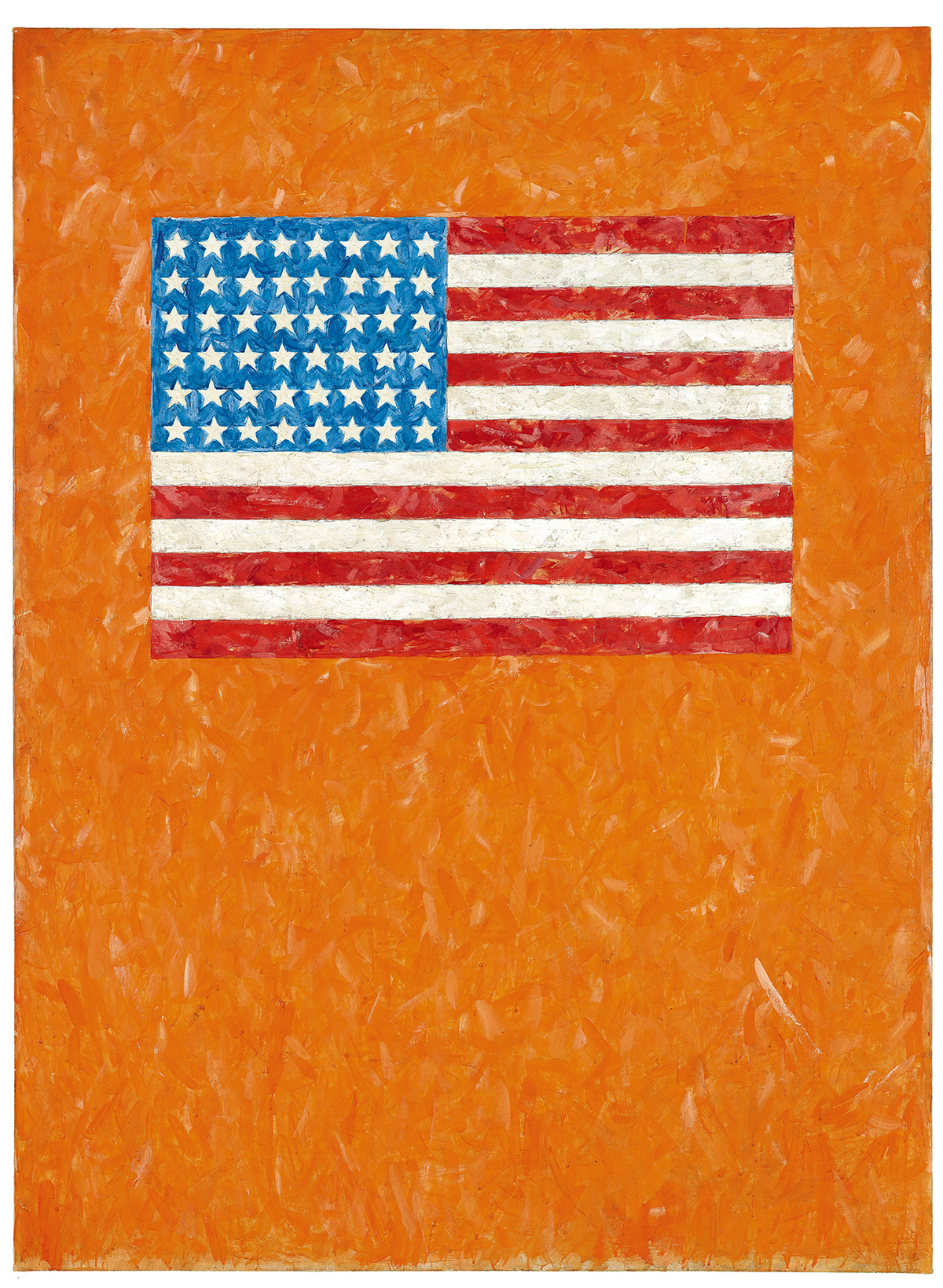
Sometime between 1954 and 1955, during the interval between Abstract Expressionism’s dominance and the emergent vanguard of Pop art, Jasper Johns – who was in his mid-twenties and had recently destroyed all his earlier work – painted Flag. The storied American artist’s first iteration of the Stars and Stripes established a dynamic that has played out in his art ever since, from his number paintings to his signature fields of crosshatchings and repeated circling-back to iconographic specificities like beer cans: you can quickly say what you’re looking at – and it’s invariably rendered in a way that makes you want to look – but the why is far more elusive. Albeit generously so.
Indeed, Johns’s art might be said to live in the spaces he crowbars open between ‘things the mind already knows’, as he famously put it in 1959, and how unknowable they can be. (It’s an ongoing, changeable process: what, for instance, does the American flag mean now?) The ninetysix-year-old Johns’s current retrospective at the Guggenheim Bilbao, Night Driver, named after a scrubby, black abstract-looking work from 1960 and featuring some 140 paintings, drawings, prints, sculptures, elements of stage design, etc, is a micro-haiku of that approach: while his art always feels purposeful and propulsive, we’re steering – or rather, he’s steering us – in the dark.
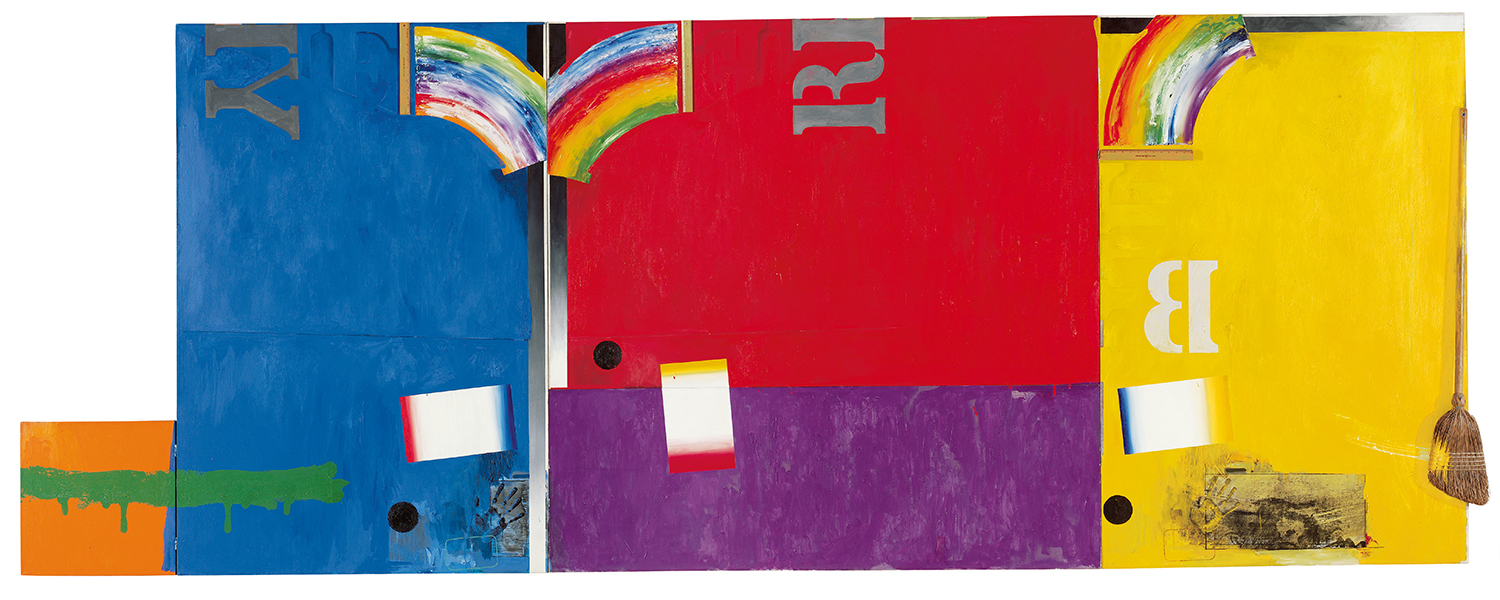
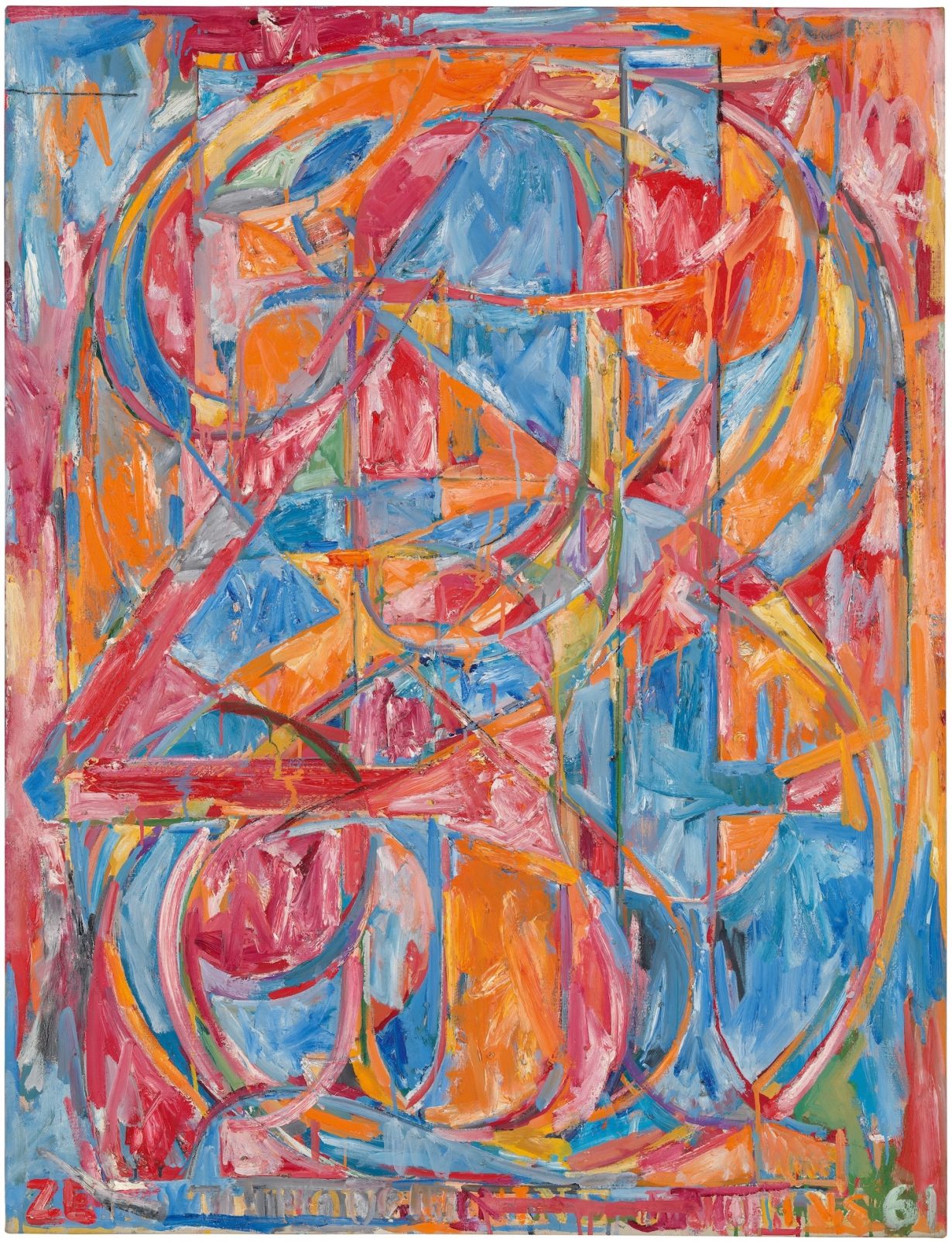
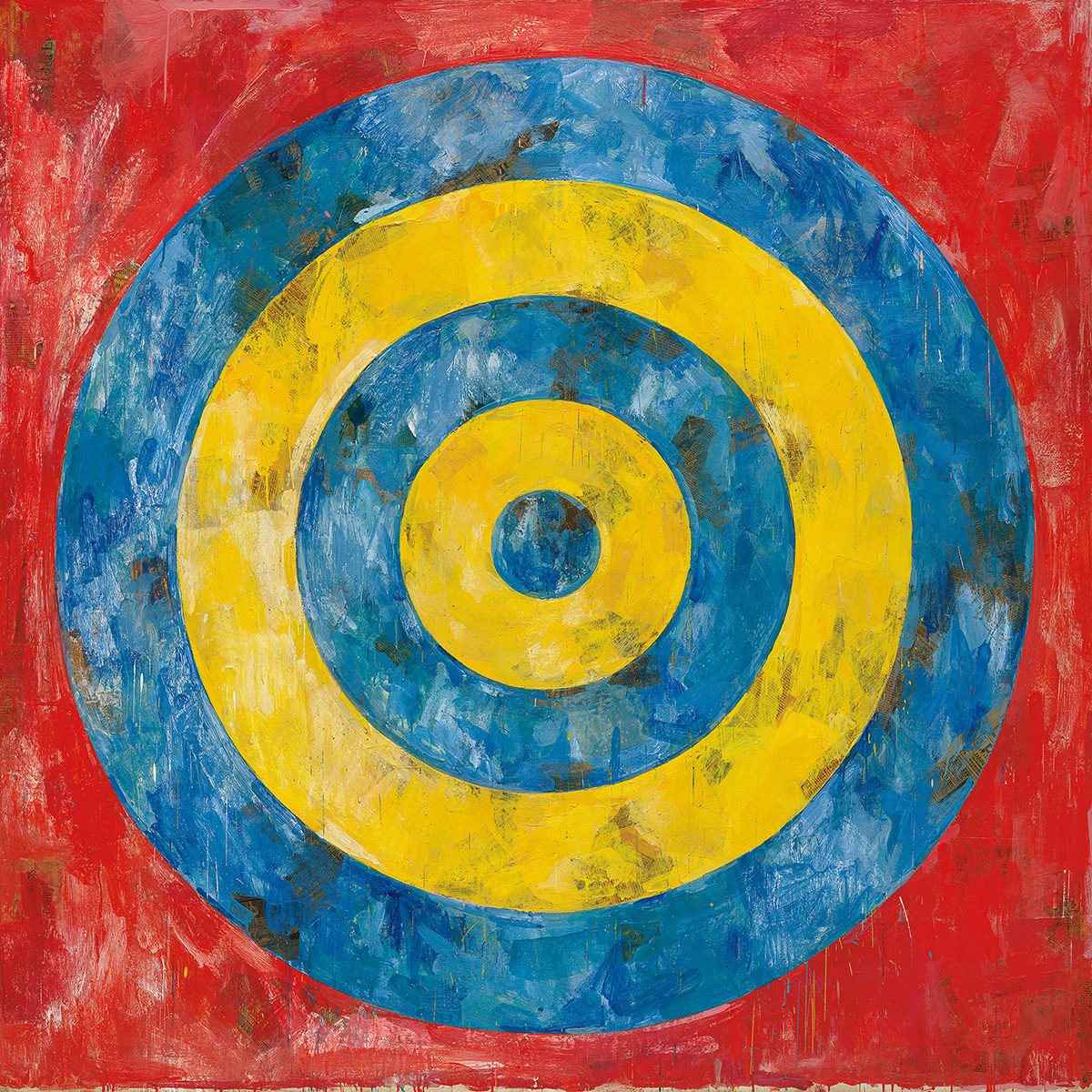
Consider the signal-jamming procedures underlying False Start (1959), in which Johns applies Ab-Ex-y yet somewhat mechanical swatches of paint in predominantly bright primary hues – deep reds, smarting yellows, sky-blue – and then rigorously stencils over each of them a misleading identification: eg ‘blue’ in blue on orange, ‘blue’ in yellow on blue or ‘red’ on yellow in orange paint. Where was Johns going with this comprehensive wrongness and internal contradiction? Or, as in 0 through 9 (1960), made two years on from his first solo show at Leo Castelli, New York (from which MoMA bought three paintings), with compositions made from all the integers preceding 10 overlaid in bright, fauvist colours that somehow don’t feel upbeat, cooled by Johns’s mathematical undertow? Or, as in his fabled Target (1961), the instant geometric composition of concentric rings in red and yellow, warmed and made sensuous this time by glistening, waxladen oils. The Ab-Exers liked to talk about ‘push-pull’, but few have pushed and pulled so rigorously as Johns.
The latitude that results from this can be construed, in one sense, as for us: to expand ourselves within. ‘Don’t you think that all our interpretations of other people’s work sound like us?’ Johns said to the late New Yorker critic Calvin Tomkins in a long-deferred profile published in 2006. ‘That’s what’s interesting – you get to see yourself another way.’ This, though, is part of a tradition in Johns’s interviews of dodging fixed and narrowing interpretation: he sees, for example, his abstract-looking, scintillant crosshatch paintings as figurative, as borne out by titles like Dancers on a Plane (1979); and in a 2010 conversation with the painter Terry Winters, republished in the Night Driver catalogue, he even undoes seemingly stable categories of medium, blurring them towards elusiveness by saying things like, ‘Certain things that I made in the past were classified as paintings until I made them in metal, and then they became sculptures’. You perhaps glimpse this protective descent into ambiguity most clearly in Johns’s longstanding engagement with shades of grey, which begins circa works like Fool’s House (1961–62), a Robert Rauschenberg-imprinted combine in which a real broom appears to sweep grey paint across the canvas – Johns being Johns, he soon swerved to the four-panel colour fields (again plus sweeping-clean broom) of Untitled (1964–65), as if to say you weren’t going to possess him in terms of palette either – and blooms in those gorgeous cool walls of mingling chevrons in the Crosshatchings series (1973–83).
Writers have, inevitably, tried to sneak behind Johns’s upraised shields, not least in aligning his protectiveness and insularity with his sexual orientation, which would admittedly have been difficult to speak of openly in 1950s and 60s America, or seeing the downbeat darkness of some of his 1961–63 paintings as reflecting his contemporaneous falling-out with Rauschenberg. And some kind of frustration with Johns’s recalcitrance seems to have spilled over, during the mid-1980s, into a (likely deserved) reputational dip, when he began mixing references to other artists with fragments of his own stylistic past in a manner that now looks like boilerplate postmodernism. See, for instance, an image of the Mona Lisa abutting an American flag in Summer (1985, part of his critically disparaged, self-consciously gnomic, collagelike The Seasons series from 1985–87) or the homagelike portrait drawing After Picasso (1986).
Johns, not listening, would continue to pursue this kind of deflective interrogation of earlier masters for decades to come – when artists reach their fifties and sixties, this sort of measuring oneself against the past is common, though one could argue that Johns was treating existing artistic styles as just more things to be appropriated, like a target. In any case, by the late 1990s he’d subsumed whatever he’d needed to learn and merged it with a startling existential wintriness. In the Catenary series of 1998–99 – which followed a 1996–97 MoMA retrospective, the kind of thing that can feel existentially career-capping for an artist – the majority of the canvas is a turbulently luscious grey encaustic void, crossed by a length of string (a catenary curve is formed by a length of chain, cable or string, hanging under its own weight). Johns gives these works subtitles – spelled out on canvas in his trademark stencilling – like ‘I Call to the Grave’, which comes from the Book of Job. In a pair of Flag works made in 2002, the flag looks blackened, scorched, as do the revisited Numbers of 2007–11. Johns isn’t saying what these works are ‘about’, but the dreadnought weight of mortality is all over them. In Untitled (2018), a grinning upright skeleton is flanked by bits of newsprint; in the 2021–22 two-venue exhibition Mind/Mirror across the Philadelphia Museum of Art and Whitney, New York, these late works were gathered under the title ‘Elegies in Dark’ at the latter. (Brighter others from the same period, nevertheless, were collected as ‘Elegies in Light’.)
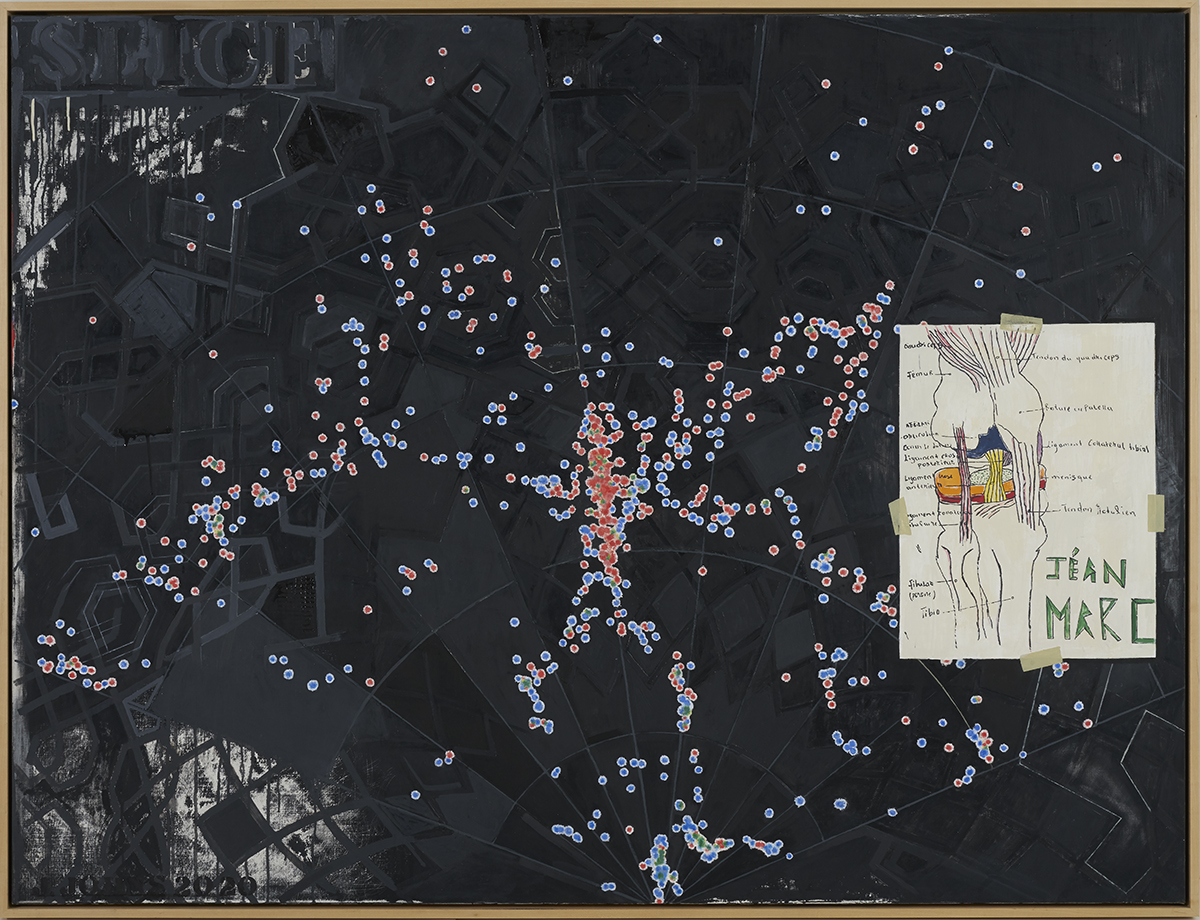
Skeletons, flags, numbers: these are, still, things the mind already knows, but what Johns knows of them – what they might have signified earlier, what they convey in changing times, what they suggest when enveloping age makes everything too real – is surely different to what we know. The newest painting in Night Driver, 2020’s Slice, is as elliptical and expansive as any in Johns’s canon: the majority of it – a deep grey, complexly subdivided field speckled with little red, blue and green splotches outlined in white – features, per its caption, ‘a map of the distribution of galaxies in a slice of the universe’. On the righthand side, meanwhile, is an anatomical sketch of the human knee, while elsewhere a harlequin pattern opens up, almost hopefully, in spaces within the grey. As so often, Johns establishes space here, this time between the vast and the local, between the cold cosmos and our warm, fallible bodies; and then he leaves us to wander amid it, thinking our own thoughts, maybe awed, maybe achy, maybe both. Both the galactic map and the knee drawing are, it turns out, appropriated: things from the scientific world brought into cosmic alignment, rubbing together to create sparks. This stuff was already here and relatively comprehensible, says Johns; now it means something else. Talk about that, and don’t ask about me.
Jasper Johns: Night Driver is on show at the Guggenheim Bilbao through 12 October
From the September 2026 issue of ArtReview – get your copy.
Read next Martin Herbert on what continues to make the work of Francis Picabia so relevant today