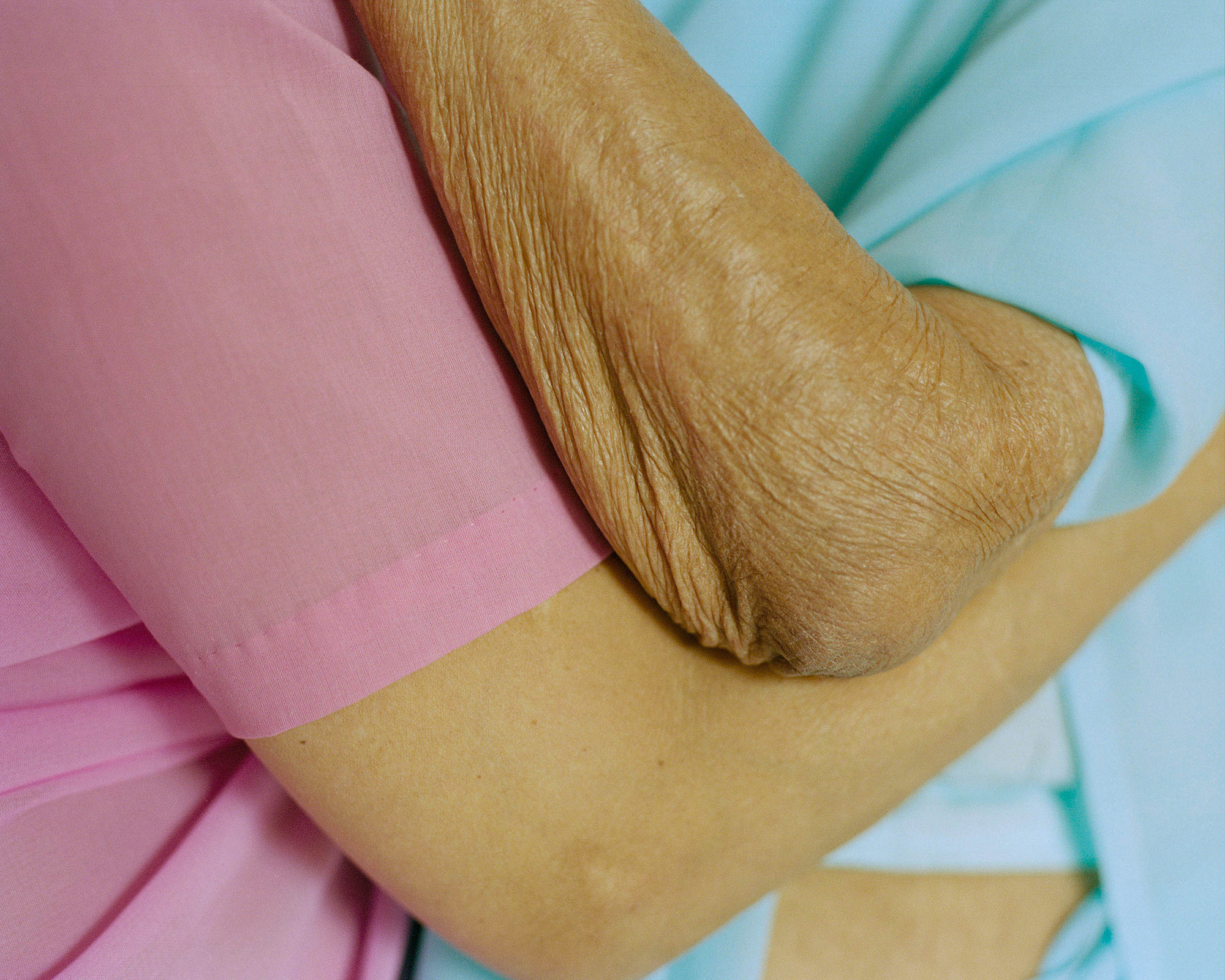
The artist’s works capture something of the fundamental unknowability of other people’s lives
At the threshold of Arpita Shah’s exhibition is a glass-topped display table, recognisably of the museological variety, in which various objects are archived, labelled and displayed: passports (Indian), coins, letters, a pair of colourful confectionary tins (from Bombay and Nairobi), beads, dried flowers, gemstones, a piece of brick, a mix of curling black-and-white and colour family portraits, together with postcards of landscapes and religious icons of various vintages. It’s the mode of display rather than any of the individual objects themselves that suggests that they are valuable.
These are the kind of portable materials that might constitute the record of any migrant’s family history (born in India, the artist herself moved between Saudi Arabia and Ireland before ending up in the UK). More particularly they are souvenirs of Shah’s own heritage, starting with her grandmother (the Nalini of the show’s title), who moved from India to Kenya (and then back again), although here the extraction of these keepsakes from a domestic context and their insertion into an institutional taxonomy creates a curious tension between the subjective and the objective values of the items. Could we value them as much as the artist does? You wonder.
A cue, perhaps, for the photographic archaeology (26 largescale, framed and wall-mounted photographs, by the artist, of places and people, mixed with further family heirlooms) of Shah’s matrilineal descent (grandmother, mother, self) that constitutes the main exhibition itself. An exercise, literally, in putting flesh on the bones of the impersonal archive. Both to give meaning to that opening vitrine for a general audience and as a chronicle of the artist’s own attempt to uncover aspects of her heritage as her Gujarati grandmother, distanced from the artist by both geography and language, became increasingly forgetful.
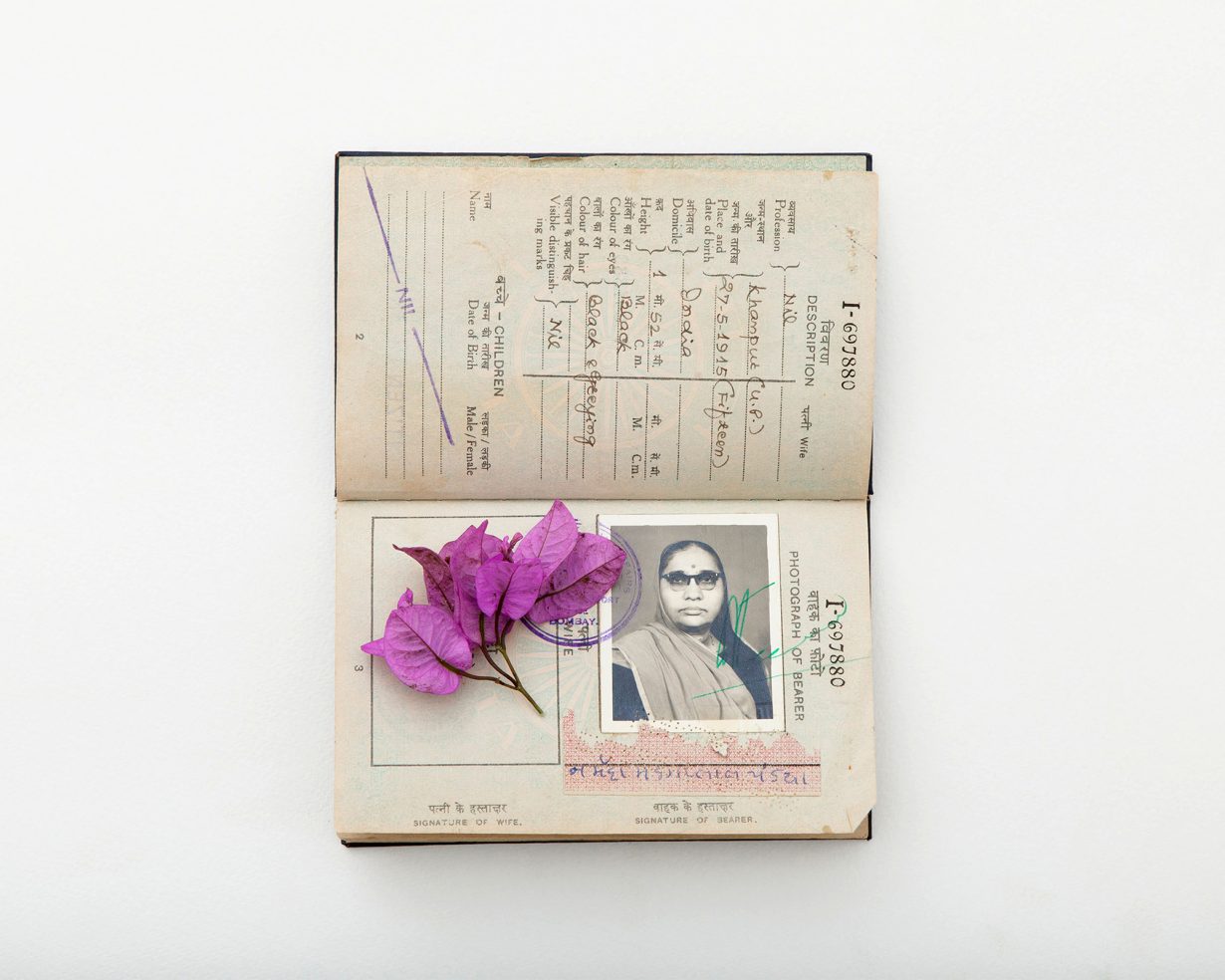
In the first artworks, we witness the framed passport of her great-grandmother Narmanda, with dried bougainvillea petals (picked by the artist from the site of what was formerly the family’s dairy farm in Nairobi) (Canal Road, 2017) placed next to a colour photograph of a dark-haired woman, her face turned away from the lens, posing in front of a bougainvillea shrub (Bougainvillea Mahara, 2016). It has echoes of a family photograph, from the vitrine, of the artist’s mother in front of flowers in Ahmedabad from 1985, as she looks out at us self-consciously. The passport contains a black-and-white photograph, along with the description of the owner’s hair colour as ‘black and greying’, her children ‘nil’. The bougainvillea is significant as a plant transplanted (from Brazil) to India under British colonial rule. Ultimately the pairing of the two adjacent works conjures a feeling that is part restoration, part reenactment. But also introduces the floral offering as a repeated theme throughout the show. Nalini means ‘lotus’ in Sanskrit, and the flower is often used as a sacred
offering in Hindu pujas; here Nalini in Bloom (2016) features a portrait from the archive garlanded with the flower’s petals. In one photographic triptych we encounter a photograph of Nalini’s decaying legs, another of a lotus blooming in a pond and a third of the (notably younger) upper body of the artist’s mother, elegantly concretising ancestral connectedness, the flower as a metaphor for the female body and the inevitability of decay.
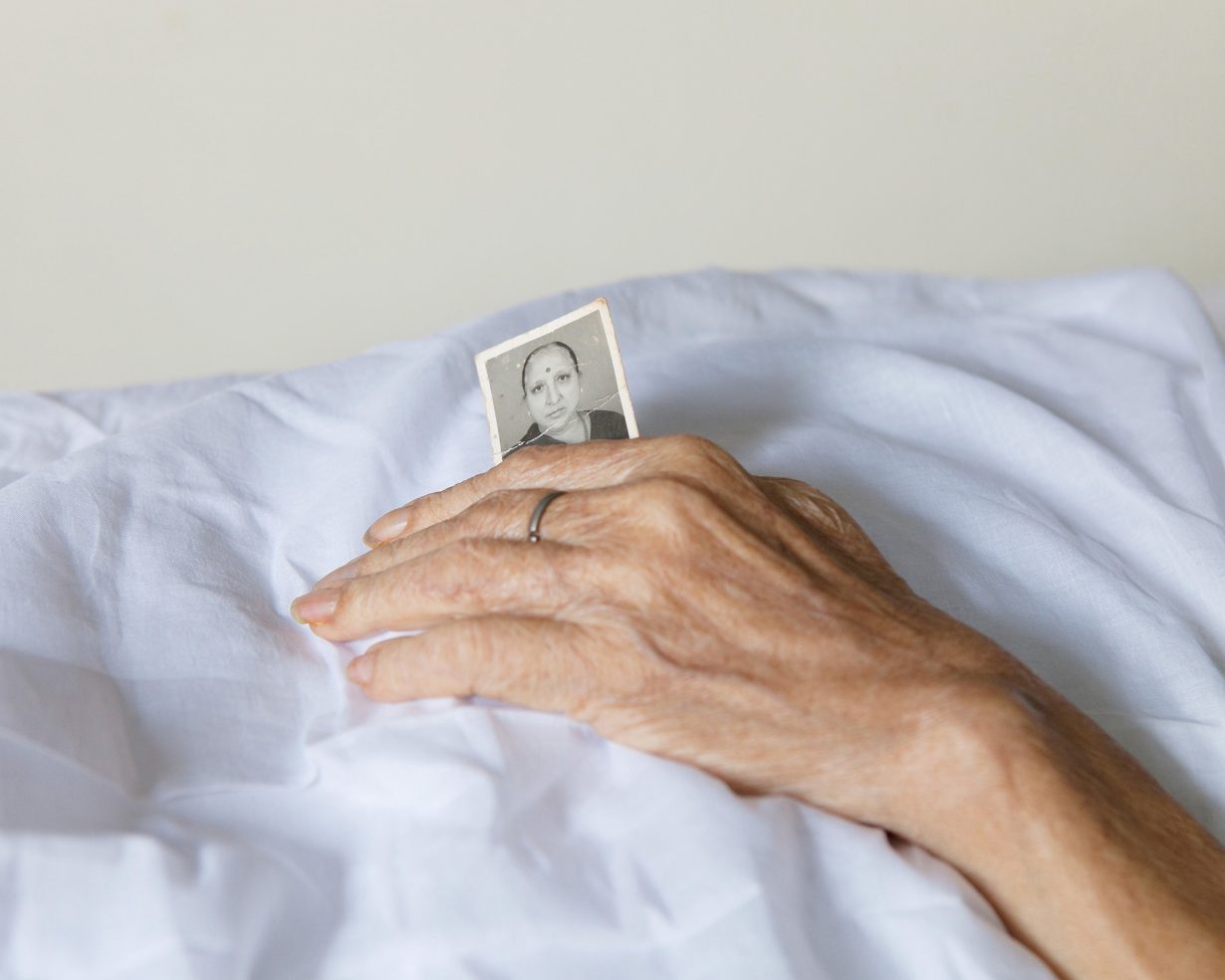
Elsewhere we see photographs featuring portraits from the archive (we might recognise the artist’s mother, Reshma, photographed in Ahmedabad in 1973, from the labels in the opening vitrine) collaged into a garland of sea spume (White Sands, 2017) paired with the beachfront spume in a colour photograph titled Mombasa (2017), or clutched in a wrinkled, elderly female hand (Nalini’s Hand, 2017). Perhaps most poignant of all is a photograph of two female bodies embracing in which the old skin and the young skin of the forearms of the individuals touch as their elbows interlock (Mother’s Mother, 2018). If connection and proximity are themes of the images (and motivations for Shah’s project of ancestral research), it’s noticeable that faces only appear in images from the archive. In Shah’s own photographs heads are turned away from the viewer or cropped out of shot, making her photographs as much a record of loss as they are of recovery. Indeed, these are works that conceal as much as they appear to reveal, and are all the more moving for their insistence on the fundamental unknowability of other people’s lives. Although, of course, it is also the absence of specific faces that allows the viewer space to project their own experiences onto Shah’s works, which present a rich study of the intersections of personal and collective histories, and the effect of both in (re)constructing identity.
Arpita Shah: Nalini at Firstsite, Colchester, 13 June – 4 October
From the October 2026 issue of ArtReview – get your copy.


