The artist’s nonimages work in codes, simultaneously revealing and withholding information
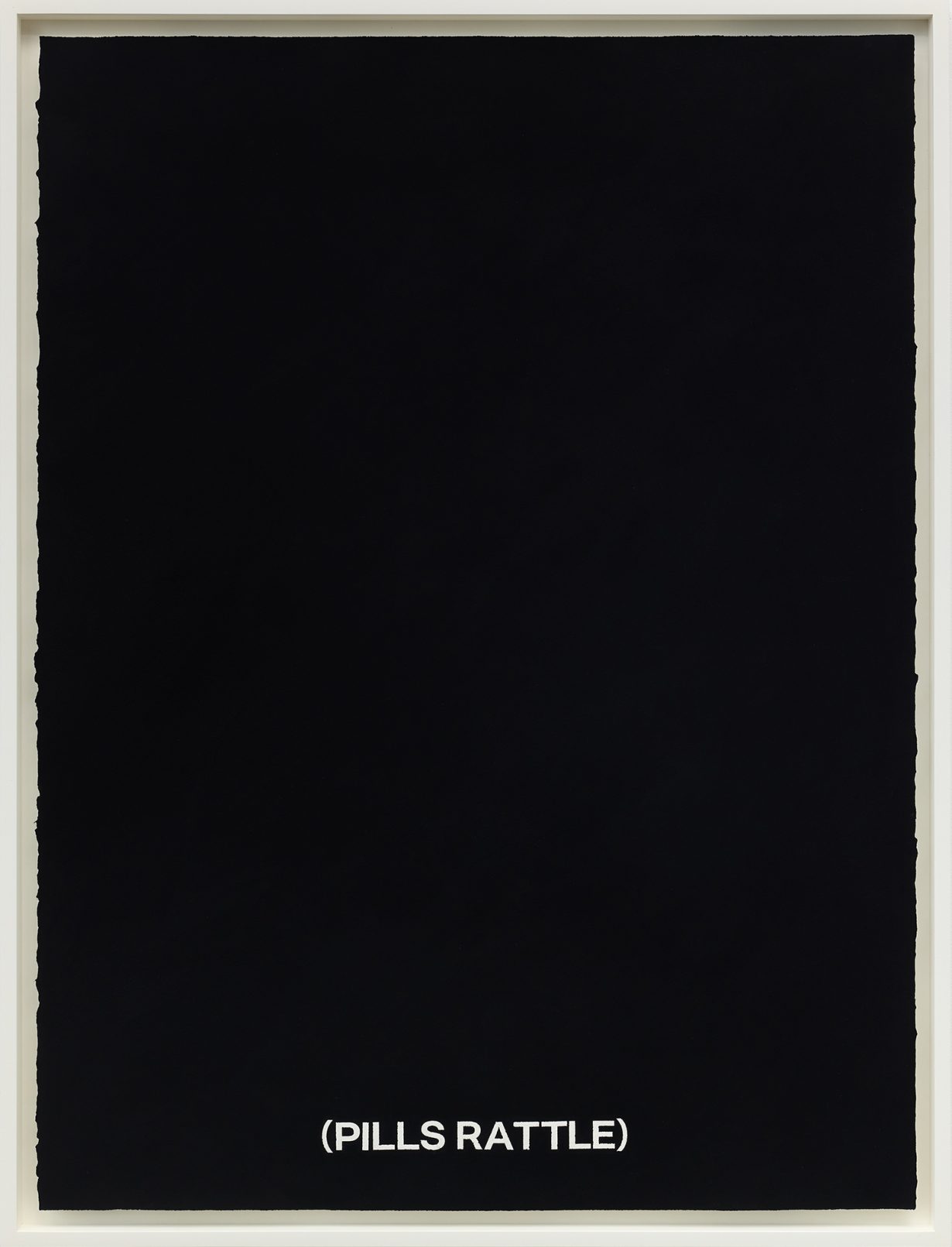
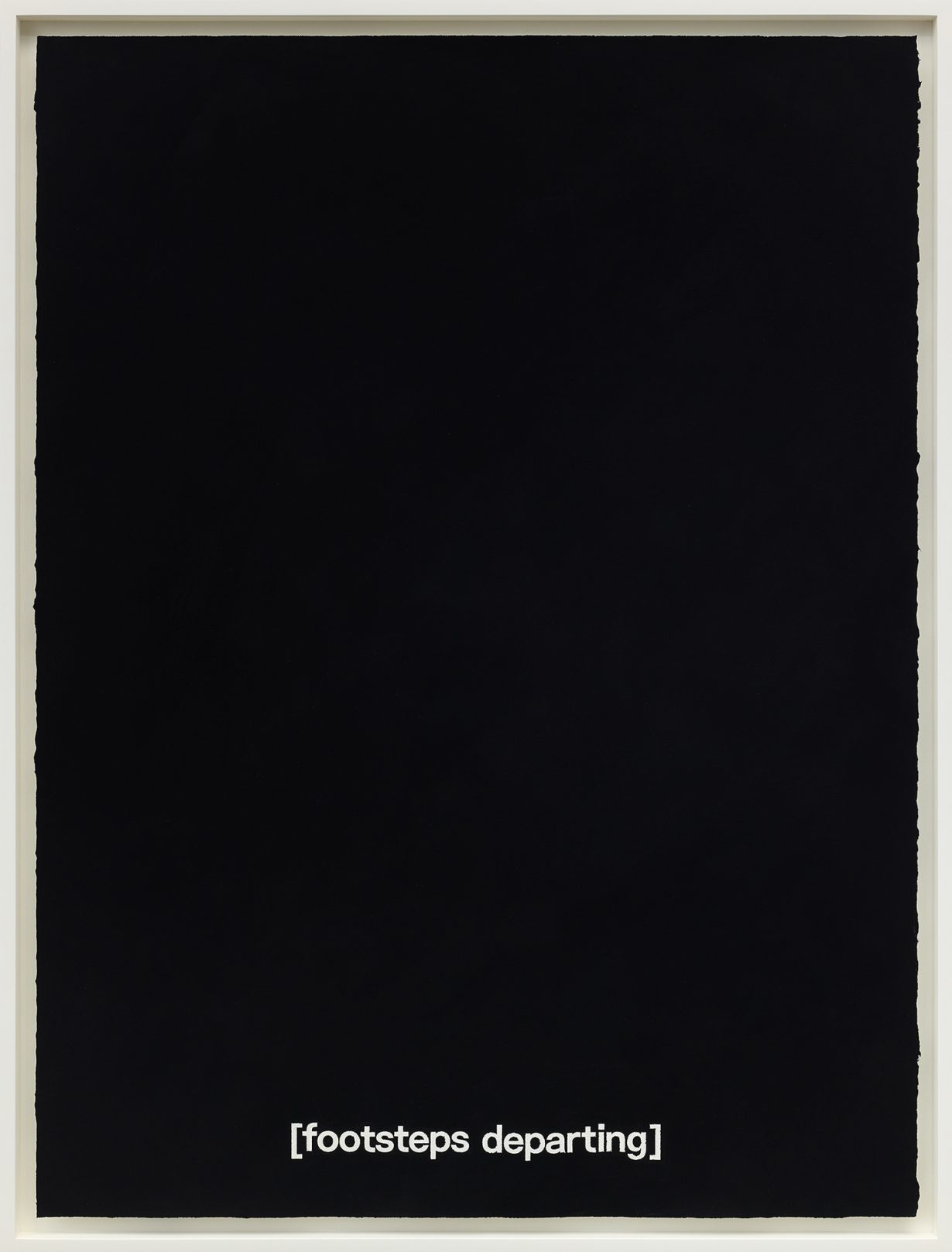
Accessed by buzzing through a nondescript door in a dilapidated East London warehouse, Maureen Paley’s latest London gallery feels like a nonplace. Within, the austere exhibition by Tokyo-based Norwegian Gardar Eide Einarsson mirrors this dissociation. Upon entering, one finds a row of ten black paintings hang on the lefthand wall like windows leading to nowhere. Each warped, gouache-drenched sheet of paper is monochrome black apart from a fragment of white text at the bottom. Titled Closed Caption (2024–25), this series of stark nonimages reveal unsettlingly little as the viewer traverses the room. The closed captions, taken from existing films and TV shows, but divorced from their original visual context, read somewhere between cryptic messages and cartoons: ‘[music playing over speech]’, says the first one; it’s followed by ‘[footsteps departing]’, ‘[door opens, closes]’ and ‘(LIGHT SWITCH CLICKS)’. They describe a series of events that, though familiar, lie just beyond comprehension, leaving the viewers in (literal) darkness.
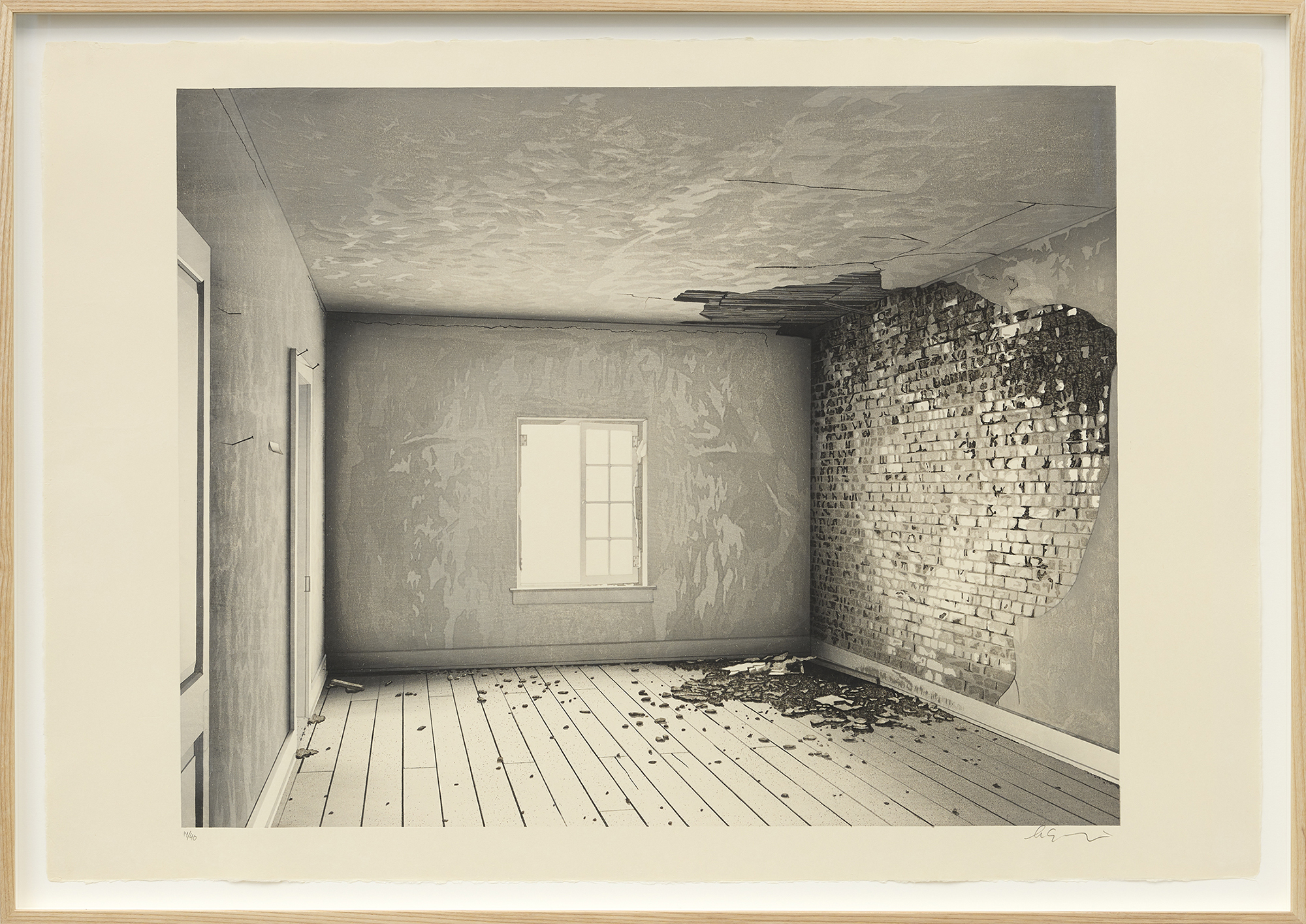
A single caption in Japanese creates a soft link with the three framed woodblock prints across the room by Mokuhabga master Shoichi Kitamura, with whom Einarsson collaborated on the series Incendiary Test Area (2024–25). The near-photorealistic prints reference the model houses built by the US Army at Dugway Proving Ground in Utah for biological and chemical weapons-testing during the Second World War. There, fullscale ‘Japanese’ and ‘German’ houses were fire-bombed and rebuilt continuously. Furnished down to chopsticks on the table, they were fit for habitation, but built for annihilation.
The prints, executed in a realistic style, depict ghostly interiors devoid of life and littered with rubble. I am immediately reminded of Danish artist Vilhelm Hammershøi’s eerie paintings in which sequences of rooms and doors left ajar hint to spaces beyond the frame. One print, Incendiary Test Area (Interior View of Second Floor Room) (2024), captures a scene from the perspective of someone peering through an open door toward a blindingly white, viewless window. Plaster crumbles from a wall, revealing brick. Another, Incendiary Test Area (Interior View of Doors Opening into South Stairwell) (2024), focuses on a corner in which two doors have swung open. Fallen cables lie on the floor, and a staircase is visible beyond. The final print, Incendiary Test Area (Interior View at South Stairwell) (2025), looks through a narrow corridor towards what appears to be the same wooden staircase, now sprinkled in broken plaster.
The prints invoke several paradoxes: one of preserving a house that was built with the intent of destruction; another of recreating the false ‘Japanese’ house through the hands of a Japanese woodblock artist; and a third of showing it within an exhibition of works by a Norwegian artist living in Japan. In their static, unpopulated views, the prints’ aestheticisation of violence is troubling – but perhaps this is the point. We are meant to feel claustrophobic, enclosed, outside of time. The viewer enters into an uncertain timeframe within the cycle of destruction and reconstruction. Is a bomb about to fall? Or are we instead witnessing a rebuilding, the re-placement of rubble into wall?
Though superficially speaking different visual languages – one minimalist, one hyperrealistic – both series presented in Music Playing Over Speech work in codes, simultaneously revealing and withholding information. That Kitamura is not credited as the prints’ coauthor (and arguably primary author), except as an aside on the gallery pamphlet, speaks to the art market’s enduring valuation of conceptual art over the physical labour of craft – perhaps yet another form of erasure to add to the rest.
Music Playing Over Speech at Maureen Paley, 4 Herald Street, London, 17 January – 21 March
Read next Carolyn Lazard’s Dance for Camera