The 2003-founded troupe’s theatre productions are a site on which fiction and reality are constantly confused – and so to in the gallery
Lagartijas Tiradas al Sol (Lizards laying in the sun)’s vision of theatre involves sparse scenography (more honest than it is minimalistic), a bold juxtaposition of the historical with the confessional and a preference for exposition over dialogue in their dramaturgy. The 2003-founded troupe’s theatre productions are a site on which fiction and reality are constantly confused, much like they are in life.
The group exhibition No es un poema, aunque soñemos muchas cosas (It’s not a poem, even if we dream of many things), is Lagartijas Tiradas al Sol’s second curatorial endeavour and is full of effective gestures: warm lights that dim up and down cyclically over walls covered with brown paper and plastic sheeting, among plants, some bricks and a modest fishtank. It feels simultaneously staged and lived in, unfussy yet focused. My eye kept wandering to an old metal fan affixed near the back wall, with pretty ribbons lazily dangling from its shield. The show includes works by 17 artists, alongside videos and props used in previous Lagartijas plays. There is an immense, entrancingly braided textile by Olga de Amaral (FIBRAS REF. OA0416, 1985), as well as a couple of postconceptual gestures by Mario García Torres and Mirosław Bałka. There is a nice group of party photos by Dayanita Singh and politically tinted landscape photography by Soumya Sankar Bose and Jo Ratfcliffe; as well as a landscape painting by Matthew Krishanu right behind a massive (mountainscape) backdrop by Pedro Pizarro that divides the room.
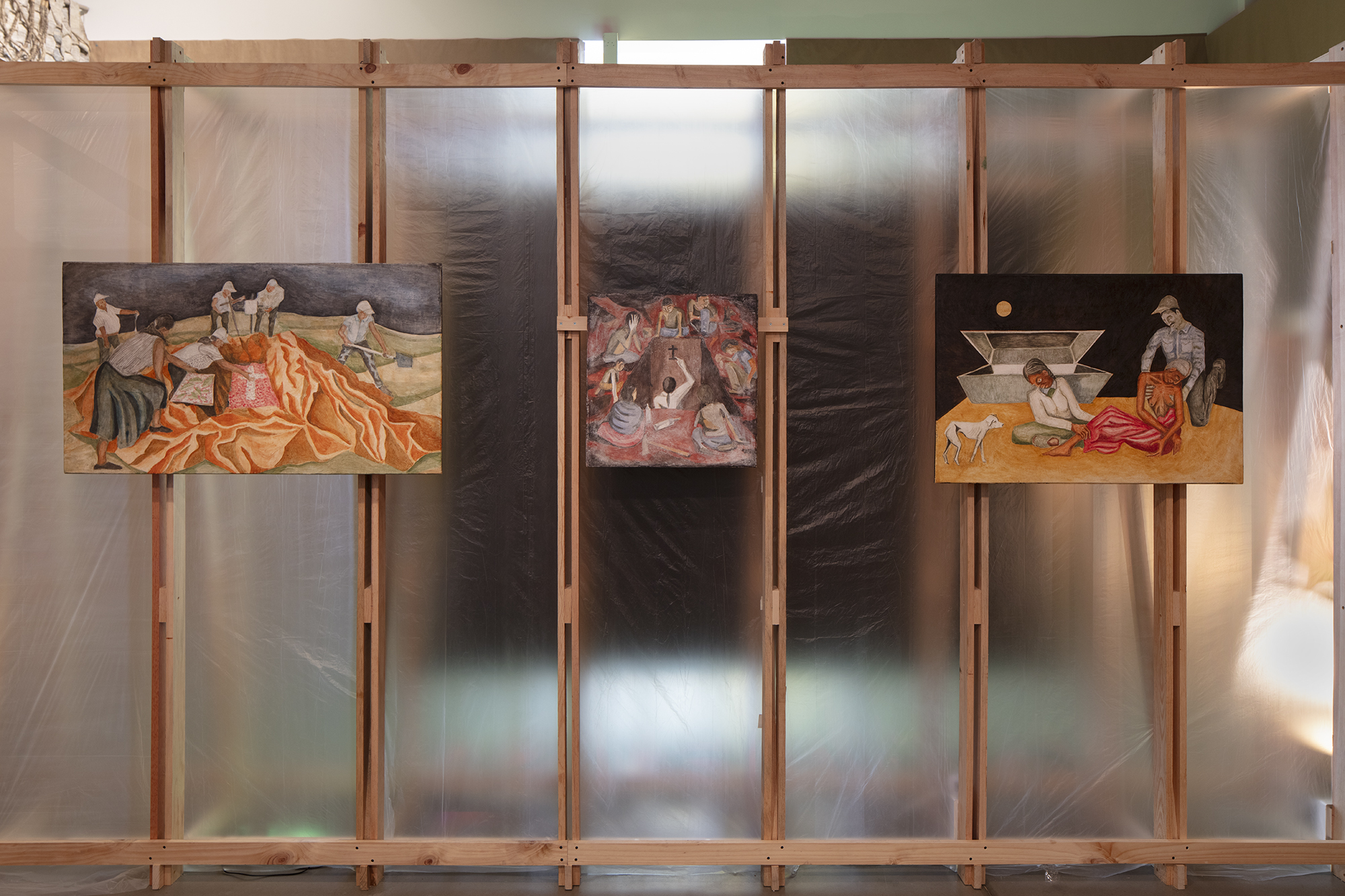
The works by the father and son Eduardo and Pedro Pizarro, although different, extend affective tendrils towards each other. The first creates baroque religious paintings; the second frescoes and backdrops for Lagartijas. A painting by Eduardo opens the show, the slightly amateurish but charming Inmaculada concepción (2016) hung over a striking cascade of golden cellophane (previously a background for one of the Lagartijas plays), evoking the excesses of gilded churrigueresco churches. Pedro is represented by a number of works, including a sombre and beautiful quartet of paintings, Nadie hereda el cansancio (No one inherits exhaustion, 2026), representing, in earthy colours, the funeral rites of the inhabitants of Yanhuitlán, a town in the mountains of Oaxaca that has been virtually abandoned by the young but where the elderly remain to till the land. Both Pedro and Lagartijas Tiradas al Sol cofounder Luisa Pardo live there now, pursuing pedagogical projects around art, architecture and theatre for the children who remain.
Pardo’s arrival in the Mixteca Alta, as the region is known, over a decade ago, was the subject of the play Epifanía sideral (Sidereal epiphany, 2026), a fragment of which is presented upstairs in a second gallery. The small stage contains only a table to the side, a chair with some books and a cloud of crumpled plastic at its centre. From the cloud hang plastic bags filled with water, which are, at one point, pierced by Pardo with her teeth to signal rain (the water subsequently flows into a series of zinc tubs). In terms of the narrative aspects of her performance, Pardo braids fiction and confession into a story of her arrival, as a self-described “predictable, comfortable, urban” dweller, in a land that was very much not her own. She was welcomed with warmth by a family of women, and with scepticism from townspeople sick of having their experiences extracted for academic research – “I am not an academic”, Pardo repeats to herself in a work that, perhaps inadvertently, also highlights some of the issues attending ‘research-based’ art practices, as well as the issues of bringing art and life together (which is another subtheme of the show as a whole).
The performance and the exhibition collectively form a well-rounded, critical and ambitious project. One that can, however, be a little repetitive in its focus on landscape (and related themes, which have almost become clichés, of ‘territory’ and ‘conflict’) in works of decidedly uneven quality. At its best, however, the artworks play with an obvious theatricality to evoke a narrative that, like the stories Lagartijas are invested in telling, is not necessarily complete or predetermined, but rather quilted together from different aspects of a fragmented reality.
No es un poema, aunque soñemos muchas cosas at Galerie Nordenhake, Mexico City, 3 September – 24 October
From the October 2026 issue of ArtReview – get your copy.