A new anthology of Cameroonian art from the past century shines a light on the difficulty in mapping a national history – and art history
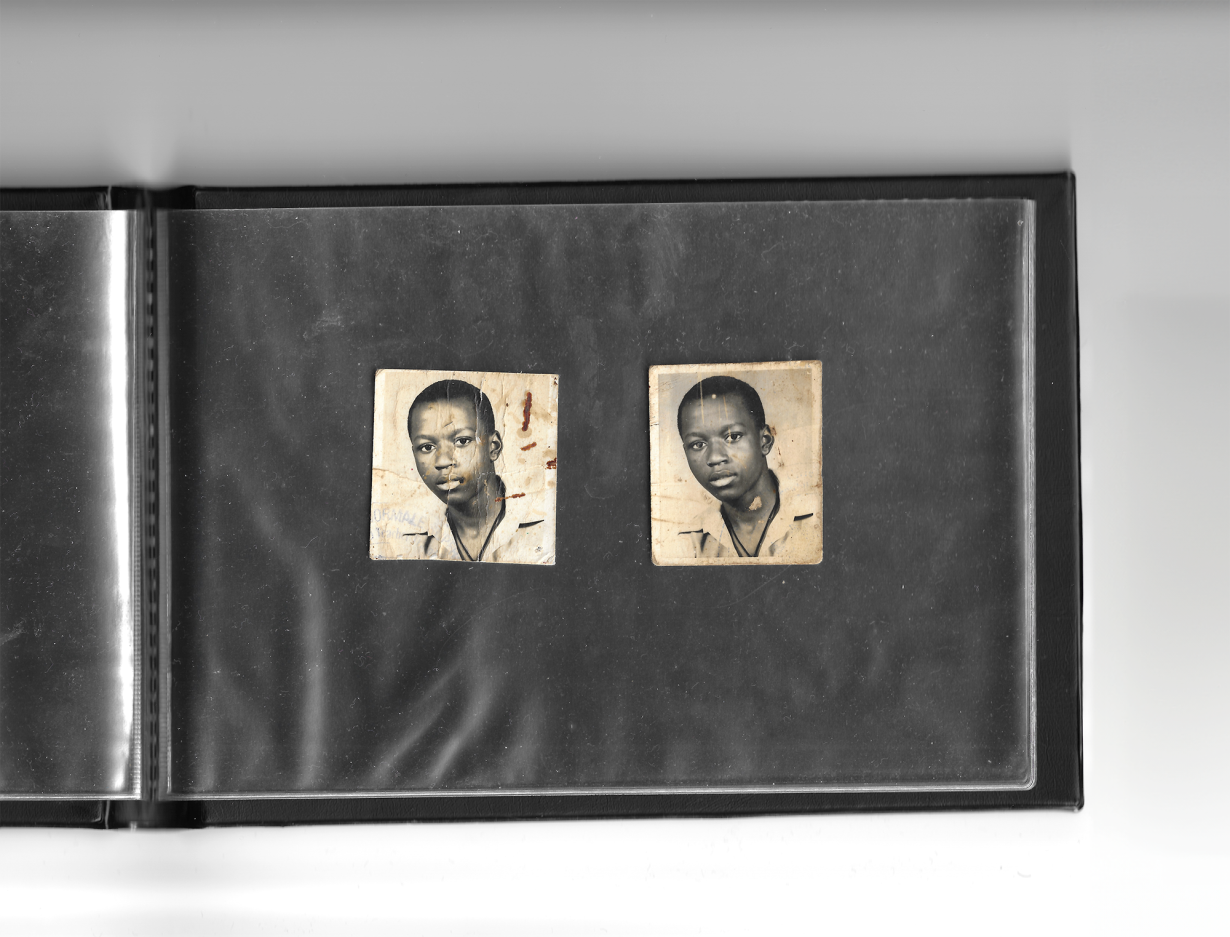
In a photograph reproduced from artist Ethel Tawe’s installation Image Frequency Modulation(2021–ongoing), two small head-and-shoulders portraits sit against a dark album page. Collared faces turned towards the camera. Creases and reddish marks interrupt the pale backgrounds. The wider project combines her father’s photographic archive with recordings of him teaching her proverbs in Limbum, her mother tongue. One translates as, ‘A river that forgets its source shall dry up.’ Their exchanges involve repeated attempts to get the intonation right, since a change in pitch can alter meaning. The recording loops within the installation. Tawe describes this as ‘transmission rather than preservation’, knowledge passing through the work of listening and trying again.
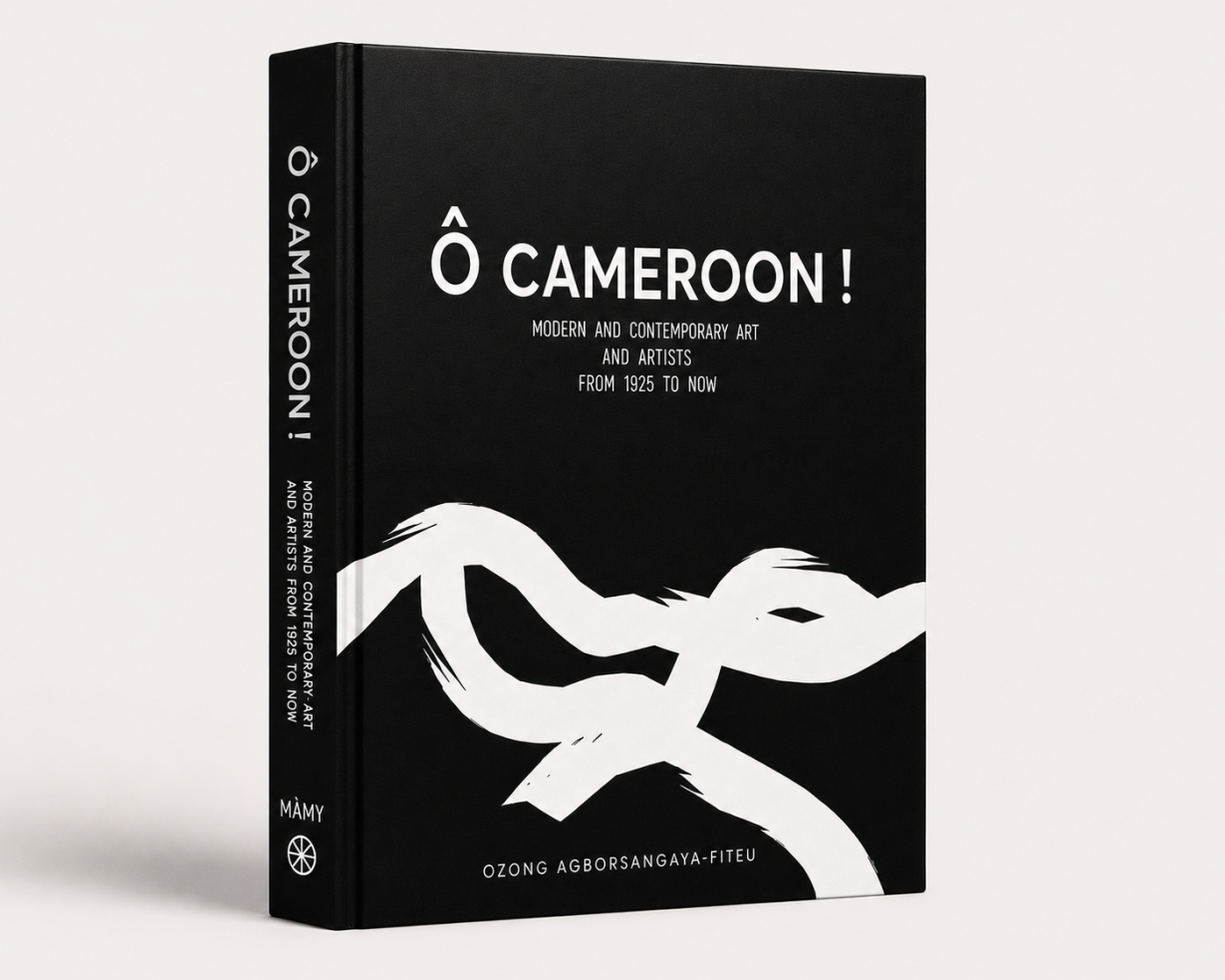
Tawe is among the 180 artists featured in Ô Cameroon! Modern and Contemporary Art and Artists from 1925 to Now, a 424-page anthology of Cameroonian art from the past 100 years, combining artwork reproductions and biographical texts with essays and conversations. Growing up in Yaoundé, Tawe found an early reference in her uncle, a teacher, musician and art lover, but little around her suggested that art could become a viable career. Music and literature brought her towards visual practice. After she moved to Tanzania as a child, East African visual culture was more dominant in shaping her artistic work. Only in the past decade did she begin learning about many of her Cameroonian predecessors and contemporaries. “Why has this history been so difficult to map?” she asks when I speak to her. “Why has it taken this long?”
Assembling a national history inevitably involves disagreements about the nation itself. After the First World War, following decades of German colonial rule, Cameroon was divided between the British and the French by League of Nations mandates. French-administered Cameroon became independent in 1960; British Southern Cameroons joined it the following year in a federation. The replacement of that federation with a unitary state in 1972 became a lasting source of Anglophone grievance. In 2016 lawyers and teachers protested what they saw as the erosion of their common-law system and English-language education within the predominantly Francophone state. Violent repression by security forces helped precipitate the subsequent armed conflict, in which civilians suffered – and continue to suffer – abuses by both government forces and separatist groups seeking independence.
Published ten years after those protests began, Ô Cameroon! groups its artist entries by generation, from pioneers to a new vanguard, rather than dividing them into Anglophone and Francophone categories. Reading it as a Cameroonian American, I value the connections this makes possible. Yet gathering artists as Cameroonian does not settle the political disagreements that designation carries. The book is most persuasive where those connections can be followed without expecting the artists to share a style or affirm a common understanding of the nation.
The book’s editor, Abidjan-based collector Ozong Agborsangaya-Fiteu, approached the undertaking after almost 30 years working in international development, including at the World Bank. As a girl she had dreams of being an artist. In our conversation she described the project as a return to that ambition. A few of those featured were already represented in her collection, but the vast majority were not. She began without a settled list, raising funds, visiting artists’ studios and holding individual conversations, through which the scope of the book developed. “I had to rely on the elders,” she tells me. The painter and sculptor Koko Komégné helped her think about an ecosystem around the work. Advisers included the artist Barthélémy Toguo, curator and writer Simon Njami, and filmmaker and curator Pascale Obolo. Assembling this Cameroonian history meant following its practitioners and their knowledge across borders.
In ‘Un certain regard’, Komégné’s essay contribution to the book, he questions the attribution of African artistic modernity to European instruction, describing knowledge and authority already held by makers when colonial instructors arrived. Identifying that modernity, he argues, ‘is not merely to look backward, but to recognize an ongoing movement of visual production that continues to unfold across the continent’. Agborsangaya-Fiteu recalls that Komégné chose the essay’s title at their first meeting and submitted it; he passed away three weeks later.
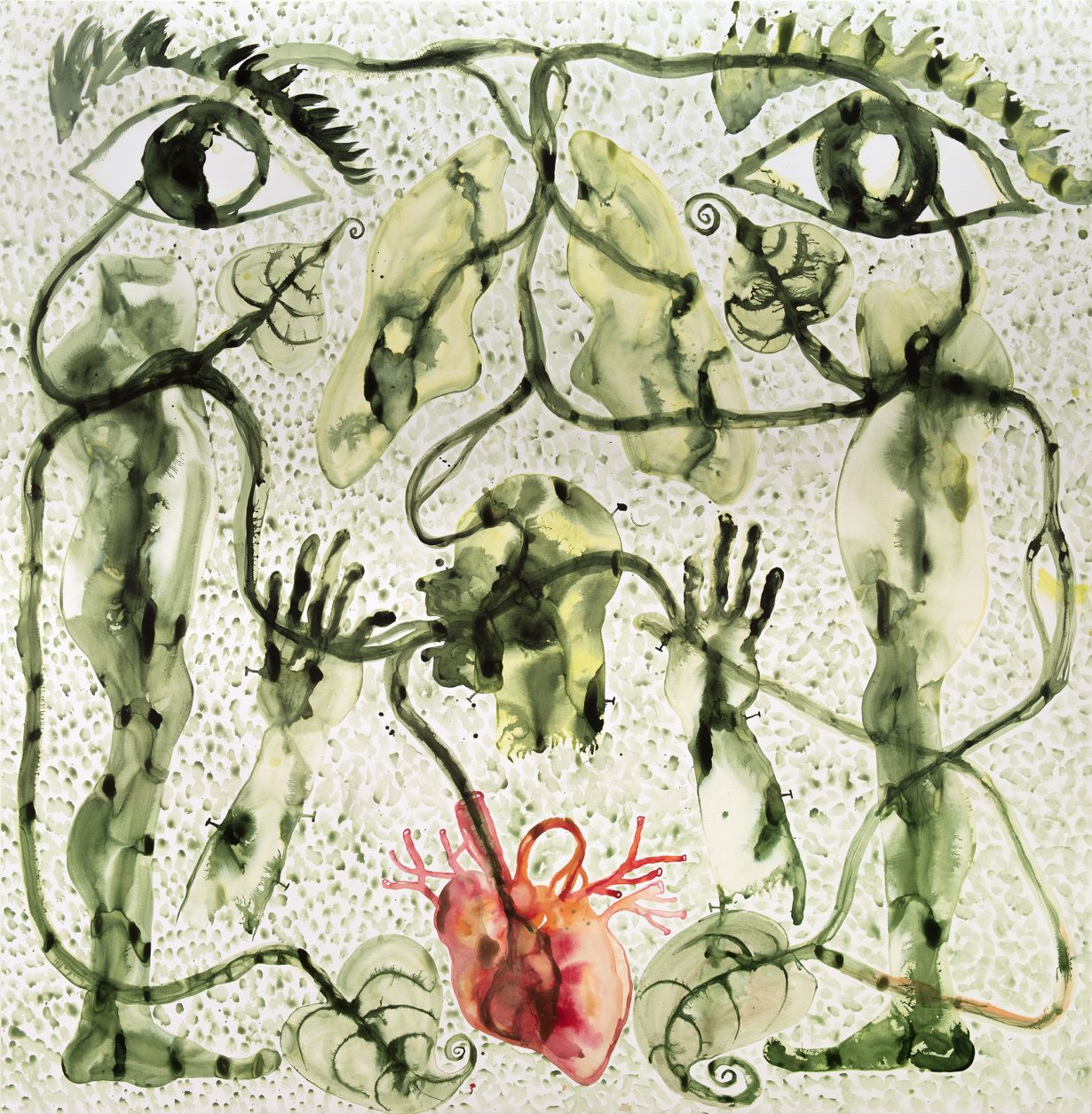
In Toguo’s ink and acrylic Heal the World (2017) in the anthology, two enormous eyes overlook elongated green figures. Between them, lungs hang above a head flanked by raised hands; a red anatomical heart sits below. Looping lines connect these forms, while translucent washes let the pale ground show through. Following those connections, I begin to read the composition as an anatomy distributed across several beings.
Toguo works between Paris and Bandjoun, Cameroon, where he founded Bandjoun Station, an independent art centre with exhibition spaces, artist residencies and an agricultural project. In a 2014 interview he described Bandjoun as a place where he can realise monumental works he has conceived in Paris. Exchanges with fellow artists helped him assemble the collection exhibited at the centre, where he sought to show African classical art alongside contemporary work from elsewhere, without treating one as subordinate to the other.
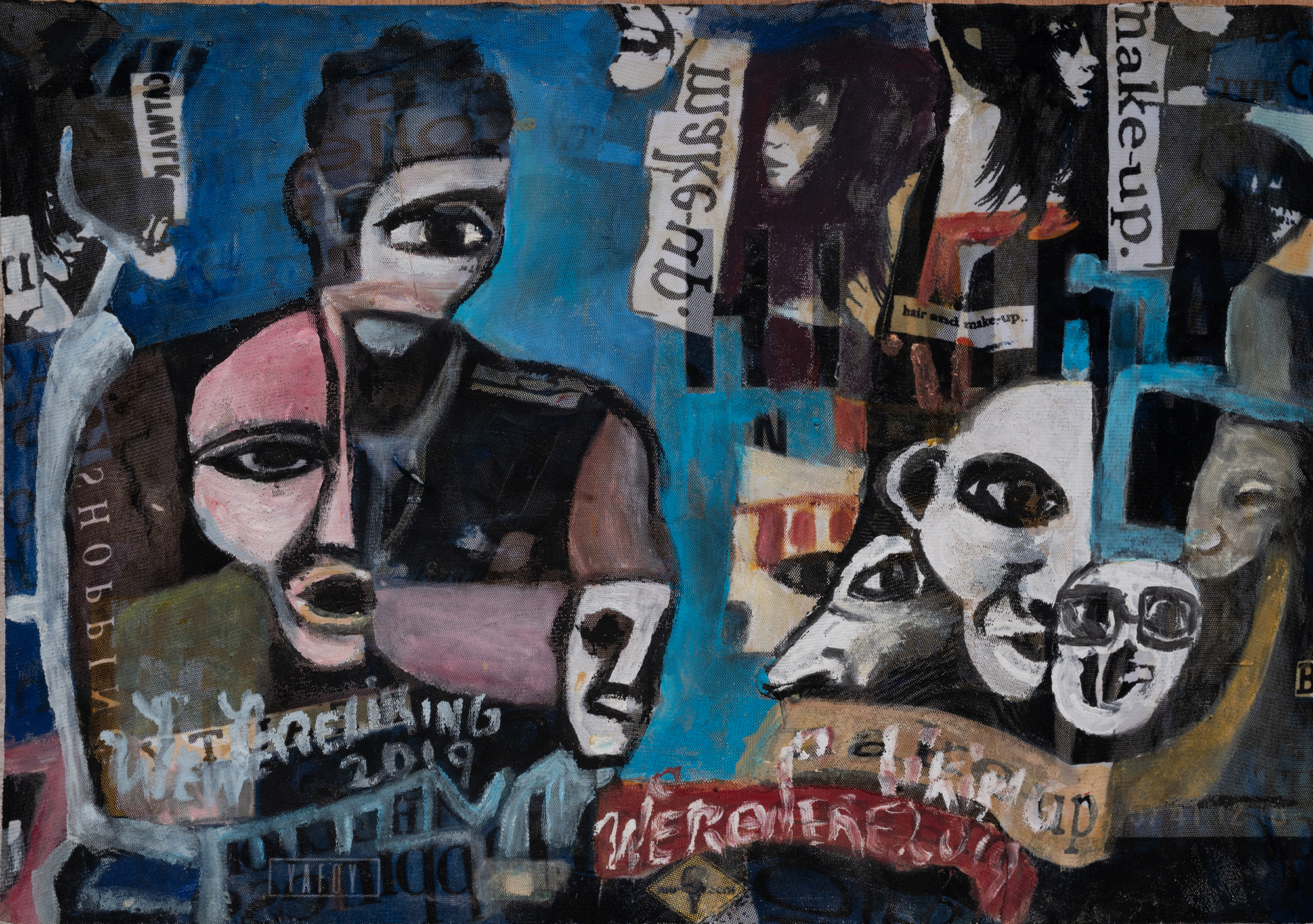
Werewere Liking’s painting Himra (2019) gathers faces at different scales across a blue-black field. On the left, a pink face with a long nose and an open, ochre-ringed mouth overlaps a darker figure. On the right, pale faces crowd around a long-snouted profile. Eyes turn in different directions – some looking towards the viewer, others turned sideways. Fragments of lettering, including the vertically placed word ‘make-up’, interrupt any attempt to read the surface as a continuous scene. My attention moves between faces and words, finding no single viewpoint from which their relationships become clear. Based in Abidjan since 1978, Liking founded in 1985 the Ki-Yi M’Bock theatre company. Its productions combined music, dance and theatrical objects; the initiative grew into a collective creative village supporting the artistic training of young people. Like Tawe’s formative encounters in Tanzania and Toguo’s work between Paris and Bandjoun, her trajectory makes places beyond Cameroon integral to the history presented here.
These international connections do not settle the question of what sustains artistic work within Cameroon. Simon Njami’s essay, ‘Another Country’, criticises the shortage of state structures and public investment while acknowledging private initiatives. He describes Cameroon as an abstraction, yet writes of his attachment to the Bassa language, spoken in Cameroon, and to conversations in Yaoundé and Douala. Uncertainty about national belonging coexists with his insistence that artistic work needs support.
The question of who can actually consult the book is more consequential than the number of places in which it launches. Agborsangaya-Fiteu aims to extend that work through a travelling programme around the anthology. Its initial and limited print-run is priced at €102. Following the London launch at 1-54, further launches are planned for Abidjan, Dakar and Douala. In Paris, a panel at the Also Known As Africa fair was cancelled amid ongoing youth-led protests in France over school spending and living costs.
Agborsangaya-Fiteu says she is in the process of discussing library copies and a workshop series with the Libre Academie des Beaux-Arts (LABA, Free Academy of Fine Arts) in Douala. The proposed programme would bring local artists and student artists together around the anthology. She particularly wants the project to benefit young artists living in Cameroon, who, she argues, have fewer opportunities than their counterparts in the diaspora.
Tawe imagines the anthology being workshopped and revisited, its entries helping young artists identify potential mentors. While at university she mentored students online in Douala, discussing their work and applications without prescribing a single blueprint for an artistic life. She names the composer, writer and musicologist Francis Bebey as someone she wishes she had encountered earlier. His movement between disciplines would have affirmed her own approach, in which sound remains an entry into visual practice. Encountering the history gathered in the anthology earlier would not have made Tawe’s East African influences less hers. It would have given her more work to think with. Its educational promise depends on carrying that work into the libraries and exchanges where young artists can use it.
Achille Tenkiang is a Cameroonian-American poet and writer based in Brooklyn. He is founder and executive director of Baldwin Institute, a nonprofit providing arts and humanities programmes for Black and Brown young people in New York City.