How to engage with art as a communal rather than elitist good
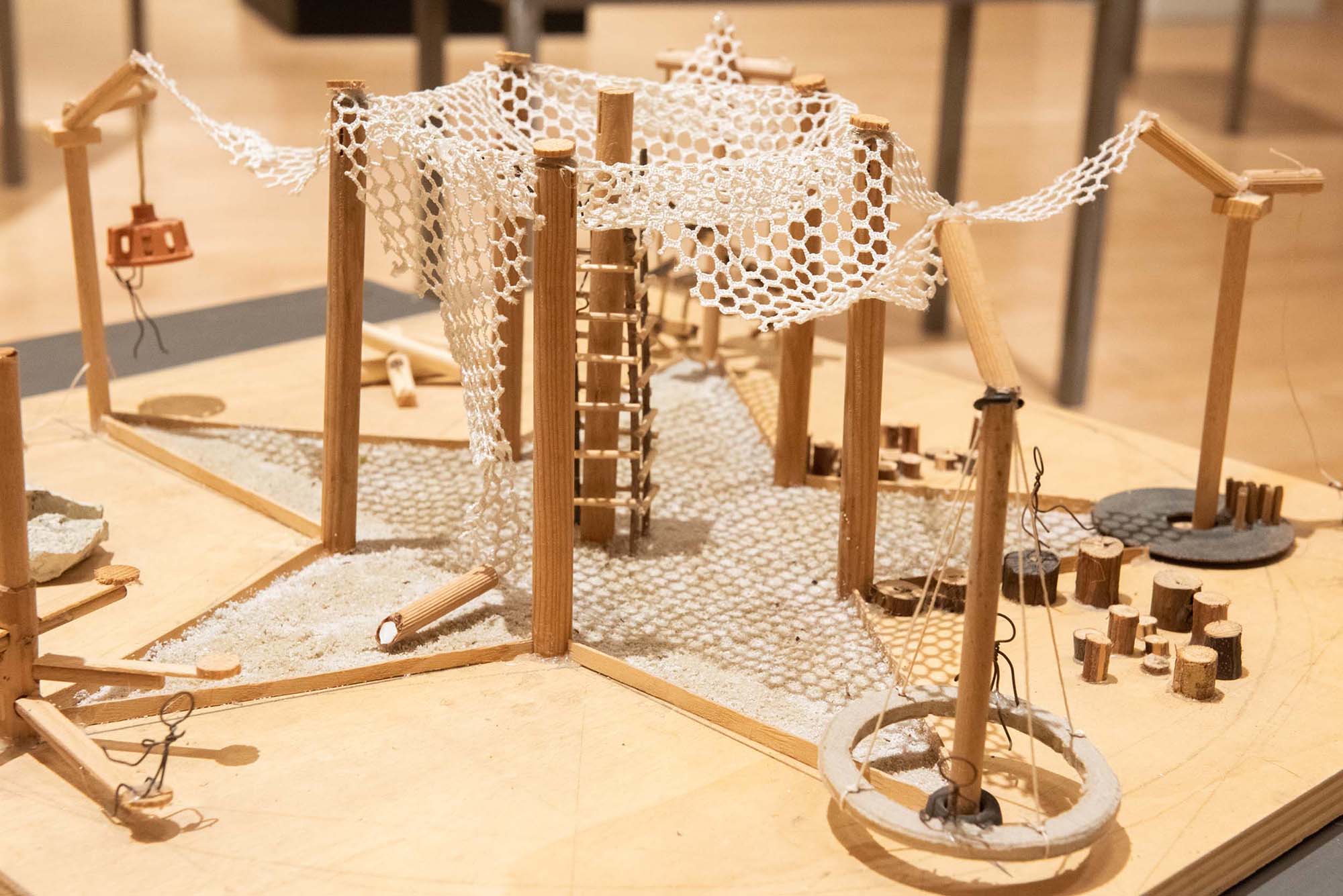
With a tendency for arts institutions in the Global North to publicly claim a politics of care for the global majority, all while extracting from those very communities and propagating exploitative labour practices internally, an initiative like ART for The World has never felt more important. Established in 1996 by curator Adelina von Fürstenberg, the nongovernmental organisation draws on Article 27 of the Universal Declaration of Human Rights, which upholds everyone’s right to culture, the arts and sciences. Resolutely engaging with art as a communal rather than elitist good, Playgrounds & Toys 2000–2025 is both ART for The World’s flagship initiative and a statement of intent, with over 50 artists and architects from across generations and geographies donating designs and models for playgrounds (at 1:15 scale) or toys (at 1:1 scale) based on nonnegotiable instructions drawn up by the NGO, including the use of cheap and readily available materials.
Among the 60+ models and drawings that have been produced across 25 years is Alfredo Jaar’s Nikinu System (2000), a soft home in which children can, as Jaar writes, ‘draw and imagine a better world than the one they’ve been given’. Jaar’s model is among those on display in an exhibition that marks the donation of the project’s collection to the Benaki Museum. Models are installed on a series of uniformly sized tables and a dedicated shelving system in a single gallery. These include Vito Acconci’s Klein Bottle Playground (2000), a transparent climbing frame described as ‘a sphere that unfolds into four tubes’, with each of the latter curving back on itself to form a kind of infinity loop; Maria-Carmen Perlingeiro’s Peace Flag (2000), inviting children to design a flag for peace; Nari Ward’s Hand Nest: A Catch Toy (2000), which invites players to get an egg back into its nest; Sergio Augusto’s Card Game: Memory (2000), of 20 playing cards featuring Augusto’s playful figurative illustrations; Vivan Sundaram’s Jantar Mantar Playground (2002), a spiral of mazes and slides; Liliana Moro’s Play-Head (2003), in which a giant head becomes the frame for a playset; and Alberto Biagetti’s Flying Mandala (2005), a series of interconnected merry-go-round-like cogs that draw on the concentric geometries of a mandala’s universal design.
Many of these playgrounds and toys have been realised across the world, mostly with the support of public institutions, which makes this exhibition an archival presentation as much as a proposal for future works. Each realised project demonstrates how it is possible to take art – and its funding – out of the institution and into the real world. From London, where Pip Horne and Shirazeh Houshiary installed Untitled (2004), a giant cube frame from which yellow fabric strips cascade, at Peckham’s Gloucester Primary School; to Shenzhen, where Chen Zhen’s trampoline Danser la Musique (2009) was installed on Yitian Holiday Plaza in 2009, with another iteration at Hobart’s Museum of Old and New Art in 2013. Images on the walls show these manifestations mentioned and more, like Joseph Kosuth’s Puzzle (2000–03), a blackboard cut into squares on which children can use chalk to draw images before the pieces are mixed up. Photographs show students drawing Donald Duck on Puzzle at Deepalaya School in New Delhi in 2002, where a series of playground designs were fabricated and later donated to the Deepalaya School Orphanage in 2004. Among them is Romi Khosla and Martand Khosla’s Slow Room (2004), a maze of shiftable, interconnected doors, walls and frames; and Edgar Soares’s Goooooaaal!!! (2002), a giant inflatable yellow and red football, with editions commissioned by SESC São Paulo sent to Tanzania, Sierra Leone, Pakistan, Nigeria, Cambodia and Afghanistan.
Installed in one gallery corner, Goooooaaal!!! appears again in photographs of the John Kirakossian School in Yerevan, Armenia, where Andreas Angelidakis curated a scenography that included his own Armenak (2002–04), interlacing concrete walls and steps creating a star, which perfectly complemented Stefano Boccalini’s Random Map (2001–04), an abstracted vision of earth composed of five coloured platforms and basins. Elsewhere, key milestones across Playgrounds & Toys are tracked on a timeline starting with 2001, when artist Maria Papadimitriou, supported by the Greek ministry of culture, fabricated Fabiana de Barros’s Fiteiro Cultural (1998–2003), a gathering place based on informal shacks selling goods in Brazil, in an area of Athens hardest hit by a 1999 earthquake. Amid the documentation, however, one image of von Fürstenberg in 2004 beaming at the children of Deepalaya stands out. This is a curator who has been unwavering in her commitment towards curating for the world rather than herself; who has charted a singular path over decades in an industry where claims of care too often mask the class-based realities of an artworld that can barely hide its contempt for the less fortunate. We need more positions like that.
Playground & Toys 2000–2025 at Benaki Museum / Pireos 138, Athens, 30 October 2025 – 11 January 2026