From Sir John Soane’s Museum and the V&A to Madelon Vriesendorp’s hoarder-lodgings, there’s more than one way to spin your tat
Sir John Soane’s Museum comprises three adjoining Georgian townhouses in Lincoln’s Inns Fields. It was once the home of the architect who gives his name to the institution, and to this day it houses his vast collection of objects, of which some 15,000 are on display to the public. Though perhaps ‘display’ isn’t the right word, given their sheer quantity and dense arrangement: if we assume the museum is c. 1,000 sqm, then that’s 15 objects per sqm.
Today, corporate museum-planners advise an object density of one per sqm. Back-of-the napkin calculations seem to agree: the V&A operates at around that ratio, the Met between 0.5 and 1.35; the British Museum pushes it to around 3.5 objects per sqm. These metrics reveal institutional ideas about objects, curating and meaning: objects should be clearly displayed; because narratives must be evident; and visitors can’t be trusted.
Remember, these institutions have specific ideas about objects, about meaning, and about you. Rooted in the Enlightenment, these (and most other) institutions require that everything be named, everything put in its place. You find echoes of this thinking in London Transport’s current paranoid security mantra: ‘See it. Say it. Sorted.’ Objects in a museum are treated like suspicious devices. Like evidence in a courtroom, a relic in a church, or a specimen in a laboratory. They must be decontaminated, elevated, studied. And handled with care.
This control is an attempt to create and impose narratives onto the world. Narratives that may or may not exist in the chaos of the present, let alone the unmoored past. Of course, ordering and disciplining objects stabilises an object’s physical condition but it does the same to its cultural meaning, which also becomes fixed. This fixing denies objects their intrinsic and independent power to have multiple and shifting meanings. One might even suggest that the surfeit of careful conservation and display conceals an intrinsic museological fear of the objects in their collection. Without discipline, their contents might, like an unruly class, disrupt the didactic authority of the museum.
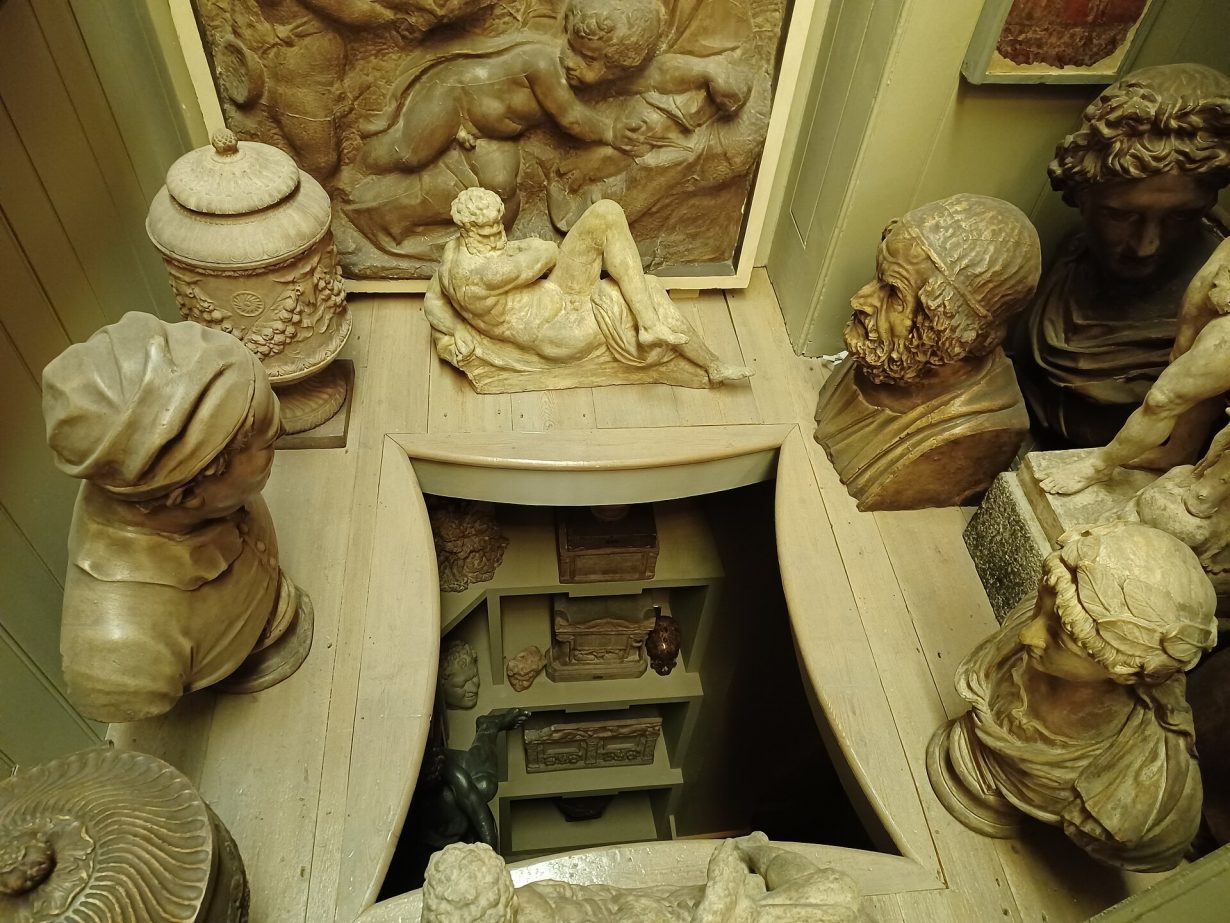
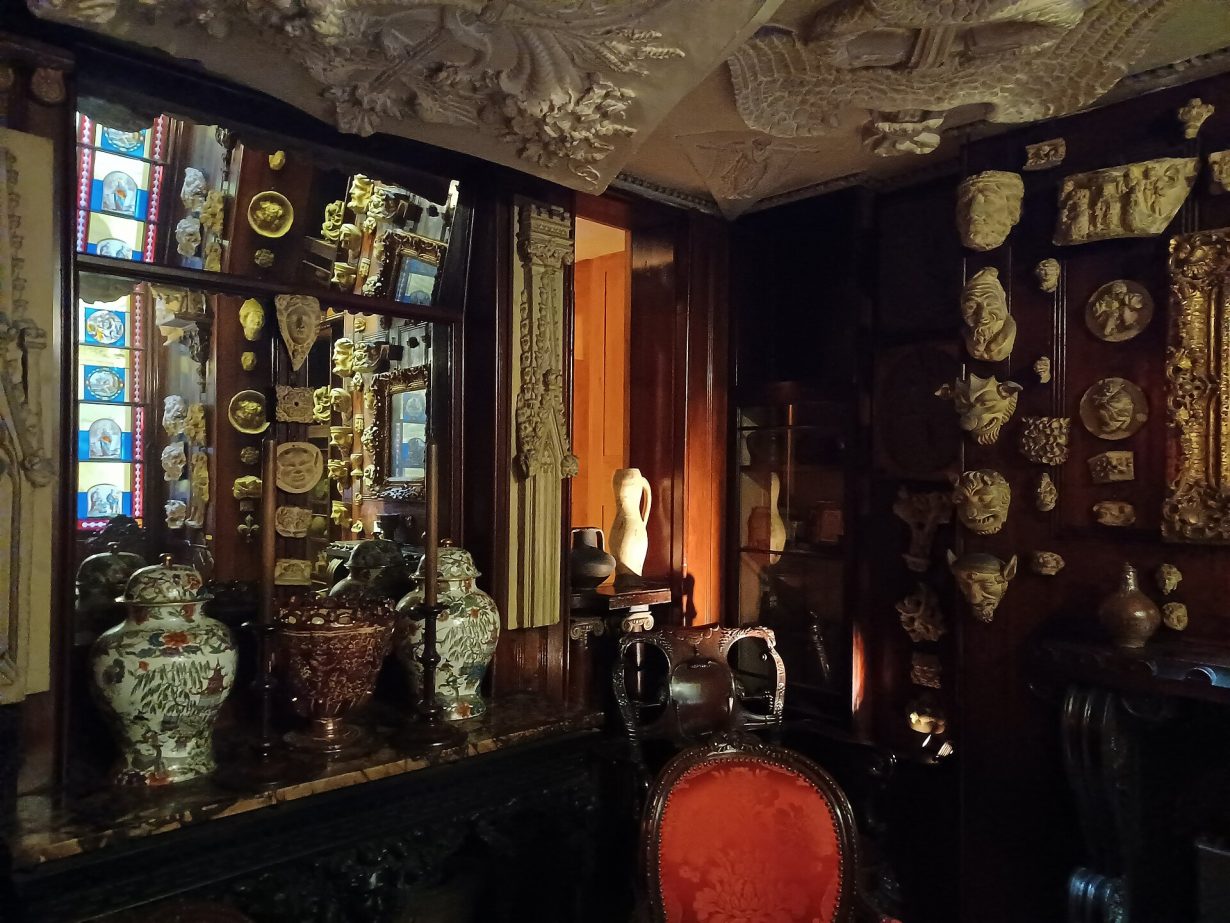
John Soane had other ideas. Lincoln’s Inn Fields is more a domestic wunderkammer than a home. He collected with intensity. Displayed with mania. Rooms, corridors, staircases and lightwells – anywhere essentially – are filled with paintings, architectural fragments, casts, sculptures, furniture, models and antiquities, all jostling for attention, cheek by jowl.
The sarcophagus of Seti I, fragments of the medieval Palace of Westminster, cork models of Pompeii, Paestum, Stonehenge and plaster models of the Pantheon, Erechtheion, temples of Venus at Baalbek and Vesta at Tivoli, a Hindu sculpture of Kamadeva with his mistress riding on a crocodile, a large fossil ammonite, three separate busts of Shakespeare, two bronze Napoleons (and a lock of his hair), a life mask of the actress Sarah Siddons, a death mask of Oliver Cromwell, various capitals, cornices, reliefs, pieces of columns, funerary urns and casts litter the place. And they are joined by models of his own architectural projects, paintings by Canaletto, Turner, Piranesi and Hogarth alongside illustrations of Soane’s work by Joseph Michael Gandy. Indeed, there are so many paintings relative to the available space that Soane invented hinged walls to triple the surface area available for their hanging. All of this mixed up with mirrors, coloured glass and intricate spatial tricks that multiply and mystify. Where the collection ends and the architecture begins is impossible to say; it’s one vast continuum of stuff.
Sometimes, things are so close together that they fuse into new things: the fictional tomb of ‘Padre Giovanni’, the kebablike Pasticcio. Things multiply, evolve, reinvent themselves. Like restless spirits. Unmoored, unruly, unhinged.
There are perhaps only two other places in London like this. The Freud Museum, once the home of the exiled founder of psychoanalysis, whose collection of antiquities filled his consulting rooms. All those gods, animals, vessels, busts, crowded around his desk and that couch, there to create a charged symbolic setting prompting indirect associations. The other is the top-floor London flat of artist Madelon Vriesendorp. Hers too is a house full of souvenirs, but unlike Soane, these are not fruits of a Grand Tour but from the kiosks servicing mass tourism and flea-market stalls. There are armies of souvenir figures, shelves triple-layered with megacities made up of souvenir buildings, a skyline of ancient American juicers on top of her kitchen cabinets. She makes Soane look like a minimalist.
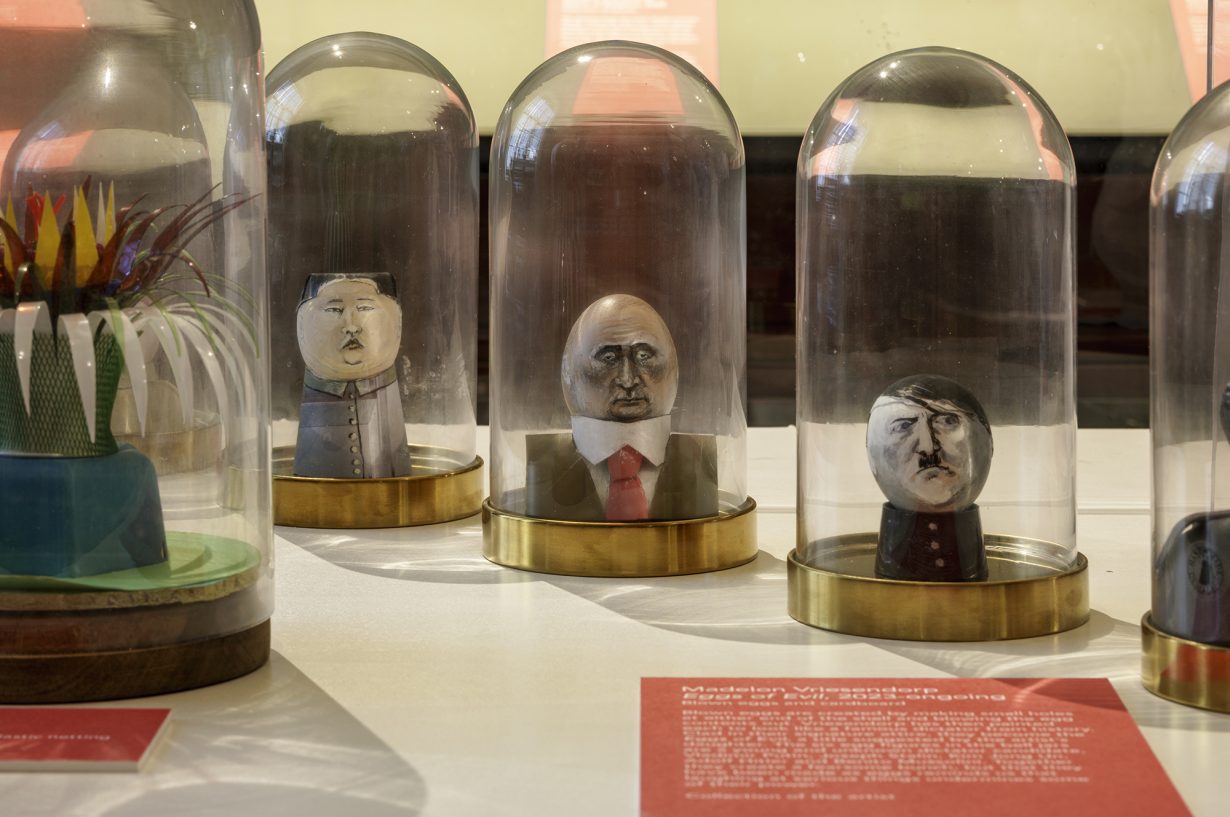
Perhaps it was always inevitable then that Vriesendorp and Soane would finally meet. After awarding her their annual medal recognising her major contribution to the architectural field in 2025, the Sir John Soane’s Museum has now opened Mind Games, a retrospective that presents fragments of Vriesendorp’s long career.
We see, for example, a selection of vintage postcards of Manhattan, culled from markets in New York during the 1970s, when Vriesendorp and Rem Koolhaas were immersing themselves in a paranoid critical reading of Manhattan, the same period when they, along with Elia and Zoe Zenghelis, founded the Office for Metropolitan Architecture (OMA), which has gone on to become one of the most fashionable architectural firms on the planet.
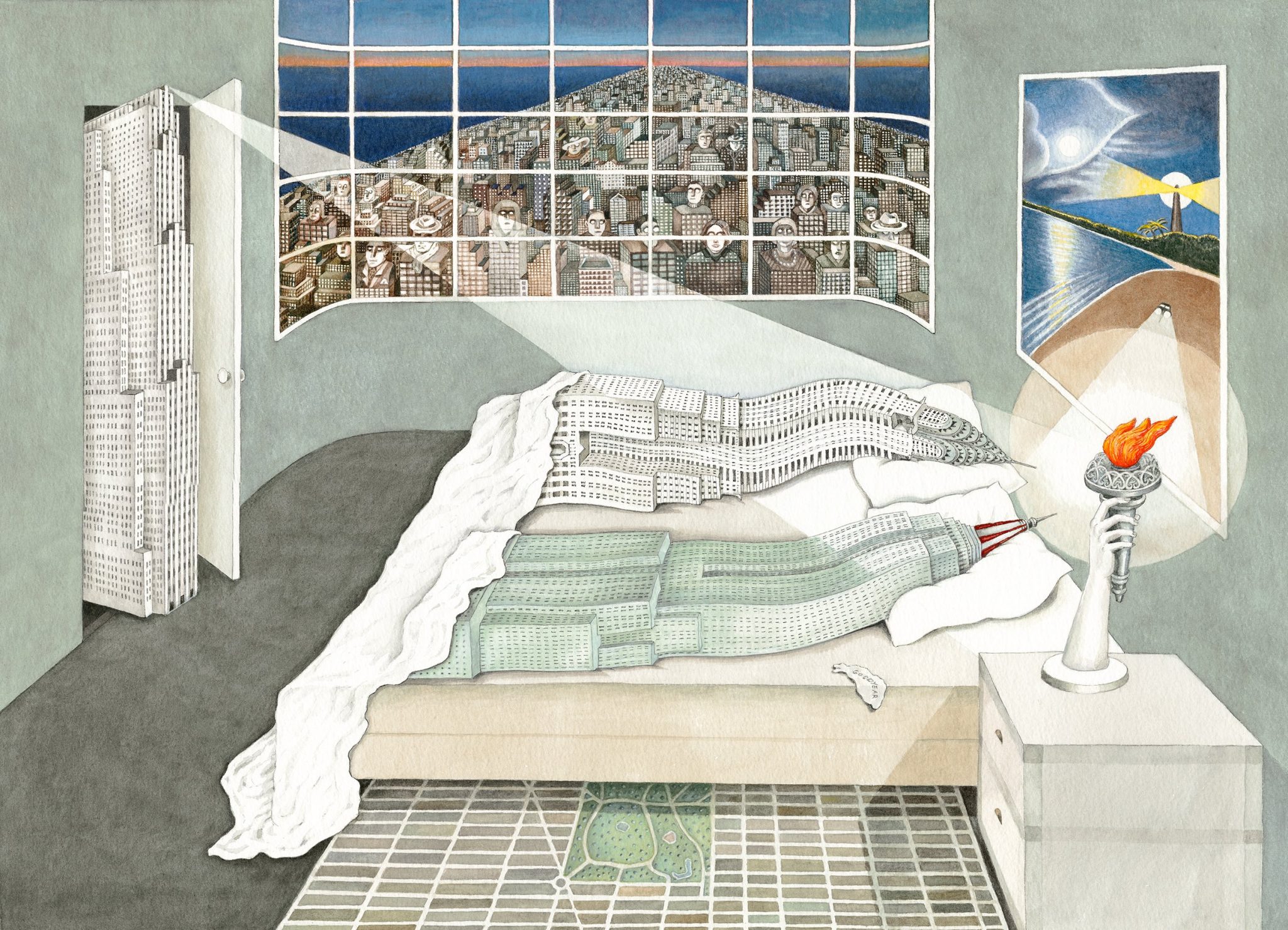
A cabinet shows a sequence of the now-legendary paintings that begin during this period: the Empire State and the Chrysler buildings as lovers in various states of romantic entanglement: sprawled postcoitally on a bed, watched by skyscraper-people, interrupted by the Rockefeller Center, carpets and rugs serving as the Manhattan grid with the Goodyear blimp as a discarded condom. In one, the Statue of Liberty peels off copper panels to reveal her body below: perhaps flesh, perhaps stone. The Statue of Liberty’s recurrence in Vriesendorp’s work might hint at her intense engagement with the cheap, the tacky, the usually disposable, recalling the statue’s inscription: ‘Give me your tired, your poor, your huddled masses yearning to breathe free’. Vriesendorp’s project, her morality even, sees potential in the places ‘serious’ architecture never looks.
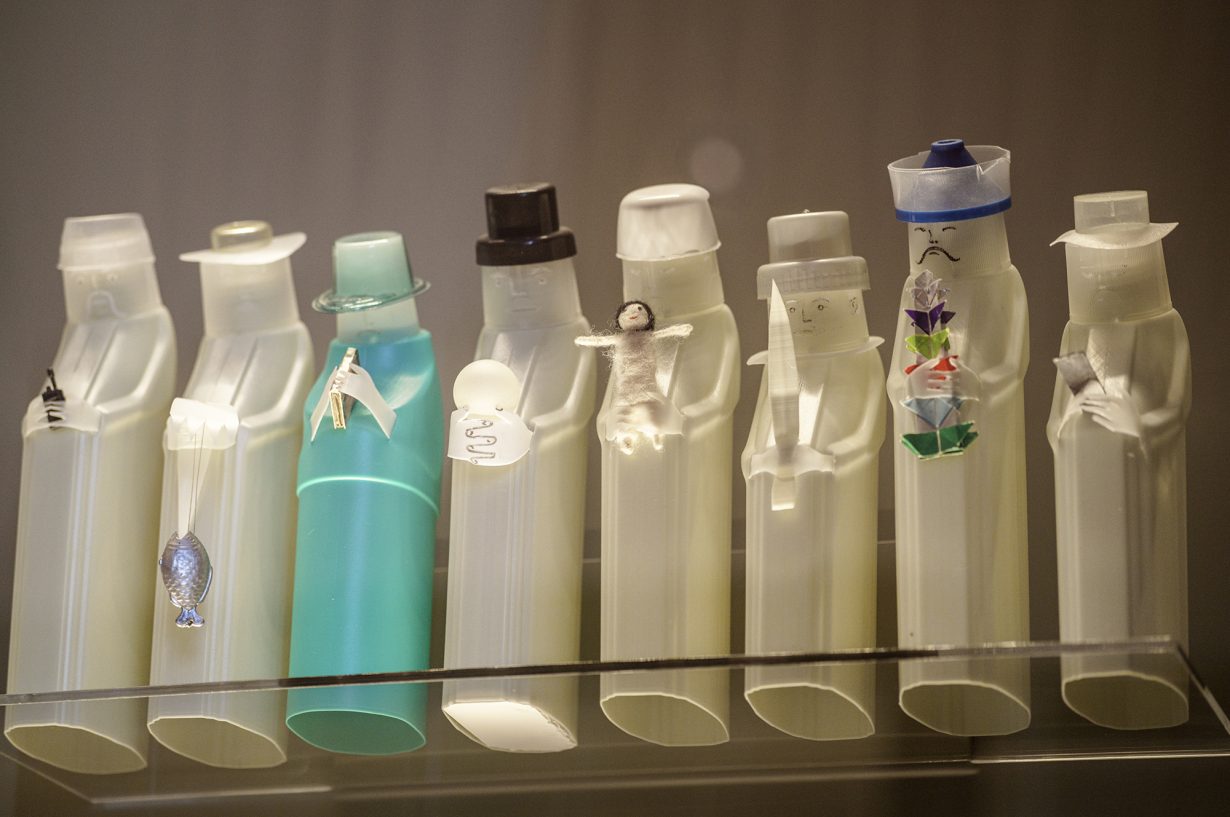
We see it in her collections – shown here via large-format photography – that elevate cheapness to something approaching pathos. It’s there in other objects in the show: everyday polyethylene milk cartons transformed into swans; plastic bottles becoming flowers; roll-on deodorant balls threaded into necklaces. Things, in Vriesendorp’s world just as in Soane’s and Freud’s, are not what they first appear to be. Not the end of an idea, frozen into form, but the launchpad for a thousand possibilities.
Read next The Museum in Crisis