The investigative Italian website Open says it has emails between the presidents’ office of the Venice Biennale and the organisers of the Russian pavilion.
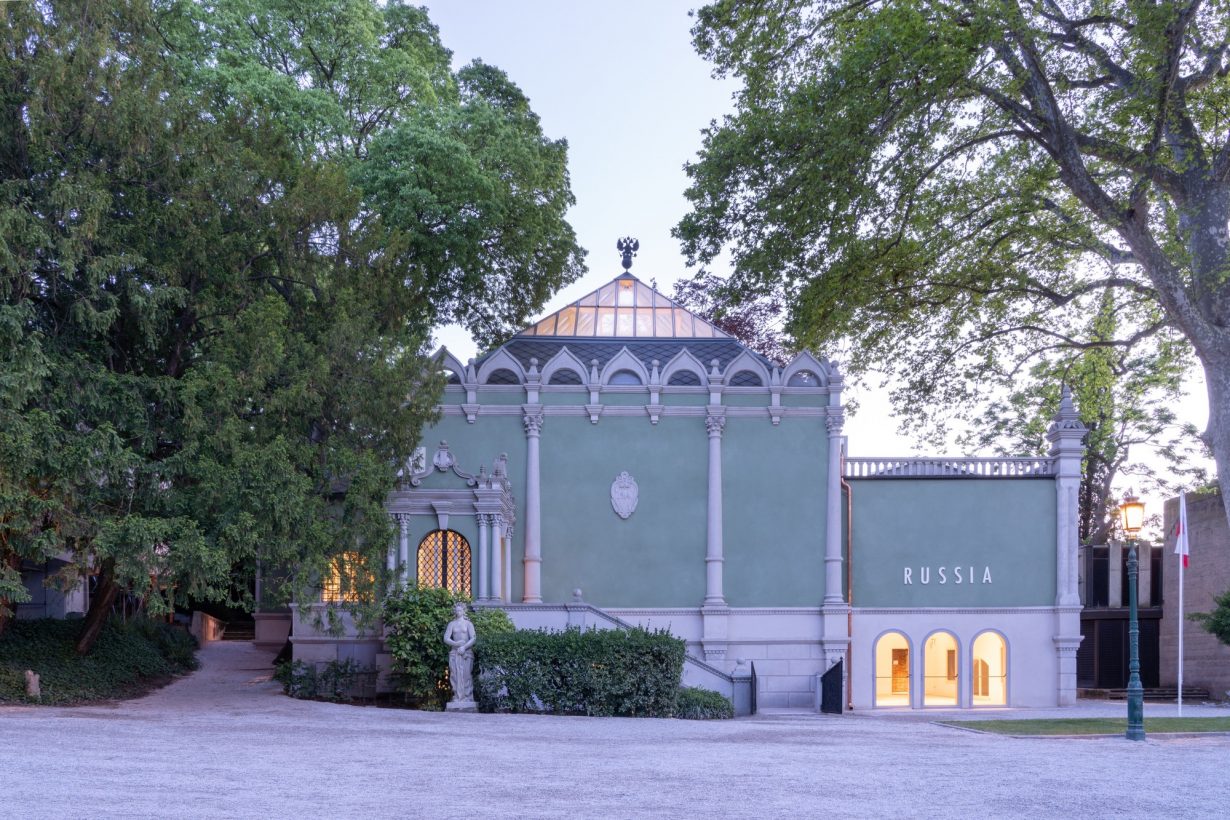
The published correspondence suggests that the Russian pavilion will only be accessible for the preview days of the exhibition – as a means of abiding by sanctions placed on Russian state entities. During these days – when only arts professionals and press are allowed into the Giardini and their passes are provided complimentary – Russia will stage a series of performances. These will then be broadcast on a loop on a screen visible from the outside of the pavilion for the rest of the exhibition.
The commissioner of the Russian Pavilion, Anastasia Karneeva, also requested for help with visas for approximately fifty artists and pavilion staff, suggesting they were having problems gaining approval: ‘We are experiencing many problems with visa issuance and need an invitation letter to obtain a multiple-entry visa,’ Karneeva writes.
Karneeva is the daughter of Nikolai Volobuev, the deputy CEO of Rostec, Russia’s largest state-owned defense company, and runs an art consultancy company with Ekaterina Vinokurova, the daughter of Russian Foreign Minister Sergey Lavrov.
The newspaper Il Giornale carries a response from the Biennale stating that it acted ‘in strict compliance with applicable national and international laws and within the limits of its own powers and responsibilities. No prohibition of the European sanctions was “circumvented”… the sanctions were rigorously applied.’
Russia has been absent from the show since 2022, but on its own volition. It has a permanent exhibition space in the Giardini, so it is unclear how much power the Biennale Foundation has to deny it access to the building. As it currently stands, ‘Any country recognized by the Italian Republic may ask independently to participate.’
Russia’s proposed pavilion exhibition is titled The Tree is Rooted in the Sky. Some 38 participants from Russia, as well as Argentina, Brazil, Mali and Mexico, will be present.
Last week the European Union said it will cut its €2 million (£1.74m) grant to the Venice Biennale following the return of Russia to the exhibition, though the Biennale has 30 days to defend itself against the cut, and has previously indicated it will do so.
Read next The Politics of Russia’s Return to the Venice Biennale