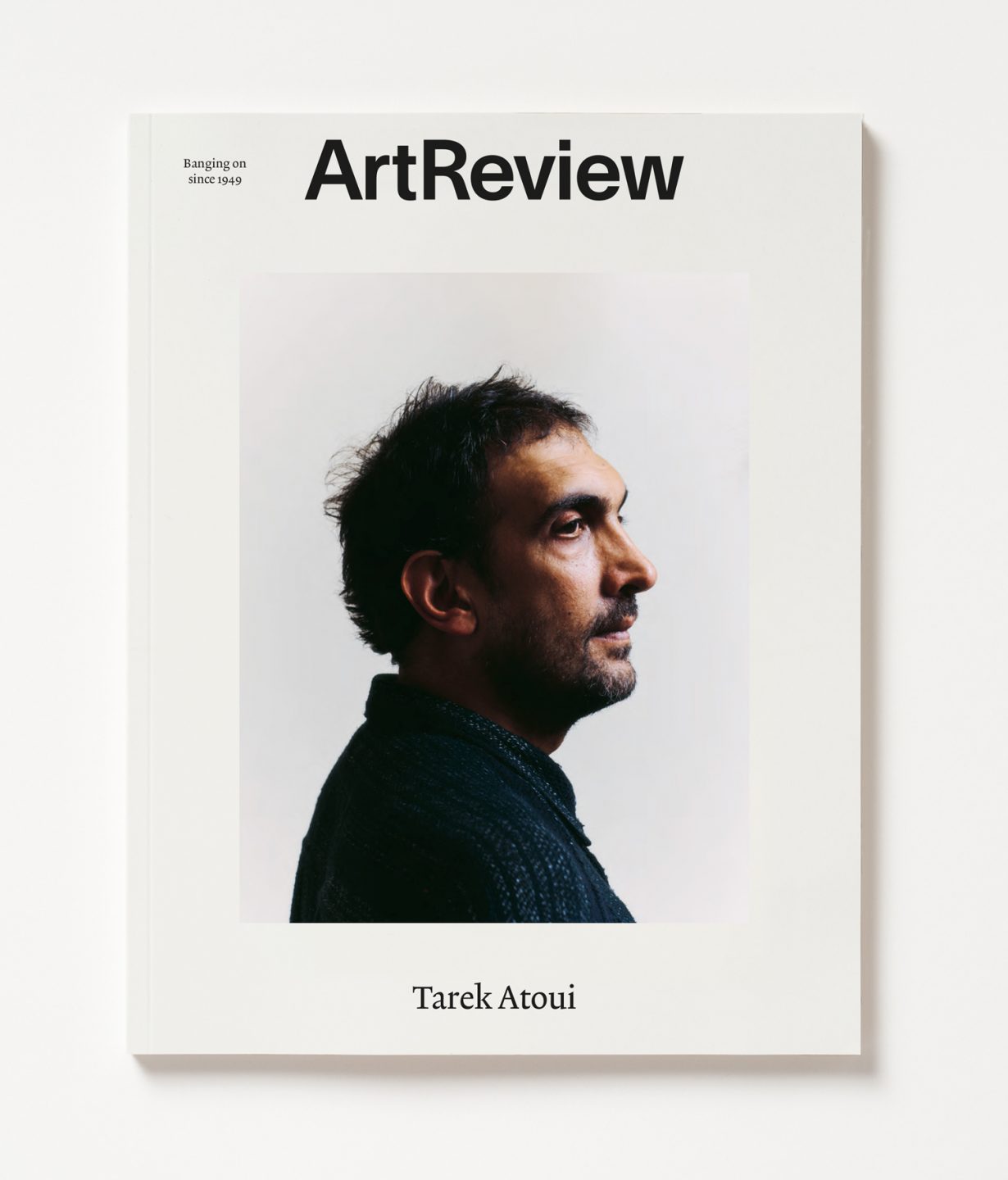
***Subscribe now or get your copy from our online shop***
The French theorist Gaston Bachelard once wrote about the extent to which people come to resemble the space they inhabit. And vice versa. Visiting the Paris studio of Tarek Atoui, Patrick Langley finds it to be ‘a fitting metaphor for [his] practice as a whole: a sonic laboratory in which different materials, instruments, digital processes and people are brought together in ephemeral ensembles’. The Lebanese artist and composer, who this month creates a new, largescale work to fill Tate Modern’s Turbine Hall in London, creates experimental instruments – some so large you can step inside them, stones that vibrate when you sit on them, bowls of water that transmit compositions to the listener when they submerge their hands – to explore listening as an active process that can alter our awareness of bodies, spaces and environments, and highlight the connections among them. Connections of the type about which Bachelard once wrote.
It’s connections and the lack of them that writer Shaunak Mahbubani explores as they discuss the forces of attraction and repulsion in Salman Toor’s paintings, which test and probe the thresholds (real and imagined) that shape the queer and migrant experience. At its most literal, this is made manifest in a body of works that foreground the bodies of immigrants at airport checkpoints. In other instances, such as recent Fag Puddle works, the threshold takes on an ‘amorphous form’, writes Mahbubani, ‘shapeshifting into a portal, collapsing into a puddle’, depicting contradictory energies that both embody ‘the comfortable safety of the cuddle puddle’ and a limpness emblematic of resignation, ‘reminiscent of the fatigue that queer, racialised, migrant and other nonhegemonic bodies carry when navigating a social structure that considers them an outsider’.
Elsewhere, Sheila Hicks looks back on her 70-year career investigating the possibilities of textiles and colour, and grills interviewer and fellow artist Dan Coopey on what he’s wearing. Hicks herself reveals how she considers making and doing to be ways of thinking about the world around her: seeing how others make and use textiles, how somebody ties their shoelaces, the particular scarf and jacket combination of a passerby or how a sock might begin to break and unravel through wear are all deeply embedded within her sculpture.
Also in this issue, on the centenary of the British writer’s birth, Jenny Wu finds common ground between John Berger and Émile Zola; Ilaria Maria Sala finds an antidote to AI in a recreation of Umberto Eco’s personal library in Bologna; Zoe Whitfield looks at a recent spate of films that tackle ageing, dementia and the right to control your own life; Mitch Speed wonders if time has been unkind to Charles Ray’s sculptures; and, in a galaxy far, far away, Desirae Embree feels the force (or lack of it) in George Lucas’s new museum in LA: you’ll have to work out to what extant Bachelard’s theories can be applied to that. Plus, reviews from exhibitions around the world, including Berlin, Athens, Copenhagen, Shenzhen and Mexico City, and of books by Róisín Tapponi, Ben Eastham and Lawrence Kramer.
Plus, free with this issue, a special supplement looking at philanthropy today.
***Subscribe now or get your copy from our online shop***


