The temptation is to decode these figures politically, psychologically or biographically, but Oototol’s visions remain stubbornly opaque
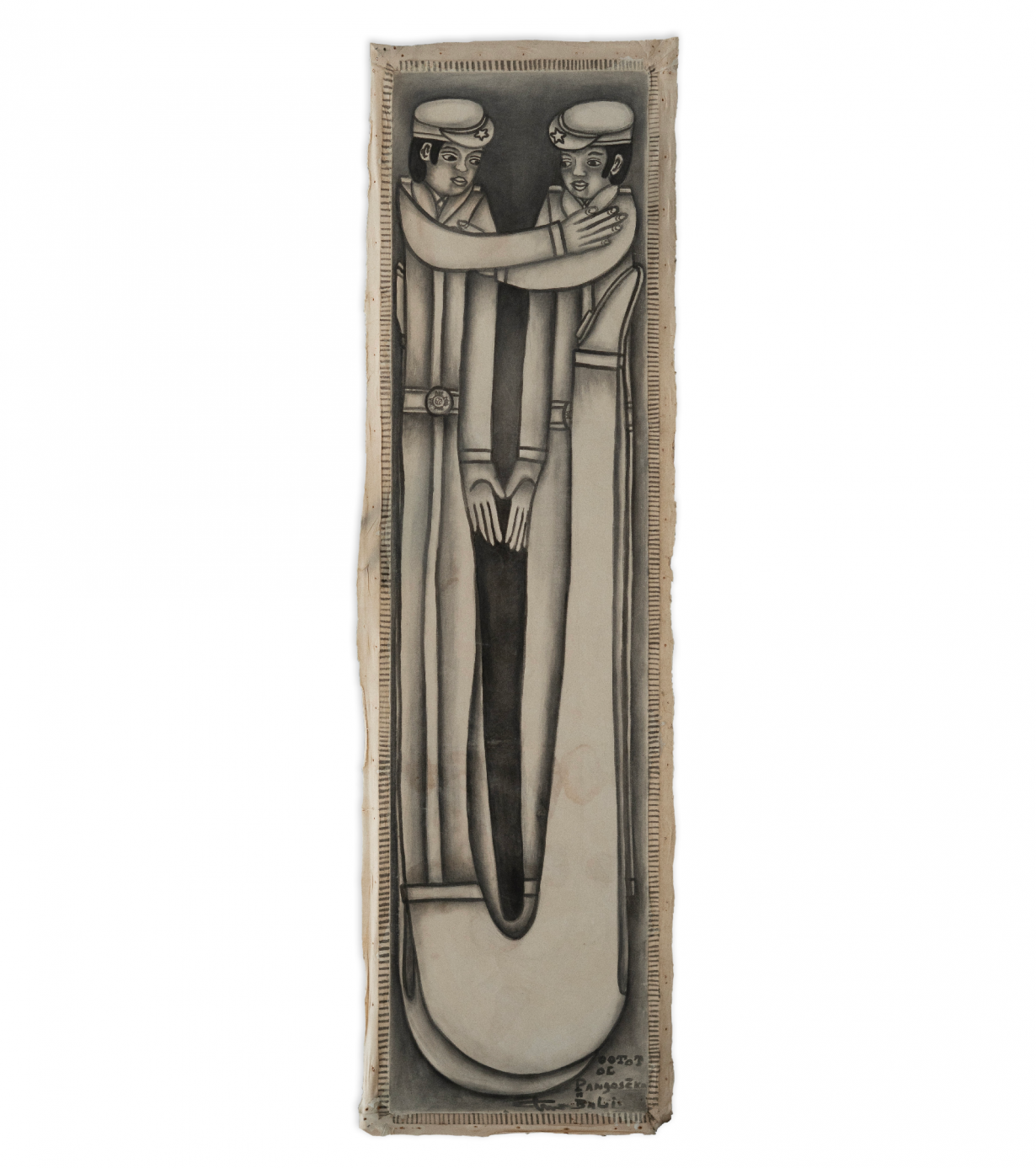
Soldiers appear throughout the work of the late Balinese artist Oototol with obsessive frequency. Rendered in flat Chinese ink, these cloned characters wear single-breasted military jackets and peci caps, recalling the iconic style of Indonesia’s first president, Sukarno. They march, surf, kiss, play music and self-fellate. Elsewhere, they mutate in all directions – made female, with exposed breasts, or hybridised with animals, their limbs stretching into snakes. In one work, which seems to explain the origin of this loopy universe, a soldier gives birth to a smaller uniformed version of themself.
These singular visions have established Oototol, born Dewa Raram, as a unique figure in recent Indonesian art history. Closely associated with the loose collective MuMoToMo during the 1990s – which included I Gusti Ayu Kadek Murniasih (Murni), Dewa Putu Mokoh and Edmondo Zanolini – his work is often discussed in relation to theirs. Now, however, his own reputation is rising (posthumously), with solo exhibitions opening in Japan, Indonesia and the United States. The Jakarta presentation is the most extensive, unfolding across ROH Projects and Komunitas Salihara, and showcases the inventiveness with which Oototol manipulates his subject. In Oototol’s works, there is a dynamic contrast between the outsiderish rigidity of their subject matter and the surprisingly wide range of references that inform them, from the flattened forms of traditional Balinese Kamasan painting to the stylings of postindependence Indonesian militarism. The soldier becomes a container for Oototol’s fantasies – though whether these repetitions arise from reverence, parody or some more private obsession remains impossible to tell.
The Komunitas Salihara venue, themed around modes of transport, presents Oototol’s playful side. Here are the artist’s curious renderings of trucks, planes, trains and improbable hybrid vehicles travelling through hallucinatory terrain. Following Oototol’s wishes – and departing from previous curatorial framings of his work – all the works are left untitled and undated. Seventeen monochrome paintings are arranged around a circular gallery, while the walls are painted in different blocks of colour, resulting in a preschool palette that slightly oversalts the artist’s oddball aesthetic. Still, the works remain affably trippy. In one, a few men surf atop perfectly round surfboards. In another, two female soldiers hover above unicycles. There is also an enormous 11-metre painting depicting alternating side profiles of male and female military figures, curving in an endless procession around the gallery walls.
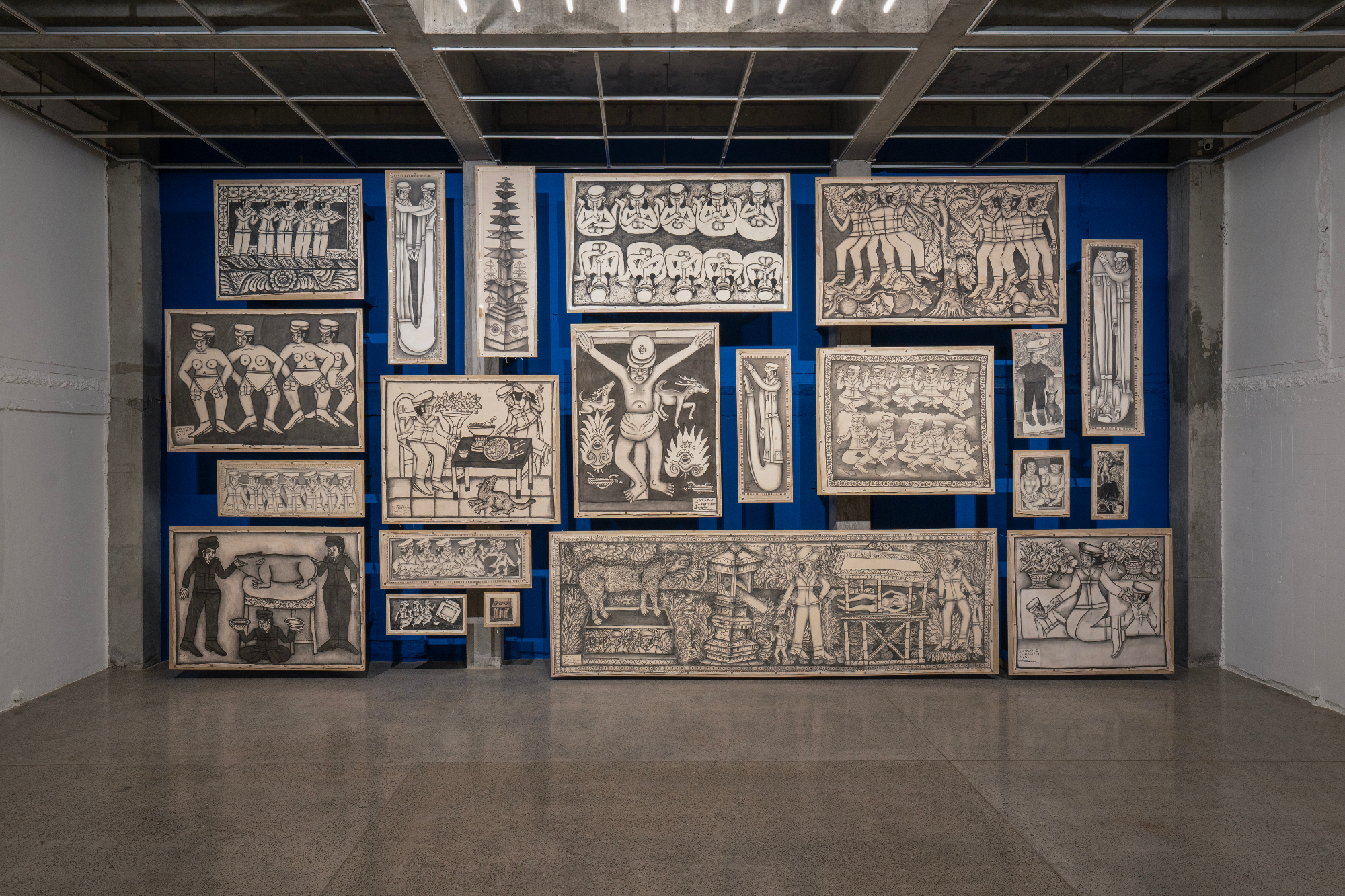
Over at ROH, things take a more adult turn – though Oototol’s works are explicit without ever becoming erotic, due to the flat affect of the matching faces and the mechanical depiction of sex and genitalia. Most of the paintings are installed in a dense salon-hang extending from floor to ceiling. At the centre is a large crucifixion scene featuring a topless, behatted soldier nailed to the cross. Surrounding it are more fantastical tableaux: soldiers fused together like conjoined triplets; military men extending thin, cigarettelike tongues towards one another with the tentative intimacy of ET touching fingers with his child host; rows of figures doubled over, casually sucking their own dicks as nonchalantly as musicians playing recorders.
It has often been argued, in attempts to stabilise Oototol’s work within the familiar language of academic discourse, that the artist subverted rigid masculine archetypes within Indonesian military identity, queering the nationalist imagery associated with the Sukarno era. By this measure, the works still resonate today, as militarism remains deeply embedded in Indonesia – from Suharto’s 32-year New Order dictatorship to current president Prabowo’s expansion of military involvement within civilian government. Yet the political critique feels less obvious here. The power of the soldier image in Oototol’s imagination is undeniable, but these fluid and superhuman visions seem to operate on another libidinous plane altogether, where reverence slips into parody and vice versa. The temptation is to decode these figures politically, psychologically or biographically. But Oototol’s visions remain stubbornly opaque – less like symbols than compulsions, animated by a private logic that resists interpretation yet continually draws viewers back into its strange orbit.
Oototol: Warna Hidup, ROH Projects and Komunitas Salihara, Jakarta, 7 March – 3 May
From the Summer 2026 issue of ArtReview Asia – get your copy.