The political and erotic charge in these rarely exhibited largescale works feels newly legible
Under the military dictatorship of Suharto from 1967 to 1998, artists in Indonesia built a livelihood painting kitschy pastiches of idealised landscapes for the tourist gaze. The late Dewa Raram, an illiterate, self-taught Balinese artist better known as Oototol, charted a stranger course. His monochrome ink paintings of uniformed soldiers engaging in various activities – made in the early years of the post-1998 reform era and in the long shadow of his country’s twentieth-century traumas – present a personal vision of exuberant life in a rigid society. He died in 2008, having rarely publicly exhibited these works, which were mainly reserved for the viewing pleasure of his colleagues in Pengosekan Village, a community of self-trained artists. Read against his homeland’s more recent neoliberal reforms and democratic backsliding, the political and erotic charge in these largescale works feels newly legible.
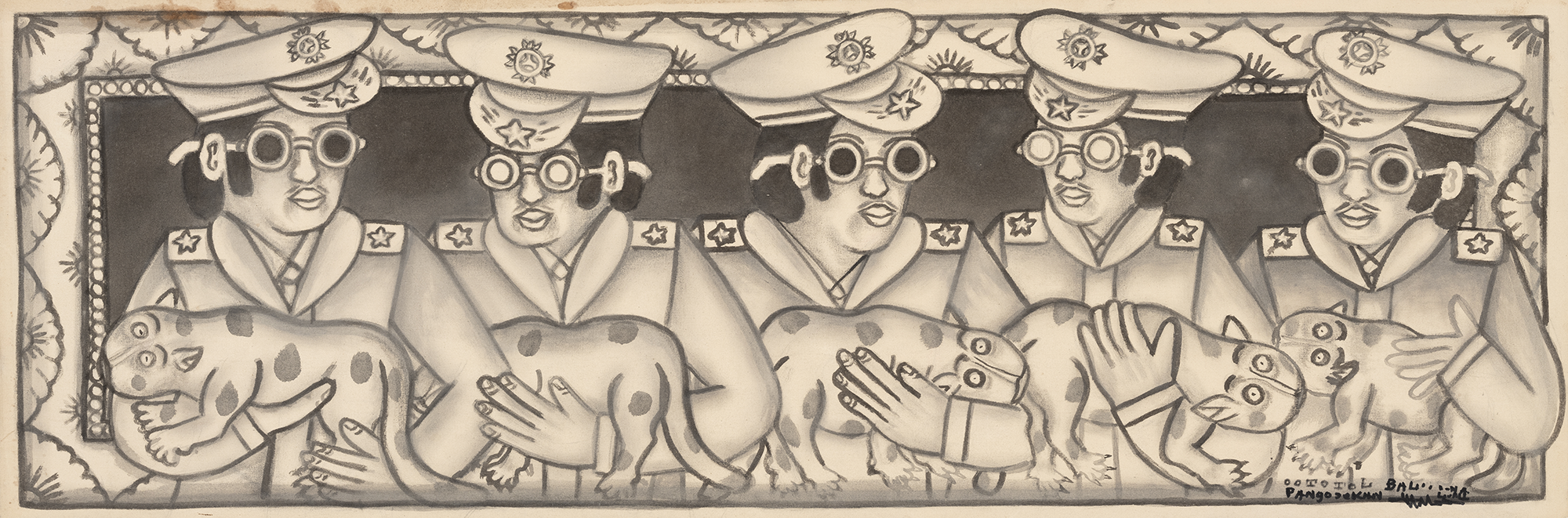
The artist’s studio attire – peci cap, sunglasses, starred epaulettes, seen here in documentary photographs – was nearly identical to the signature kit of Sukarno, Indonesia’s first president (later overthrown by Suharto), and might be seen as a kind of political drag or private protest. On the gallery’s first floor, Untitled (Figures with Sunglasses and Cats) (c. 2002) multiplies Oototol-as-Sukarno into a frieze of five. Each officer, framed against a curtainlike backdrop, cradles a spotted cat against his breast. The hard surface of the state, bemedalled, bespectacled, is undone by the soft, wide-eyed, faintly ridiculous felines. The painting’s self-conscious theatricality feminises authority and parodies masculinity. Consequently, the officers with their tough accessories appear rather closeted.
Untitled (Stacked Figures) (c. 2004) trades the horizontal drill formation for a vertical column of officers, hands and feet jutting at every angle, each man’s body braced against the body beneath. The very picture of discipline collapses into a tangle of limbs that recall the rugby scrum, the cheerleading pyramid, the wrestler’s hold. In Untitled (Seated Figures) (c. 2004) three standing officers touch the heads of three seated ones. Between benediction, examination, grooming and induction, their gestures are indecipherable, and it is precisely this ambiguity that queers and politicises the painting.
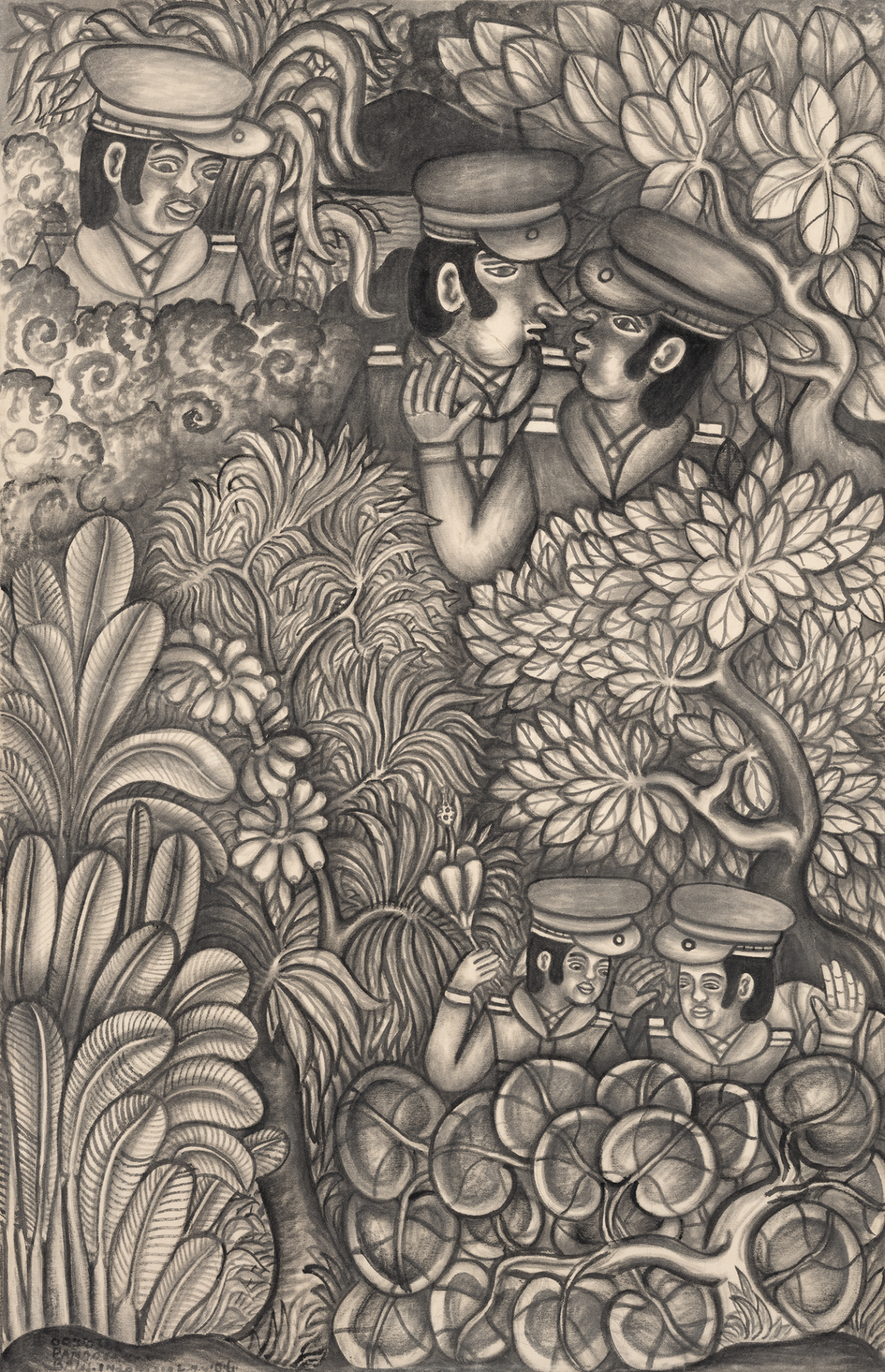
Untitled (Kissing Frogs) (c. 2003) shows two officers in profile puckering their lips at one another; above them, two cap-wearing frogs mirror their kiss, intimating, perhaps, that queer desire and love exist as part of, rather than deviations from, nature. Untitled (Kissing Figures) (c. 2006) tucks a couple into the centre of a canopy of intricately rendered foliage, witnessed by a third figure half-hidden in the greenery, while, in the bottom right of the canvas, a soldier plucks a flower, likely as a token of affection for his uniformed companion. One cannot but wonder if Oototol’s affinity for painting men in groups rather than in pairs was a necessary alibi in his tight-knit Balinese society, where queer life must exist discreetly. Alas, the works resist biographical speculation.
The third floor presents a bestiary and scenes of leisure where the soldier’s authority is consistently outscaled, outridden and outplayed. Untitled (Riding Crocodiles) (c. 2002) sets two clumsy, struggling officers astride reptilian beasts – reminiscent of the mystical sea creature that the Hindu goddess Ganga rides – that race across a flatly incised sea. The scene refuses to resolve as either religious cosmography or modern hedonism. In Untitled (Figures with Elephants) (c. 2005), officers stand either side of elephants resembling the divine Supratika (a legendary elephant associated with royal warfare), their palms raised as if in surrender. In a country whose military still holds political influence, Oototol’s soldiers – caring towards animals and towards each other – are fitting subjects in which to smuggle queer subtext. No match for the inherited mythic war machine, however, his army stands dwarfed by the very symbol of its own origins, delighting, instead of fighting, in the homosocial pastoral.
Oototol is on view at Fort Gansevoort, New York through 19 June
From the Summer 2026 issue of ArtReview – get your copy.