A new museum dedicated to the late Tang Chang lays the groundwork for a comprehensive understanding of the artist’s life and career
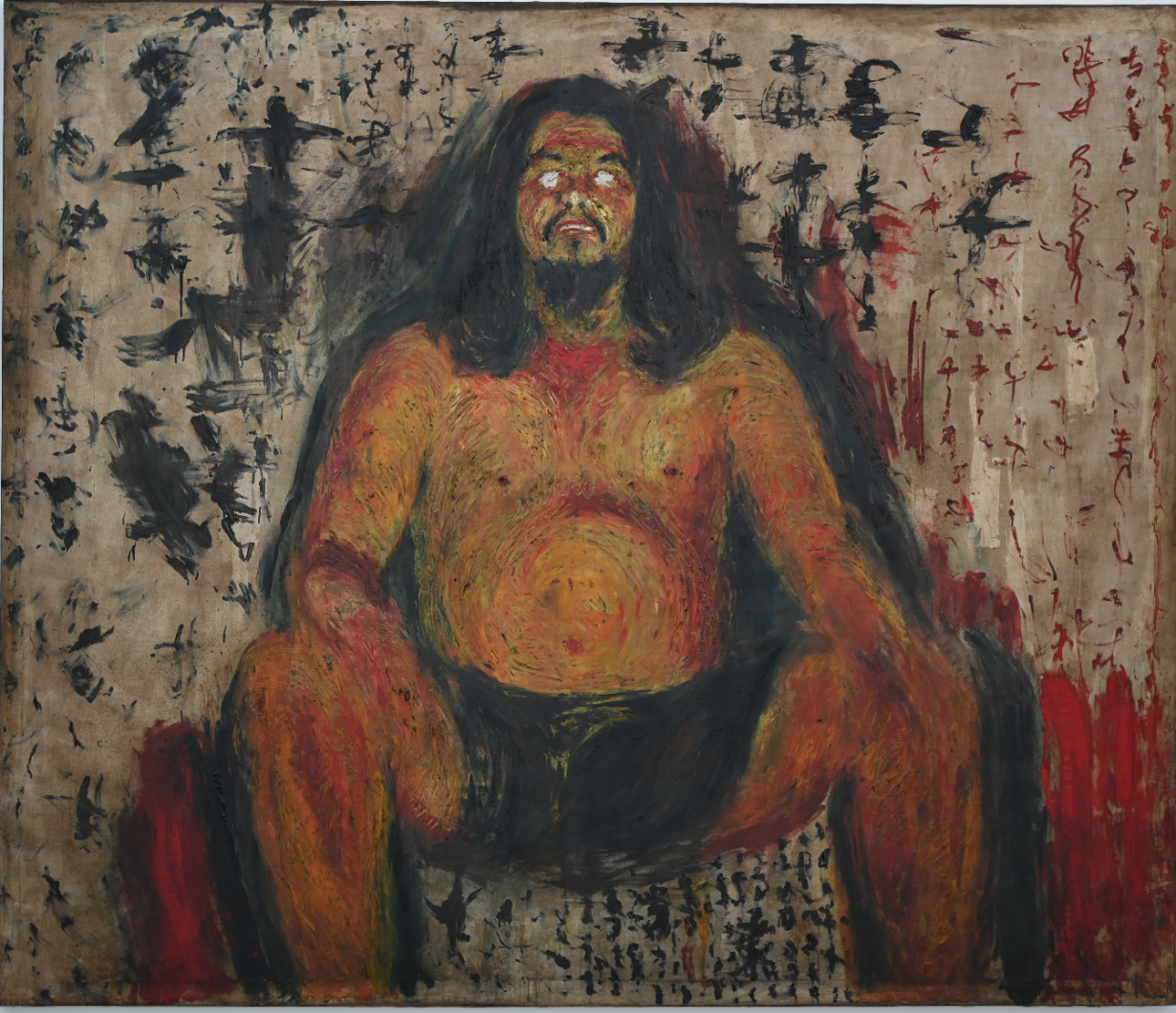
Much is uncertain about the legacy of the late Tang Chang – a poet-painter in Thailand between the 1950s and 80s – but one thing is clear: 14 October (1973) is an unforgettable painting. Upon its two-by-two-metre surface, the hirsute Chang, chest bare, legs akimbo, looks at us with hollowed-out eyes and scrubbed out hands. Hovering around him are swirls of inky black patterns that seem to owe their contours to Chinese script but that break down into watery swashes of unintelligibility, chaos.
At Reframing Modernism, a 2016 exhibition at the National Gallery Singapore, 14 October appeared alongside works by Picasso and some of Chang’s far-flung Southeast Asian contemporaries. But at this new family-run private museum, located west of Bangkok and containing nearly his entire oeuvre (around 8,000 works), this enigmatic response to the popular uprising and military crackdown of 14 October 1973 – a period during which he was aghast to witness Thais slaughtering Thais – now finds itself in very different company. Framing its central position in a warehouse are walls lined with smaller self-portraits in calligraphic and semi-abstract styles; Chang is corpulent, vividly lifelike in some, and in others he distils himself to a couple of thick, urgent brush strokes. More such self-portraits are on display around the corner, including a hyperrealistic earlier one, dated 1954, in which he looks like a different person entirely: a dapper, fresh-faced young man; someone who has yet to encounter pain or find his true calling.
A Bangkok-born child of Chinese immigrants, Chang had no formal training, never left Thailand, and never reached the hallowed status of National Artist. In his lifetime – during which he opened a portrait shop in his early twenties and then went on to become an avowedly non-commercial painter largely guided by Taoism, Buddhism and his Chinese ethnicity – his works barely travelled or registered abroad. Yet scholars are increasingly arguing for his posthumous recognition, and this inaugural exhibition offers many moments that hint at Chang’s virtuosity, temperament and local impact.
The opening section centres his humble origins as a copyist. Charcoal portraits, including one of King Chulalongkorn garbed in a Western-style suit, are presented alongside the photographs that the artist used as references. On the wall opposite are early examples of what came next, once he had tired of churning out figurative paintings on a commission basis: ink drawings on paper (all untitled, 1958). Their repeating squiggles hover somewhere between cursive Chinese, or perhaps Thai, script and image. Then come larger works that fuse this calligraphic inclination with action painting: monochromatic canvases caked with viscous marine paint, upon which we can discern the sweep of his hand, the impasto marks left by his fingers. In the second warehouse, the self-portraits (a smattering from the over 400 he created) are bookended by what a wall text terms his ‘return to nature’: wildly experimental figurative paintings drawing on daily life (the alleys and peri-urban landscapes of his neighbourhood) and produced throughout the 1980s – the decade when his health failed him but his spirit, evidently, remained strong. Rendered in severe lines and vivacious colours, the world ardently depicted here, Chang’s world, is on the verge of being out of focus, and sometimes scarred by repeating shapes redolent of language.
Structurally, this monographic survey is conventional. But given that the recent international exhibitions and scholarship preceding it have, in an attempt to pluck Chang from obscurity, privileged certain facets of his career (namely those works deemed assimilable within the global history of abstraction or concrete poetry) and produced a certain essentialism and mythology (ie positioned him as a ‘perennial nonconformist’, ‘outsider’, ‘firebrand’ or ‘misfit’), a broad-brush show encompassing his entire career feels like necessary groundwork.
Some themes are only lightly touched on: his political activism, his fascination with Chinese art and philosophy, his facility with experimental poems (he produced books and canvases full of them, but only an undated handwritten example, Life, appears here). However, the exhibition includes archival materials – such as a satirical 1972 cartoon drawing of a rotund, unkempt Chang from Thairath newspaper, and a TV documentary in which he describes the act of mixing paint as meditation – that add flesh to the persona, reveal him to have been, by the 1970s, a public figure, albeit a fringe one who saw painting as an extension of Buddhist Dhamma practice. The result is a show that not only sketches the contours of his practice, the stylistic and material diversity found throughout it, and the bounteous use of colour at its beginning and its end, but also, pivotally, situates him within his Thai milieu – something most recent attempts by scholars to canonise him have neglected to do.
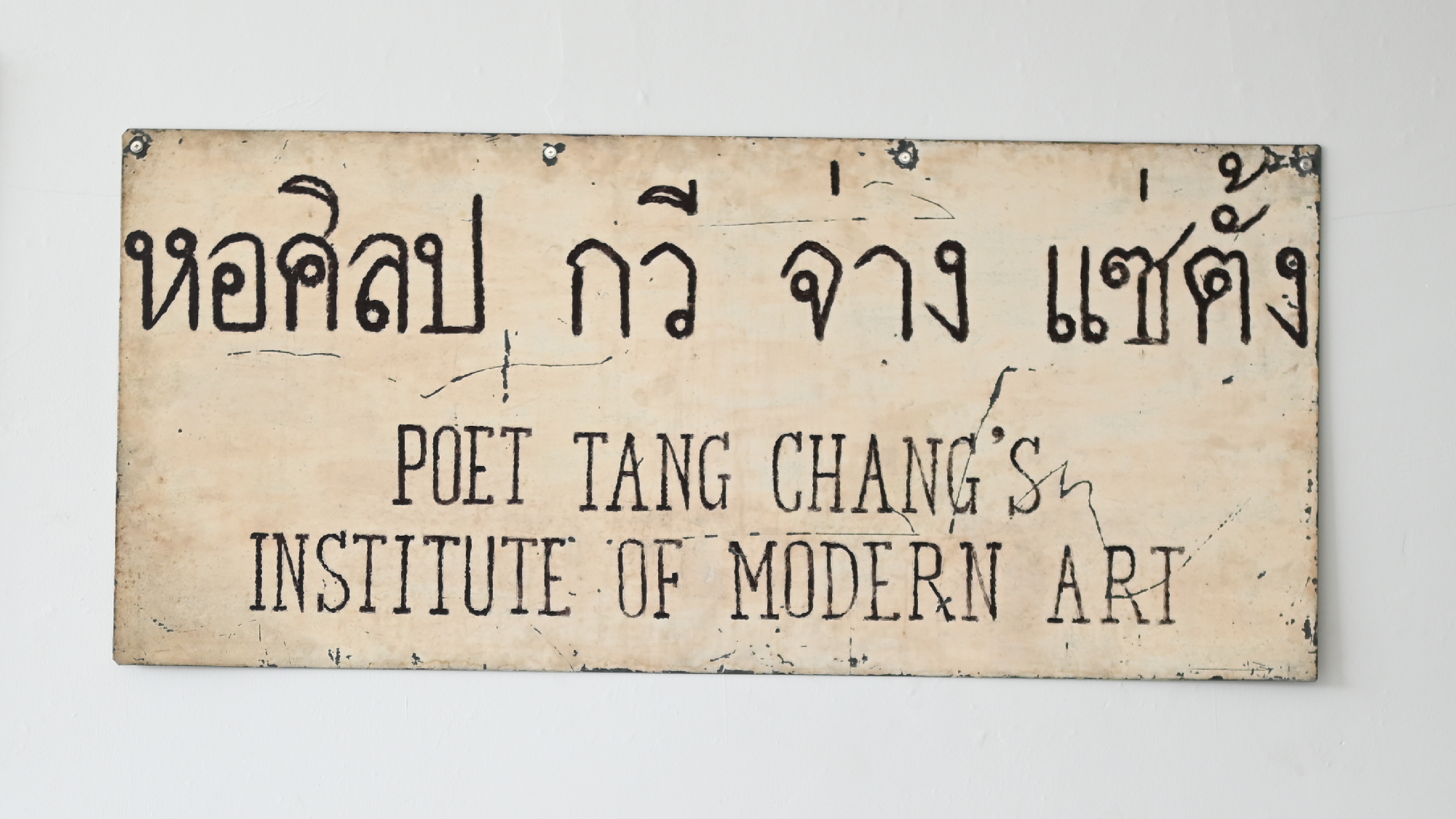
Back at the beginning of the show, a bilingual sign from his long-gone home-studio – which reads ‘Poet Tang Chang’s Institute of Modern Art’ – hangs near a vitrine of old photos and handwritten flyers. Far from being a hovel where he wallowed in obscurity, Chang’s ‘institute’ was, these paratexts prove, a grassroots venue for sharing and learning, a gathering point for students and artists of a similarly antiestablishment bent. Here, Chang painted in pursuit of an inner spiritual wisdom unswayed by commerce or profit (a career path/lifestyle decision that he funded by selling flowers, helping his wife at flea markets and producing homemade instant chrysanthemum tea, according to one academic paper), although he clearly also personified an authenticity, a form of errant modernism, that others were drawn to – and, judging from the strong aura of this introduction to him and his art, still are.
Poet Tang Chang’s Institute of Modern Art is on view at The Tang Chang Private Museum, Nakhon Pathom, through 30 April 2027
From the Summer 2026 issue of ArtReview Asia – get your copy.