The art of Mongolian Tuguldur Yondonjamts appears to amplify the voices of the landscape around him, but might more simply be an encouragement for us to listen
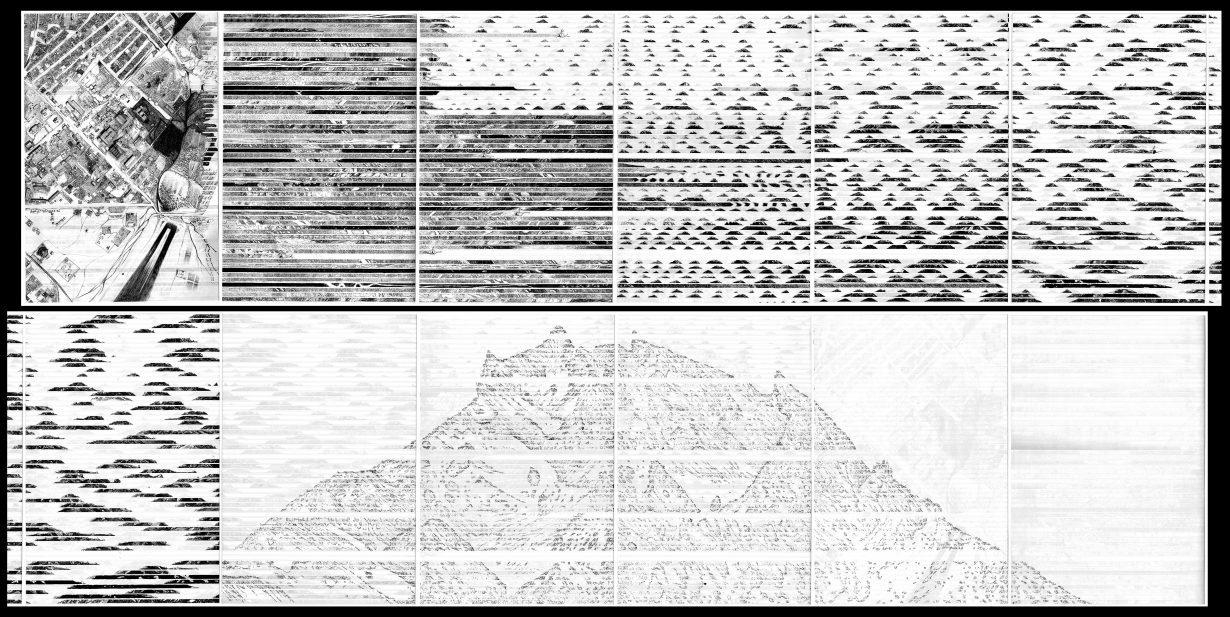
When Mongolian artist Tuguldur Yondonjamts set about exploring the habitat of the saker falcon during the early 2010s, he had in mind a kind of role-play. While taking in the vastness of the country’s steppes, he tried to imagine how this blindingly fast bird of prey with staggering visual acuity might do the same. Then, back in his studio, he used an ink pen and paper to picture the saker falcon’s way of seeing as perceived by him. The laborious outcome: four books representing his fieldwork in the north, south, east and west of his homeland, each unfolding accordion-style to reveal drawings plotted along lines resembling strips of enlarged 8mm film.
Were the viewer permitted to handle The Secret Mountain of Falcons (2011–14), its components might unfold like a flipbook animation – its visual data would rush past to form an illusion of motion – but at Wolf Loving Princess, Yondonjamts’s recent solo exhibition at Gallery Ver in Bangkok, they were presented in Perspex vitrines, like codices from Antiquity. Circling these sense diaries, certain qualities became apparent: the intensity of the imagery running along each strip, some of which resembles a black-and-white film recording of a mountain range framed from afar, and some of which resembles a closeup of an organic texture, or a meaningless scribble. And how these uncanny drawings – or charts of visual data – alternate with, or fade to, empty space.
Thematically, they float somewhere between social commentary and arcane cross-species mystery. In 2012 the saker falcon was designated the national bird of Mongolia by the government, largely in response to public anxieties about its declining population. Yondonjamts’s interest in its fate, which predates this designation, was spurred by a practice that contributes (alongside electrocution of birds that perch on power lines) to its dwindling numbers: the falcon trade, particularly to the Middle East. “There were 240 falcons officially exported in 2010 from Mongolia to Saudi Arabia for diplomatic reasons. I used to know a friend who was trapping them using pigeons, so I went to the places where the birds were captured,” the artist says, speaking from his studio in the capital, Ulaanbaatar. But while these books “manifest what the falcons see in the last seconds in Mongolia before they are captured”, the story they immortalise “isn’t super sad”, he emphasises. “Typically, female birds are captured because they are stronger and better at hunting than the male birds, and after years of training and using them to hunt desert prey, they are released. Some may stay in the Middle East; others migrate back.” For him, these ‘falcon drawings’ relate to issues of mapping and memory, and operate in the realm of phenomenology and human-animal intersubjectivity. “In a way, they’re about trying to connect with different species by walking the same landscape – trying rather than accomplishing,” he said during a 2024 talk.
Yondonjamts trained in Mongol zurag painting, a style of early-twentieth-century Mongolian painting defined by its flattened perspective, pastoral nomadic (or nationalistic) scenes and bright mineral colours on cotton. Then he studied under German conceptual artist Lothar Baumgarten at the Berlin University of the Arts. But it was the methodology forged in the making of The Secret Mountain of Falcons that has most emphatically shaped his practice. Grounded in observation, mimesis and translation, his works hint at the epistemic complexity, or qualia, of animal’s inner lives. In his visual language, something of what it is like to be a falcon, or another animal in his purview, is articulated, often through an elaborate process of aesthetic transmutation or recoding. As Rirkrit Tiravanija, curator of Wolf Loving Princess (and Yondonjamts’s mentor during his MFA at Columbia University, New York), writes in a statement accompanying the show that ‘his speech opens us to the path of spirits and sentients we have long neglected. It isn’t about reading, it’s about listening.’
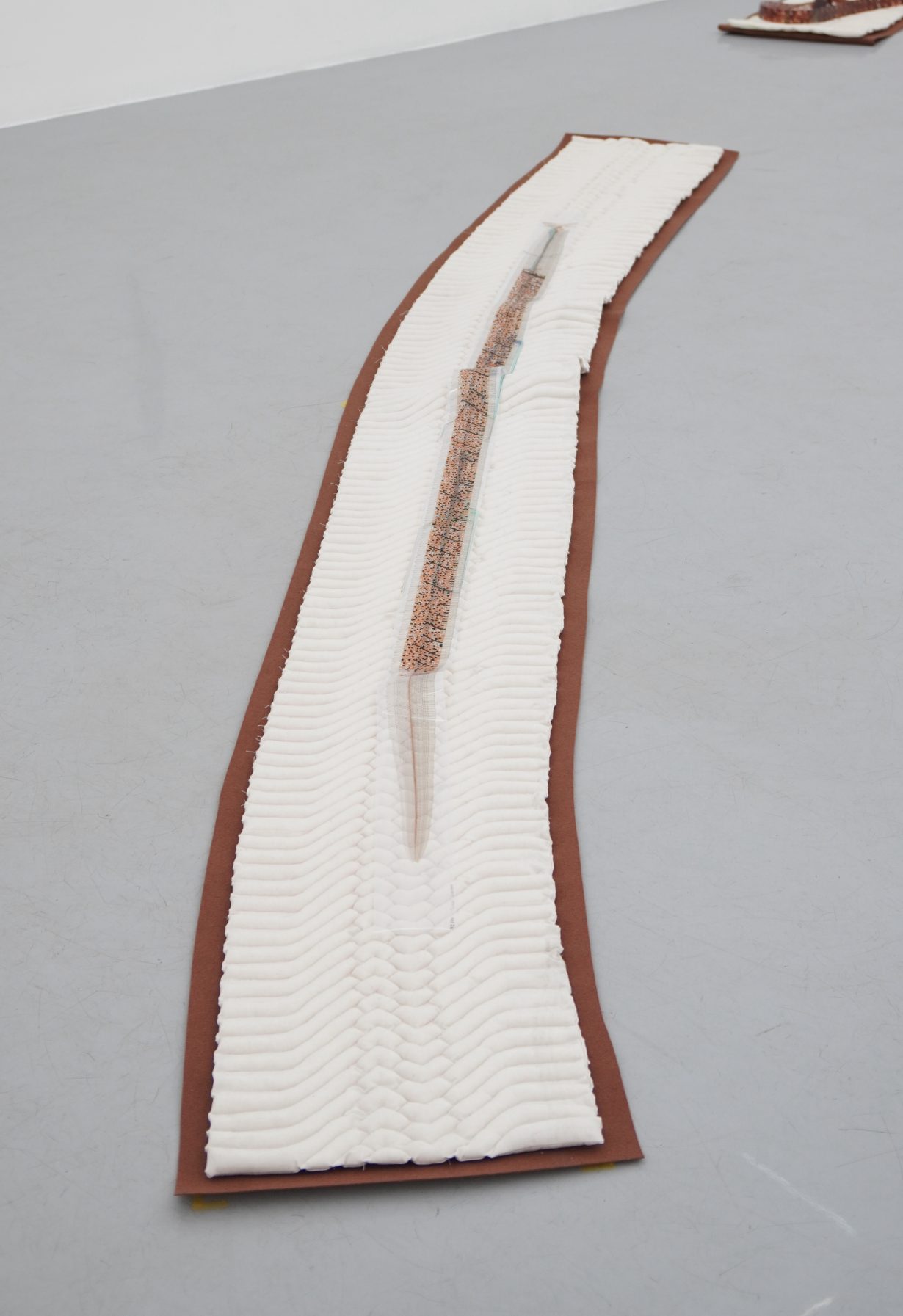
At this exhibition – a shadowy landscape of objects, drawings and text – it wasn’t clear what exactly we were listening to, although it certainly felt like a portal into an animalistic realm, or a cabalistic mapping of creaturely data. Among its highlights were three snakeskins drawn on strips of translucent Mylar (Serpent writing…, 2026), each patterned with pointillist scales derived from natural pigments. Written in English and Mongolian Cyrillic on the walls nearby were poems sprinkled with gnomic references to animals – from ‘crocodile tattoos’ to the titular ‘wolf loving princess’ – and lists where a flowing script, likely traditional Mongolian, appeared alongside numbers and the English equivalent, from ‘snail eye’ to ‘bird on the branch’. Dreams, myths and memories blurred in this space, and the maker appeared to be a type of obsessive sleuth: fixated on deciphering the language and systems of meaning possessed by all living things.
To approach Yondonjamts’s art through the lens of the animal world is one temptation. This urge is especially strong given that many of his videos and installations feature, as a key visual or performance element, what he calls an ‘antipode suit’, each of which is fashioned in the shape of a creature – a serpent, mosquito, extinct crocodile, etc – and more resembles a voluminous sleeping bag, or shed skin, than a suit. But there is also, given his capacity for turning journeys into forms and performing acts of transformation, the temptation to apply labels: namely, the artist as nomad, and the artist as shaman.
However, as Hermione Spriggs and Rebecca Empson caution in Five Heads (Tavan Tolgoi): Art, Anthropology and Mongol Futurism (2018) – a book accompanying the 2018 exhibition of the same name – these are ‘generalising tropes within the context of Mongolia’, which a ‘persistent Western imaginary’ still frames or envisions as ‘a bastion for timeless nomadic mobility’, despite the ‘chaotic forces of transition’ being experienced in the country. In their view, art by the likes of Yondonjamts is more akin to an antenna that tilts ‘towards the forcefully exposed timelines of deep-earth geology, the lighter surface movements of cyclical migration and the supernatural histories and futures of myth’.
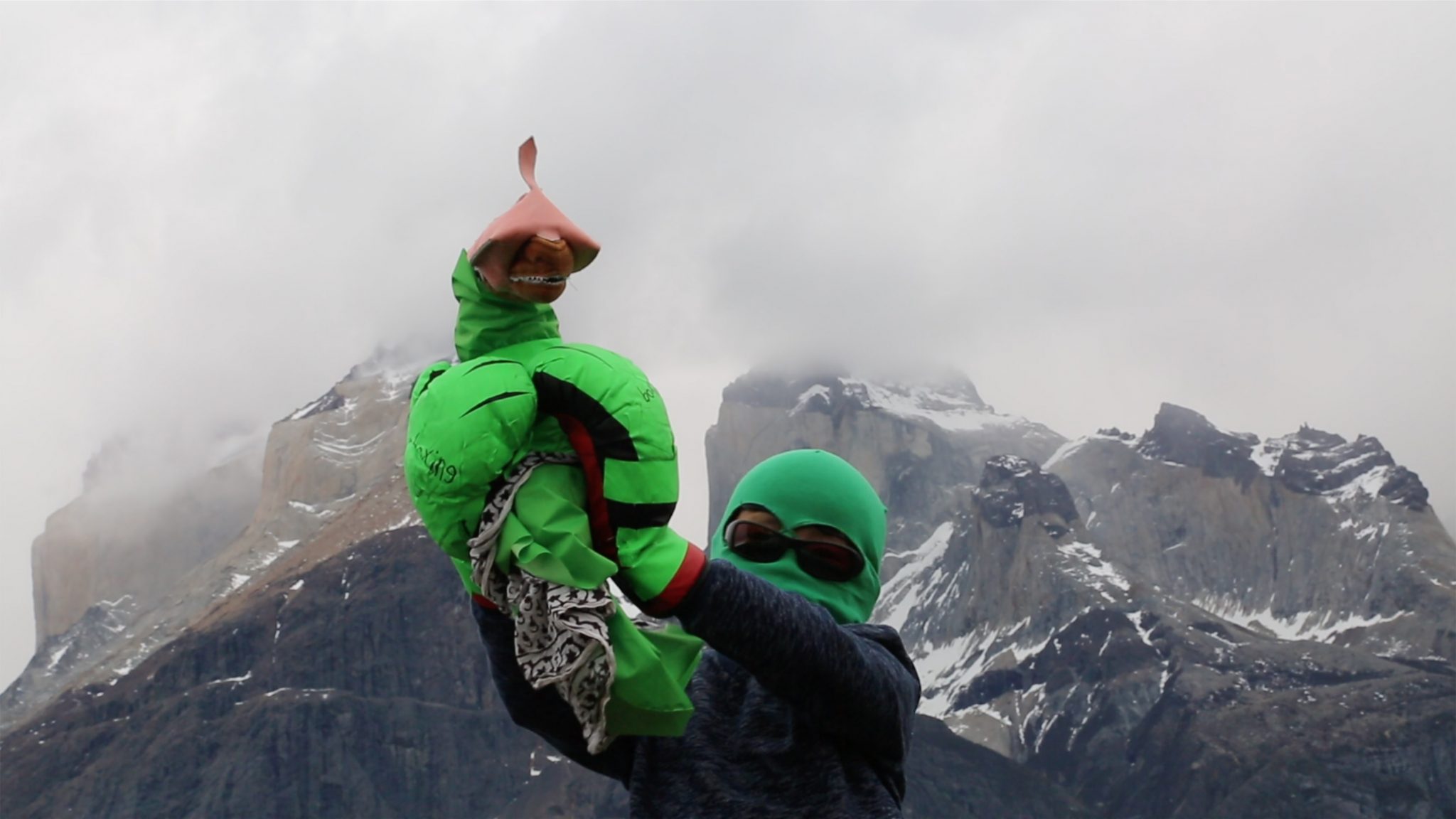
Nonnarrative videoworks like An Artificial Nest Captures a King (2016) hardly resolve matters, embodying a thematic slipperiness and syncretism. We see, in the opening frames, a man on a motorbike break into folk song: “Since many generations a beaklike tattoo has been travelling, from body to body.” This establishing scene gives way to a static landscape-shot of an artificial nest – the kind erected across the Mongolian steppe to encourage falcon breeding – rising out of the snow of the Gobi Desert, then a closeup of an Angry Bird plush toy ensconced within it. At the four-minute mark of this 25-minute piece, a bird’s-eye view zooms in on what appears to be a dead crocodile, then pans out to reveal a Russian jeep doing doughnuts around it. When it grinds to a halt, the driver – Yondonjamts – gets out, circles the crocodile, then proceeds to climb inside what is, in fact, an ‘antipode suit’ resembling one.
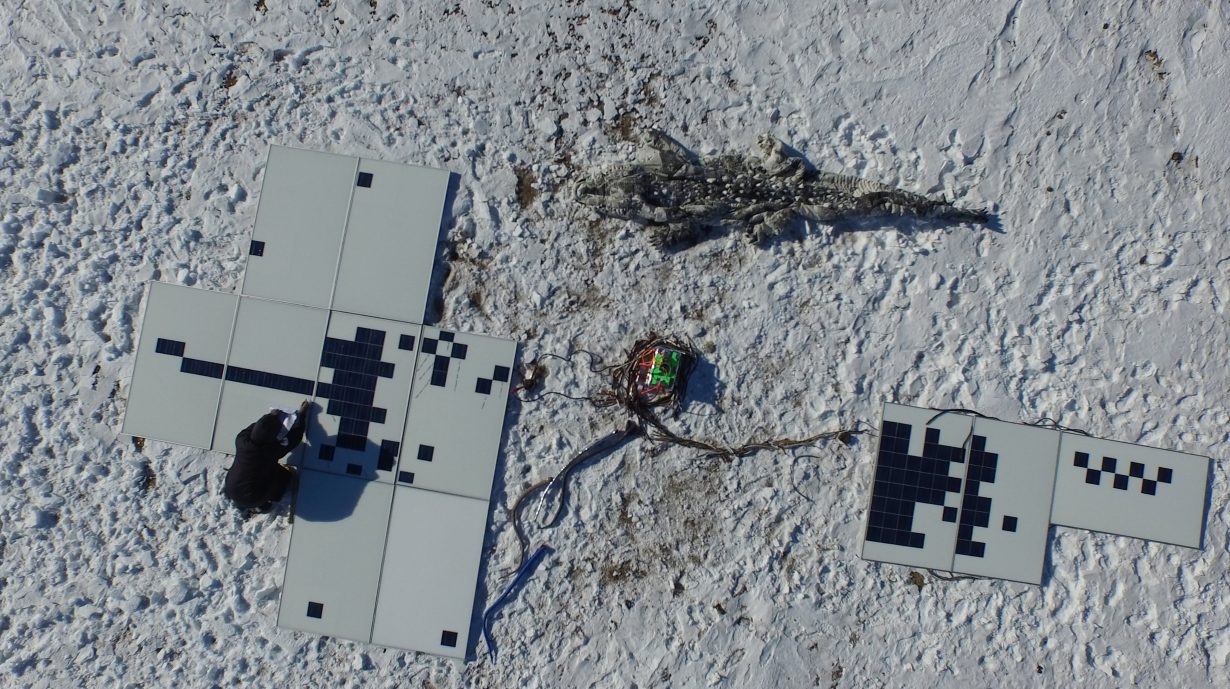
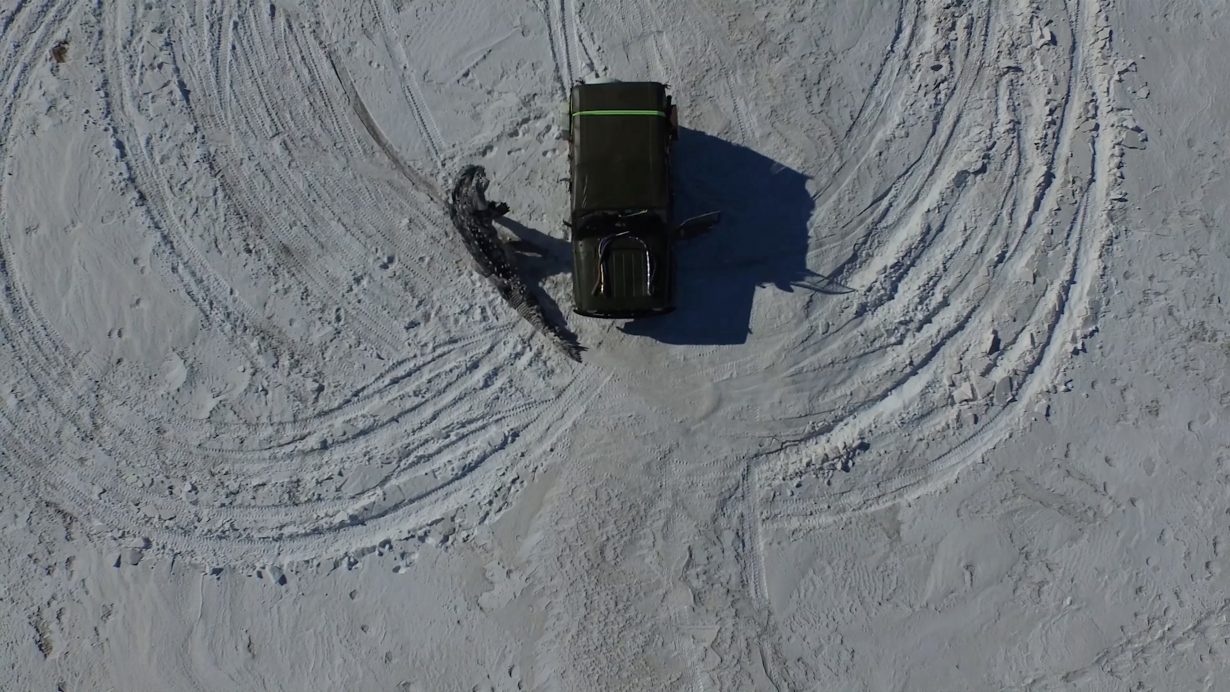
(above) Antipode suit #4 (Tzaganosuchus), 2016. Courtesy the artist
The switching of vehicles, from jeep to crocodile, and the wriggling in the snow that ensues, is suggestive of a magico-religious technique or journey: a process of exiting and entering bodies, or a crossing over from human to nonhuman worlds. Yet Yondonjamts is clearly not a primitivist interested in recreating Indigenous rituals or eliciting a return to past ways. Later sections of the film, in which he proceeds to plot constellations on a solar-panel array, and where a drumming sound accompanies an interior shot of the shaking jeep, are more redolent of a scientific expedition than a shamanic episode. And suggest that while his work can, as one bio states, ‘be understood as a series of journeys, not unlike those of the historically nomadic people of Central Asia’, it spans transnational knowledge and incongruent interests.
By his admission, his relationship with Mongolia’s nomadic genealogy exists at one remove. “My parents were born as nomads but came to the capital as young people,” he says. He has been interested in nomadism since a young age, he adds, but doesn’t know much about it in a quotidian sense. “Its lifestyle or ideas or lessons are still mostly a fiction to me, because I didn’t really live with them. It is a concept in a way.” Which might be tantamount to admitting that nomadic lifestyles offer a toolkit from which he extrapolates ideas, approaches, processes. Or that they offer him a potent means of approaching contemporaneity in Mongolia, where, according to many reports, a resurgence of traditional knowledge since the end of Soviet-dominated Communist rule now intersects with neoliberal policy and a boom-bust economy driven by its dependence on the volatile mining sector.
In practice, his work is more peculiar and elusive than that reductive description suggests, largely due to his sustained and deeply involved experimentations with his homeland’s oral traditions, music and mineral riches. Take, for example, his longest project to date, Binary Serpent (2015–20), which is a transcription of a heroic epic that embodies and expresses something of ancient nomadic people’s ambitions and worldview: ‘Khan Kharangui’, a story about two brothers setting out on a 99-year journey. Traditionally it takes the form of a song accompanied by the morin khuur (horse-head fiddle) and sung in a covered yurt late into the night. But Yondonjamts had other ideas. Inspired by the Arecibo message – an interstellar radio signal transmitted in a binary language from Puerto Rico’s Arecibo Observatory in November 1974 – he translated it using binary numbers derived from the traditional Mongolian alphabet. And he then ciphered this code, using natural pigments and his hand, to create a gridded, 81-metre snakeskin on Mylar.
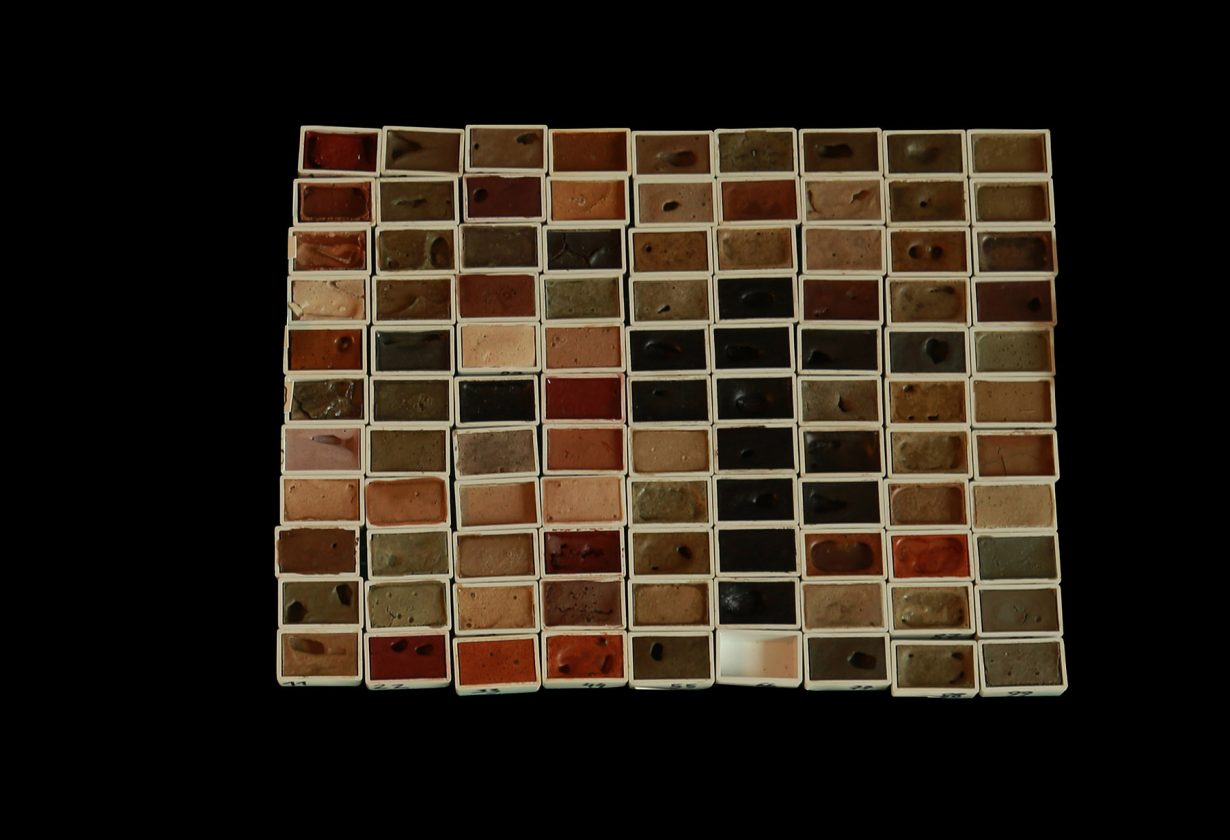
Through its imbrication of narrative content with animal morphology, this widely exhibited work, 81 Meters Backwards to the Darkest Dark (2018/2020), challenges anthropocentric hubris and bias: it implies that the serpent (and animal world at large) carries with it a message that might be of interest to intelligent alien life. But beyond the veiled suggestion that animals innately possess complex perspectives and stories (ones that are no less valid just because we don’t understand them), this work has spurred a constellation of interrelated ones that draw out its meanings. Elements of this constellation betray an interest in musicology: for the Five Heads exhibition, a passage from the ‘Khan Kharangui’, or what Yondonjamts calls the ‘Darkest Dark’ poem, was transposed using a similar method to create morin khuur music. Others extend the kinship with animals: the sound piece Myna Song (2019) is a recording of him repeating words from his version of the poem, all lifted from a passage in which the titular bird appears, which is sped up to create a myna-like sound. Another spinoff entitled 99 Pigments (2019) is a map consisting of 99 small watercolour pans, each containing a different pigment derived from his travels across Mongolia, including the Gobi Desert and mountainous Altai region. These pigments correspond, in Yondonjamts’s imagination, to the landscapes traversed in the poem.
Judging from what has come since, 81 Meters… and 99 Pigments have been particularly impactful. Yondonjamts’s fascination with mineral pigments is not the first thing that strikes you about his forms, but, perhaps linking back to his training in Mongol zurag paintings, or relating to the fact that mining now accounts for about 30 percent of Mongolia’s GDP, it is nevertheless important. Once you do cotton on to the earth tones and their organic origins, they fuel animist readings, much as do his experiments with language, script and binary code. At the recent Gallery Ver show, there were dream drawings made from iron oxide; new Mylar snakeskins bearing fine dots of jarosite, malachite and magnetite; and primitive clay figures made from a doughy, Siberian forest soil. If, as Tiravanija claims, Yondonjamts is ‘laying out a language for us to experience otherness’, the land, as well as the animal, does much of the speaking.
Tuguldur Yondonjamts, alongside Nomin Bold, Dorjderem Davaa and Gerelkhuu Ganbold, will represent Mongolia at the 61st Venice Biennale, 9 May – 22 November
From the April & May 2026 issue of ArtReview – get your copy.