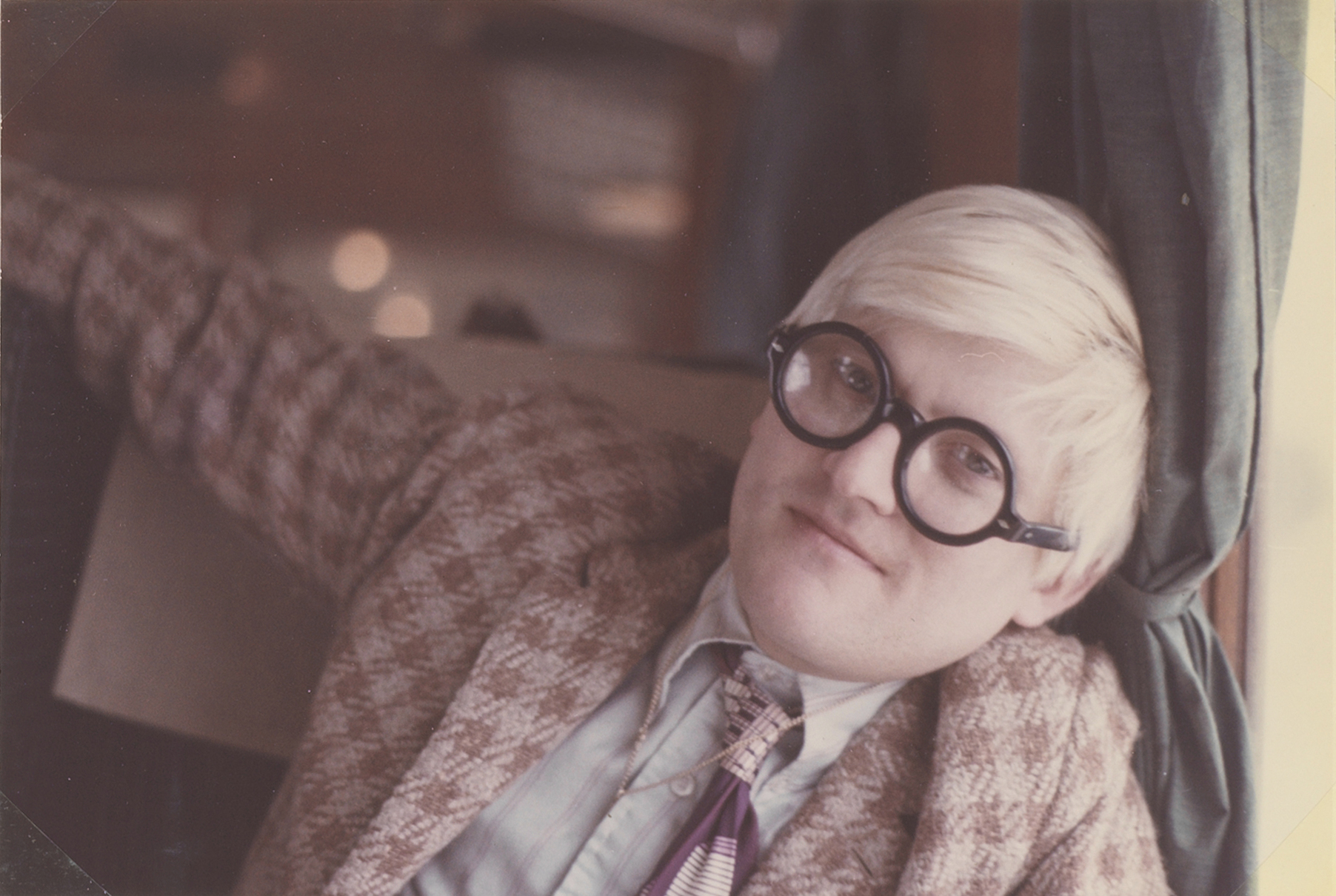
In 1970, Pat Gilmour reviewed the first major retrospective of work by Hockney – who was only thirty two – at the Whitechapel Gallery
A huge tea-spotted square-jawed solemn Hockney cougar, flashing through space with a smoke trail of dynamic energy, seems about to devour a pair of vulnerable chaps, one nude, chatting somewhat incongruously in a suburban garden. But between the cougar and his apparent dinner, a small-scale typographic barrier announces: ‘Don’t worry, this is a still’.
Thus with wry humour, having created the impossible-movement in a static art – Hockney cancels it with a graphic device and entitles the work: ‘Picture emphasising still-ness’.
Opening, appropriately enough, around April Fool’s Day (for the leg-pulls are on us), Hockney’s first major retrospective at the Whitechapel Art Gallery will assemble over 40 paintings, as many drawings, and his entire output of prints.
Hockney’s paintings have been largely autobiographical, and writing in Ark in 1962, Richard Smith stressed this, and commented that the spindle-legged, beetle-bodied figures he then affected had many cousins in cartoon conventions. Critics at this time sometimes complained Hockney’s paintings were blown-up graphics and the flat figures were often interspersed with ribbons of writing such as ‘Cha-cha-cha I love every moment’, or the little inscription ending: ‘eating, drinking, sleeping, loving’ from We two boys together clinging. But as well as borrowing cartoon conventions, Hockney’s early works seem also to have drawn on the naïveté of child art, and the classroom situation, in which the teacher writes a caption for an infant’s illustration, is touchingly invoked by the etching Myself and my Heroes, in which Hockney, accompanied by Gandhi and Walt Whitman, notes: ‘David: I am 23 years old and wear glasses’. The brilliantly successful Rake’s Progress, recording the ups and downs of his first visit to America, dates from this time.
The cluttered scribble and two dimensionality of the faux-naïf has been replaced throughout the late 60s by an increasing interest in artistic devices for rendering pictorial depth, with corny shadows, or obvious vanishing points. There has been a whole series of interiors and exteriors pinpointing the reality of a bland American vacancy by unreal images which might have been lifted neat from the estate agent’s brochure. Other preoccupations have included a passion for the male nude, an obsession with the unpaintability of glass and graphic notations for representing water, a genius for portraiture (notably of dealers and picture collectors as the wallet, instead of emptying, as in Rake’s Progress, begins to fill) and various other artistic devices which make for a greater or lesser degree of realism. These, ranging from ludicrously spelt-out shadows, to trompe l’oeil frames within the picture space, are all part of the Hockney comment on pictorial conventions. One of the most comprehensive spatial statements in the exhibition is Play within a Play in which a chair in front of a tapestry of fantasy (a hanging, forming a demarcation of space, and a persistent Hockney contrivance) defined a shallow stage on which Kasmin, Hockney’s London dealer, stands with palms and nose pressed flat against an imaginary pane of glass so that the picture projects both fore and aft. Hockney’s frank treatment of homosexuality, his adoration of the male nude, combines well, in shower or swimming-pool, with his absorption in attempting to represent water, and there have been witty comparisons of graphic treatments of this insubstantial substance, and of its modifying qualities as it cascades over the human form.
His attitude to the male nude emerges with greatest clarity from the illustrations for the poems of Cavafy, openly celebrating the joys and anxieties of a hitherto darkly illicit love. There were even rash comparisons between the Cavafy illustrations and Picasso’s Vollard Suite, both of which employed a deceptive simplicity of line, and although Hockney’s draughtsmanship is not really in the same effortless class (every hand in his suite is hidden or resembles an unfilled baggy white cotton glove) it is on his remarkable graphic work that much of his reputation rests.
Print-wise he is very trad. The only screen-print he has done, in that 1964/5 ICA venture, was, typically, a view of Cassius Clay nude behind a shower curtain, called Cleanliness is next to Godliness. Apart from the lithographic portfolio Hollywood Collection all his major suites have been in intaglio, and the Hayter message has been rightly ignored in favour of a marvellous spare use of black and white.
Although one still has occasional doubts about his drawing (difficult to resolve with an artist who oscillates not only in stance but in style between naïve innocence and cunning knowing) the publication of his most recent graphics, the illustrations to Grimm’s Fairy Tales, is a really exciting event, and they have magnificently developed his range. Irregular crosshatching is matched with formal multiple ruling, sweetly graded aquatints give an unparalleled richness of colour from Irish mists to murky black magic. Fuzzy soft ground strokes or drypoint bleed confront the precise spare line of the finest etching needle. The wit and variety are stunning.
And although one may point to mixed quality in some of his work, the show marks a high point in the career of a very considerable artist, one who is real, has feelings, and, with wit, candour and devilishly intriguing manipulation of his means, is able to communicate them to us.
First published in Arts Review, Vol XXII, Issue 6, 28 March 1970