Speaking to ArtReview in 2007, the late artist reflects on her extraordinary life and work
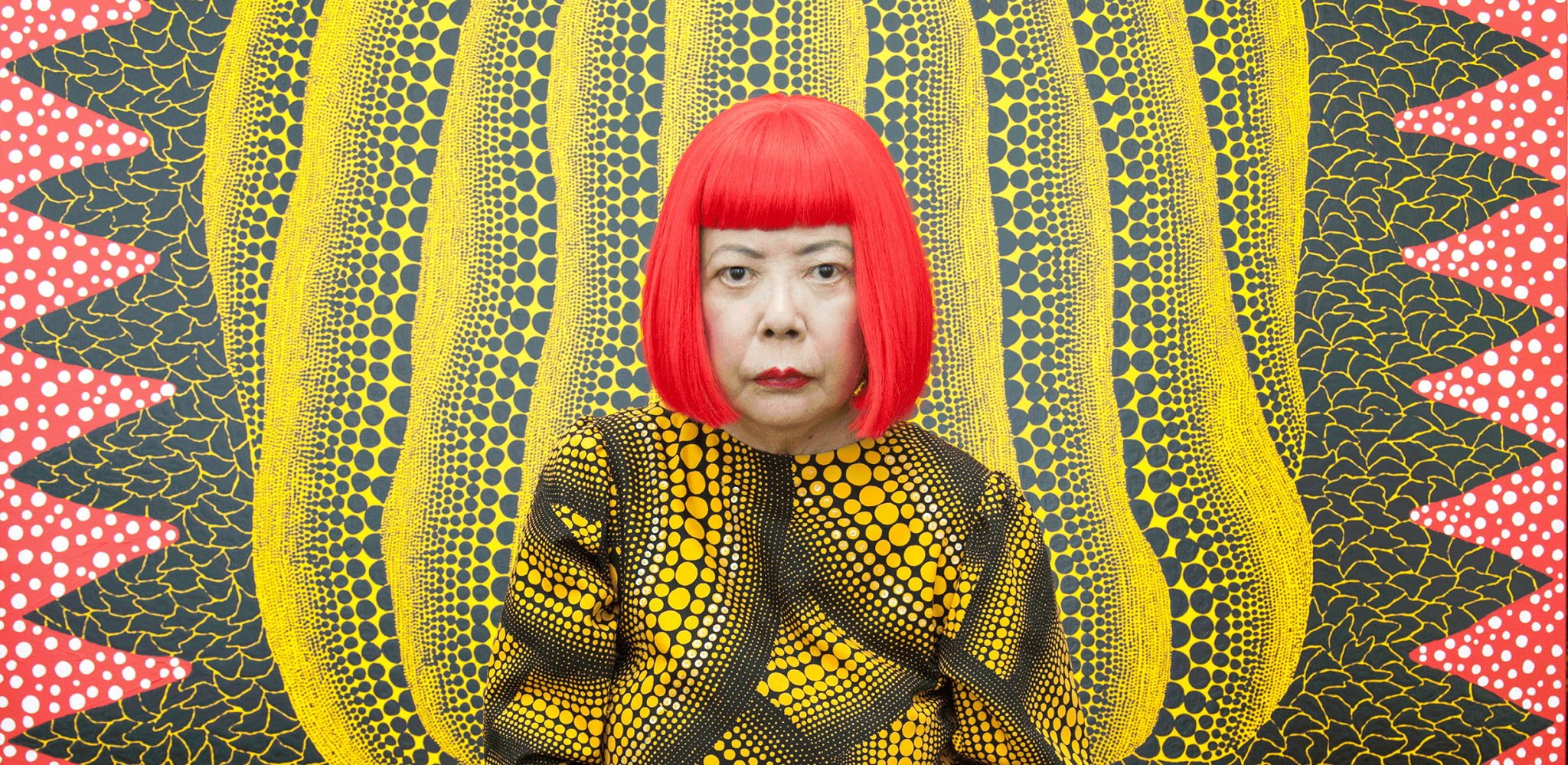
Yayoi Kusama is often described as Japan’s greatest living artist. More than that, she is without doubt one of the most intriguing and contradictory figures of the global artworld. She is considered a proto-feminist icon, who from the 1950s onwards has created an entirely idiosyncratic oeuvre that has included environments, sculptures, paintings and performance pieces, instantly recognisable for her signature use of obsessively realised patterns, dots and penile protrusions. Notoriously, compulsion born of mental illness has fuelled her practice, and she has described childhood hallucinations in which patterns encompassed the universe, so that she and everything else was obliterated. Indeed, while her performance work, where she vanishes into her surrounds, her body masked in dotty costumes that blend into dotted environments, is a disappearing act, she rose to notoriety through a campaign of determined self-publicising. Such performance work was perfectly tuned into the burgeoning psychedelic, ‘free love’ era, notably her famous naked ‘orgy’ pieces that were so seized upon by the mainstream media at the time. Her work is paradoxically inseparable from her image, and regularly appears in both art and fashion magazines worldwide. And yet following the deaths of her father and her close friend Joseph Cornell, Kusama fled the New York highlife, ensconcing herself in a Tokyo psychiatric hospital, where she has lived since 1977. Following a period of withdrawal from the international stage, she was selected to represent Japan at the Venice Biennale in 1993, and has since expanded on this grand return with major solo exhibitions worldwide. In this exclusive interview, as Kusama prepares for her first show at London’s Victoria Miro Gallery in almost 10 years, she reflects on her extraordinary life and work.
ArtReview You’ve said that ‘if it were not for art, I would have killed myself a long time ago’. What is it about making art that makes life easier?
Yayoi Kusama I have lived my life putting my all into the path called ‘love forever’.
AR Has the process of making art changed as your career has progressed? Or is it the same as it always was?
YK I have spent every day, step by step, always struggling with art. This straight path has helped me grow as a constant process for making art.
AR Do you think the art you make in Japan is different from the art you were making in New York? How much is your location and environment a factor in the outcome of your art?
YK Regardless of where I make art, be it in Tokyo or in other parts of the world, the art I create has always stayed with me as ‘Kusama’s philosophy’. My thought stays with love that covers the whole world, and life and death.
AR You are often described as Japan’s greatest living artist. To what extent do you think of your work as being ‘Japanese’?
YK Rather than being a Japanese artist, I consider myself as an artist who is in the forefront of art in the world. It is my earnest wish that love is forever infinite in the universe.
AR Do you look at what other contemporary artists are doing? Or do you just do your own thing?
YK I have been concentrating on my own activities. I don’t pay attention to what other artists are doing. I am focusing every day on the thoughts and aspirations concerning my art.
AR What do you hope to communicate to the viewer?
YK I hope to communicate that love is forever in the universe, and to share with them wishes for peace on the earth without terror and war.
AR When you make your work, to what extent are you thinking of the way it communicates with other people?
YK I am I. Others are others. We are different in many ways. Behind art are, however, aspirations common to all humankind. It gives me a great joy when I find them.
AR What artists have influenced your work?
YK I myself. My greatest aspiration in life is to discover myself and create artwork.
AR How does it feel to be an influence on other people?
YK I feel delighted. I would like to strive further, setting my goals higher. I would like people to evaluate my works after I have achieved them.
AR You work through a large range of media. How do you decide whether an idea will become a sculpture, performance, painting, fashion, poetry, installation or film? Or is there no gap between the transformation from idea to object?
YK Each time I have an idea formed in the mind, I have incorporated new themes in my artwork, one after another.
AR After your time in New York, you were kind of forgotten for a while by the artworld. Now you’ve achieved great success and fame quite late on in your career. What reasons do you think there are for the artworld being so slow to appreciate your work as enduringly important?
YK I have gained fame quite naturally, while being unconcerned about it. Now I am approaching the time when I have to think seriously about my own life and death.
AR Do you see your work (as other people have) as being particularly feminist?
YK I have never thought about it.
AR You grew up in quite a conventional environment. Did that make you determined to make your art transgressive?
YK I have suffered the greater part of my life because of the environment I grew up in. This has strengthened me a great deal, though.
AR You destroyed a lot of work as you left New York. Why did you do this, and would you still do it now?
YK I destroyed my earlier works to make better works. When I left for the US at twenty-seven years of age I burned some 2,000 paintings on the riverbank behind my parents’ house, in order to create a new world of art.
AR You’ve called your art ‘obsessional art’. Why is that?
YK Stereotypical action, repetition, hallucination, accumulation, obsession, the curtain of depersonalisation, emptiness, infinity, psychosomatic art, proliferation, ‘vacuum’, cell, segmentation, eternity, driving image. These are some of the themes I have used for my artworks: paintings, sculptures as well as films.
AR Your work is often categorised as ‘outsider art’. Can you be famous and be an ‘outsider’?
YK Yes, I can indeed. With my artworks I have become a world-renowned artist before my knowing it. This is unrelated to my work being ‘outsider art’.
From ArtReview October 2007 –– explore the archive.