Featuring 61 artists from around the world, If the word we broadly addresses notions of community and connection
A miniature glass reproduction of the demolished sixteenth-century Babri Masjid mosque in Ayodhya, India, sits a windowsill in Jasleen Kaur’s installation Supra (all works but one 2026), an empty, red-carpeted room. An arrangement of trumpet, vocals and dilruba – a North Indian bowed instrument – filters through two viewless tinted windows, devotional music from a permanently inaccessible elsewhere. The jarring contrast between the richly textured sonic world and the barrenness of the room, where images of another time and place are compacted into a lonely souvenir, characterises many of the works in the 59th Carnegie International, If the word we.
Featuring 61 artists from around the world, this loosely curated group show broadly addresses notions of community and connection (the ‘we’ in the exhibition’s title). Many participating artists explore more specific themes such as land, indigeneity, dislocation and emplacement. Their works feverishly map – using artefacts, images, sounds and smells – connections between Pittsburgh and places as varied as Brazil’s National Congress Palace (Cinthia Marcelle, Blue Hall Annex) and the farms and kitchens of East Asia (Ginger Brooks Takahashi, The smell of perilla floated through the village). The most effective pieces convey the physical connections shared between artist and site.
Hong Lee Hyunsook’s What You’re Touching Now – Insubong in 2025 (2025), for instance, greets visitors at one entrance of the museum. Spanning an entire wall, this 11-metre frottage indexes a landform in South Korea: it was made by rubbing crayon on gwangmok fabric against the side of Bukhan Mountain’s Insu Peak. Dineo Seshee Bopape’s Fiela, fiela (I’ve come to take you home), an installation of brown curved, gummy-looking walls, offers something of an indoor earthwork for the age of immersive experiences. Footage of verdant trees, a portal to a sunny getaway, is projected onto one wall. In the back corner of the gallery, another video, zoomed in on someone’s bare feet as they sweep the ground with a twig broom, is cast like a mirage on a boulder resting atop a pile of dirt and gravel. Although we are not told from where the rock and earth originate or where the sweeping took place, the act implies a tactile relationship between the human body and the land, an expression of humble stewardship.
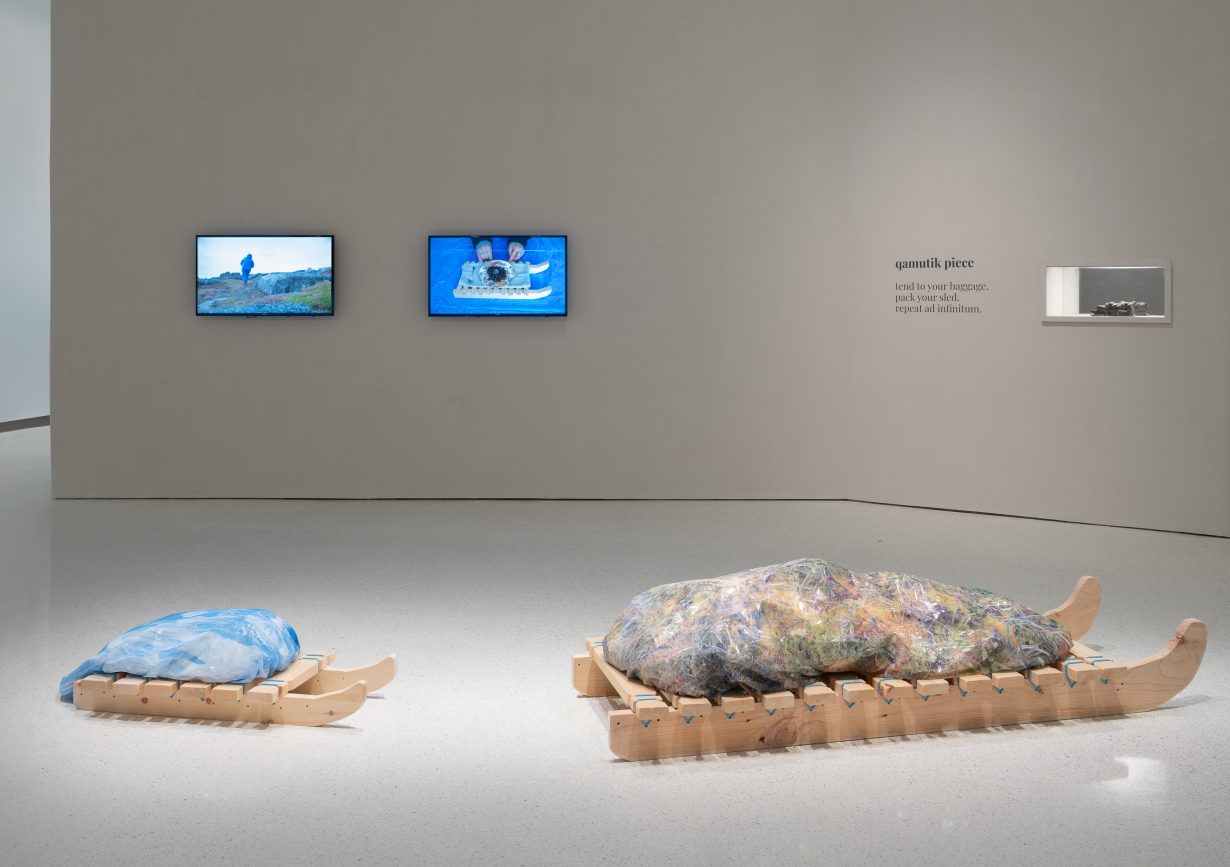
Most poignant are asinnajaq’s water qamutik and moss qamutik, two Inuit sleds each holding an emergency blanket wrapped in a large fabric-printed photograph of water and vegetation, respectively. Brought from the village of Inukjuak to the museum by the artist – and, judging by the journey depicted in a video playing on a nearby monitor (together), at least partly on foot – these uncanny objects, which invert the relationship between landscape and hauling implement, provide glimpses of the terrain in asinnajaq’s ancestral homeland. In a video on another monitor, tending, a pair of hands tie votives like food and incense to a miniature qamutik as if preparing them for transport. In together, the artist trudges across a snowy field, pulling moss qamutik towards Pittsburgh’s skyline.
Sometimes, however, works’ engagement with specific sites appears merely discursive. One would not hazard to guess without the exhibition guide, for instance, that the plastic water bottles floating in a white void in the cgi animation accompanying a new album by Alia Farid, which plays on three vertical monitors, ‘connect Pittsburgh with the Iraqi marshlands’, or that the bottles reference litter on the banks of the Shatt al Arab waterway. Nor could one say confidently that Camara Taylor’s installation of metal panels and stakes, a slide carousel flashing words like ‘Grave’, ‘Plot’, ‘Permanent’ and ‘Future’, plastic tubing and nature photographs submerged in vats of clear liquid references sugar production and rum distillation in Barbados and imperial trade and industrial decline on Scotland’s River Clyde (even the scent of the liquid, white rum, is imperceptible unless you know where to stick your nose). Place names, when invoked in the didactics, expand the conceptual footprint of these artists’ projects, lending them literary texture and reinforcing their cultural authority. But they can do little to sharpen the vague imagery in the videos and photographs we see.
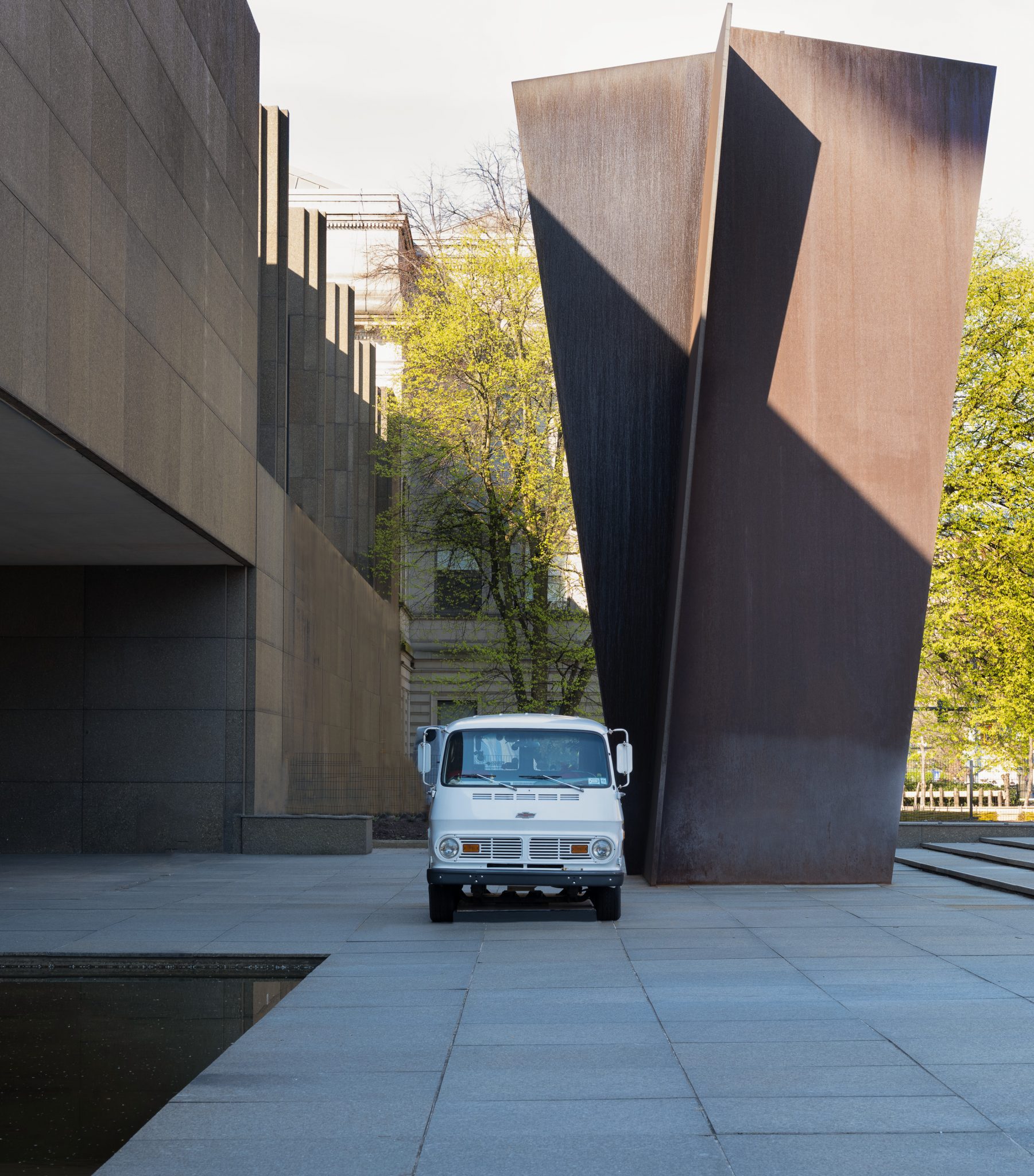
What becomes of the pattern of works pointing beyond the museum and beyond the city is a pervasive sense throughout the exhibition that the action is – always already, it seems – happening elsewhere. Seneca artist G. Peter Jemison’s Our Journey to Deyo:gê:h (between two rivers) illustrates this best. The project involved him driving a Chevy Mini to the museum from his home in Victor, New York, transporting beadwork, carvings and vessels by seven Haudenosaunee artists to install in the International, where the objects were promptly displayed in vitrines. Jemison’s van will sit like a piece of public art in front of the museum for the show’s duration, evidence of a journey completed. On its sides are vinyl images of sunflowers blooming in a 400-year-old Indigenous site in Victor that serve not only as stamps of cultural authenticity for the works that came in the van but also as oversize postcards, which seem to say, ‘Wish you were here’, or had been, anyway
59th Carnegie International is on view at Carnegie Museum of Art, Pittsburgh, through 3 January 2027
From the Summer 2026 issue of ArtReview – get your copy.
Read next An Entry: A poem written at the 59th Carnegie International by Paula Bohince