Prisoners of Love embodies Abbas and Abou-Rahme’s strategy of using art to frame and disseminate suppressed information
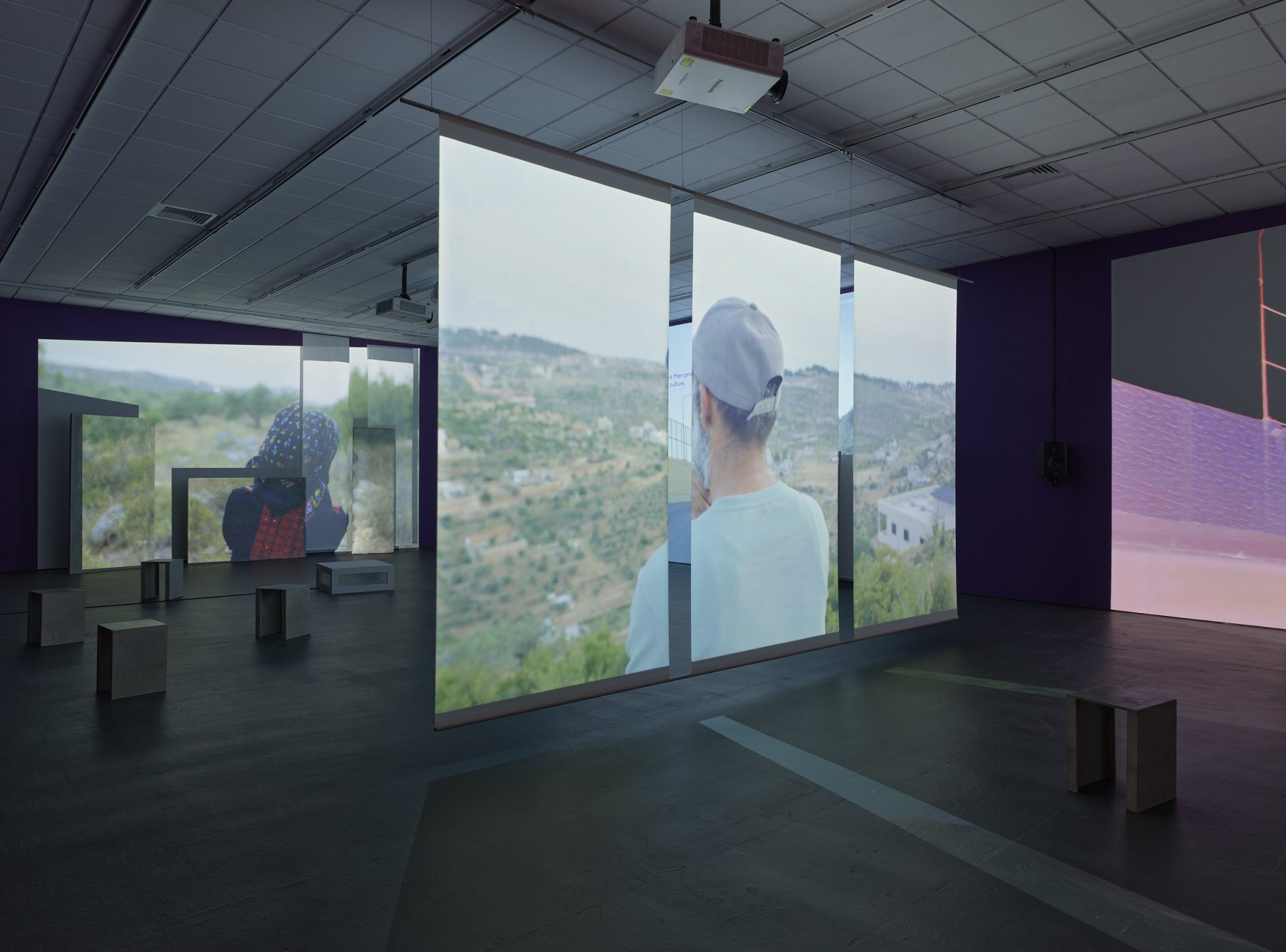
Prisoners of Love: Until the Sun of Freedom (2025), an hour-long four-channel film by New York- and Ramallah-based Palestinian artists Basel Abbas and Ruanne Abou-Rahme, plays in a dimly lit room lined with steel and concrete panels and suspended scrims. Onto these staggered planes, which fill The Bell’s gallery, are projected chromatically modified and psychedelically saturated shots of men and women hiking, leaning on trees and cradling thistles, which advance to an incongruously propulsive soundtrack of looping, layered electronic music. The montage is overlaid with spoken and written statements about Palestinians formerly detained by Israeli authorities, recounting the conditions of their cells, the behaviour of guards and interrogators, survival strategies passed down between inmates and the drifting thoughts that reverberate in the aftermath of incarceration. A strophe in purple sans-serif font, for example, floats briefly in the upper left corner of the largest projection: ‘The sea whispers the tale of an / imprisoned homeland / to the stars,’ it reads. ‘L treads lightly on / all that remains / of Umm il Zinnat / Her graveyard / and her vegetation.’ The text appears beside a figure in a green linen shirt and jeans stepping through a field of rubble. This could be L, or somebody else. As in the duo’s previous work, Prisoners of Love dons its text, imagery and sound in ornate and mismatched layers.
French philosopher Michel Foucault stated during the 1970s that when institutions like schools, charitable societies, hospitals and lodging houses adopt ‘penitentiary techniques’ – panoptic surveillance, for example, or routine inspections – the prison in its assorted guises permeates all aspects of society. Lines from the film – ‘How many mobile prison cells are in our Arab world’, ‘The camp is prison; your house, prison; / the newspapers, prison; / the radio, prison…’ – echo Foucault’s observations. Throughout the hour, the understated panels of concrete, steel and fabric stand and hang menacingly as images flicker across them. Slivers of landscapes and freeways, sometimes parts of a word, are lost where one screen ends and another picks up the light, and occasionally, for few-second intervals when one of the four channels goes dark, the colourless projection surfaces lurch back into full view, like minimalist sculptures or uninscribed headstones. By erecting what appear to be wall after wall around the viewer, who may understandably confuse the diaphanous scrims for opaque planes and the shadows on the deep purple walls for solid objects, the artists bring a sudden sense of prisonlike claustrophobia to the gallery.
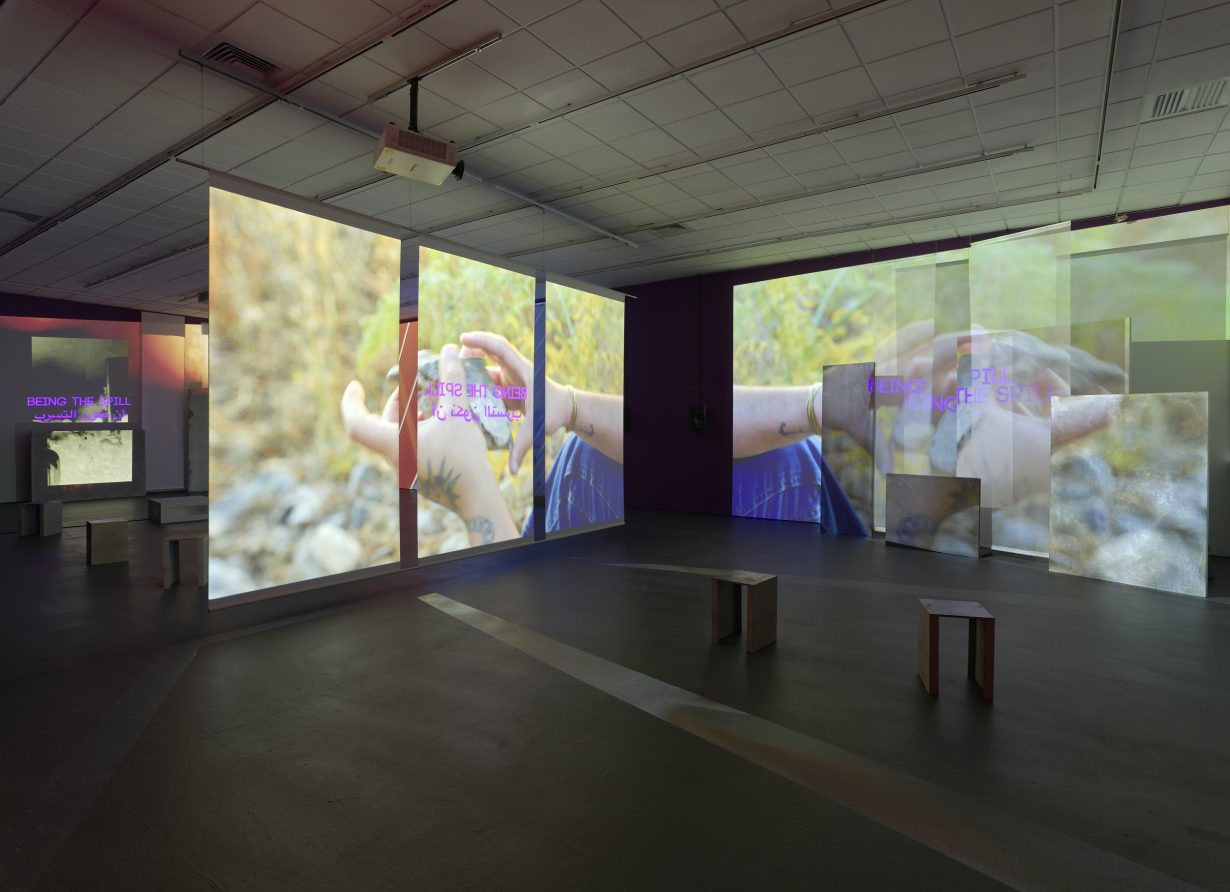
Read another way, these screens embody Abbas and Abou-Rahme’s strategy as archivists and activists who use art to frame and disseminate suppressed information. On one hand, the duo provides a stage for Palestinians’ testimonies and creative expressions, whether in the texts of Prisoners of Love or in a suite of drawings by Abou-Rahme’s father – of protesters, a ghostly city, women feeding birds and flying – displayed on metal panels and banners in the gallery’s lobby and accompanying printed screenshots of unattributed ruminations on the genocide in Gaza. On the other hand, the artists do not hide their editorial interventions or temper their penchant for jagged transitions and poetic disjunction. Their aesthetic choices fragment the narratives they’ve collected and render the personal evidence of illegal occupation, unlawful detention and torture entrusted to their care less legible and less user-friendly – and, somehow, that much truer to life.
Prisoners of Love: Until the Sun of Freedom is on view at The Bell/Brown Arts Institute, Providence, through 31 May
From the April & May 2026 issue of ArtReview – get your copy.