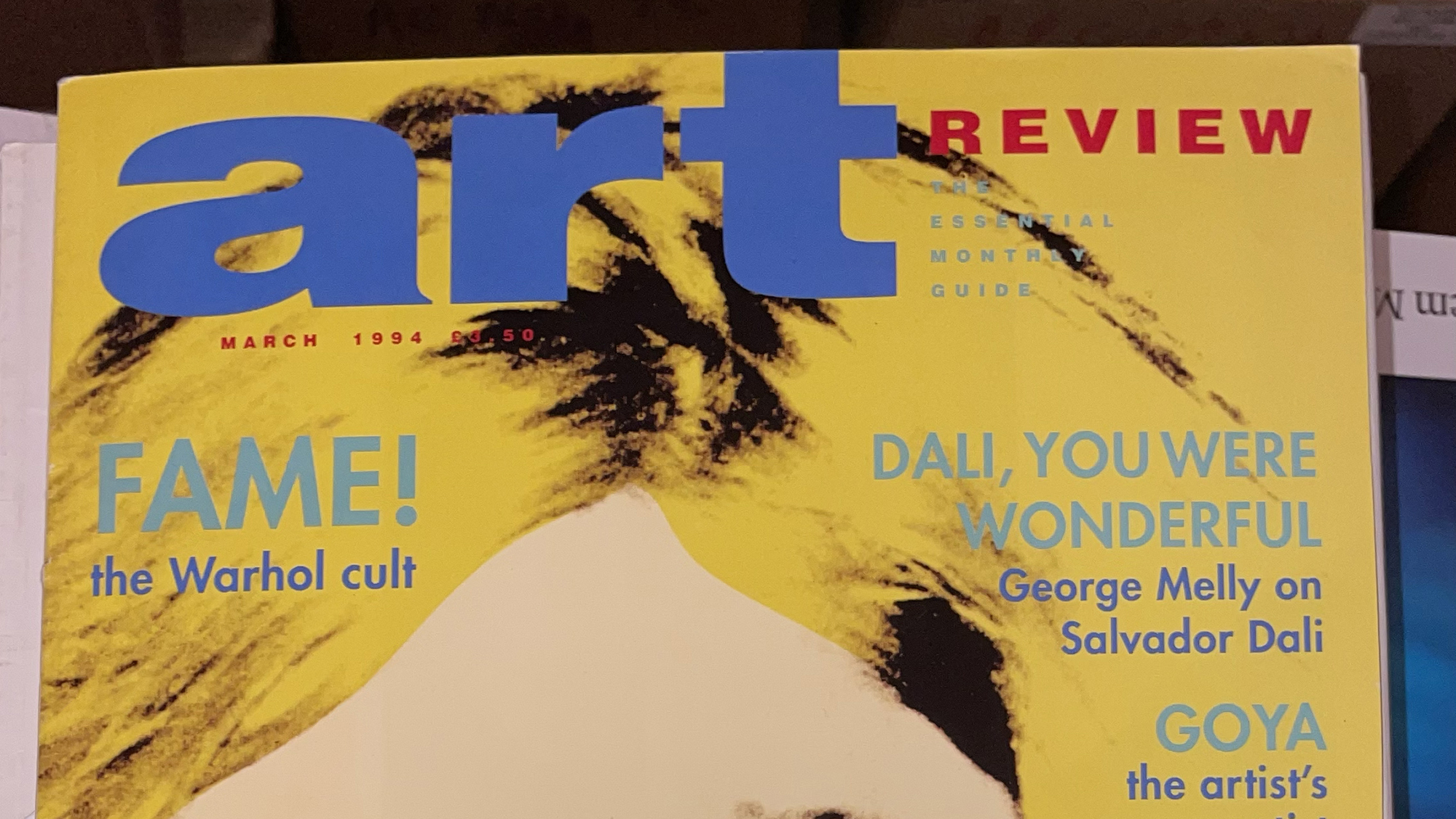
From 1994: Edward Lucie Smith on Andy Warhol, the glitterati’s favourite image maker
Andy Warhol is in the process of being forgiven by people who ought to know better. I remember the first occasion when this realisation came home to me. I was sitting in on a seminar about art criticism held at the Contemporary Art Centre in New Orleans. Three panel members had already tried to state a view on criticism – the word, with its judgmental overtones, clearly made them unhappy. Why couldn’t we avoid the issue, and accept all artistic efforts as equally worthy? It was the effort that counted, not the result.
A fourth and final member was more abrasive. He rose to his feet and pronounced that the two greatest American artists of the late 20th century were undoubtedly Andy Warhol and Bobby (sic) Mapplethorpe. Criticism was really very simple – all contemporary achievement should be measured against theirs.
I wonder how anyone could say this without being challenged – but all around me the heads were nodding sagely in agreement. Andy Warhol rules OK. How can anyone think ill of a contemporary artist whose estate was valued at $220 million?
It is easy to list the things which appear to be wrong with Warhol’s art. He began as a fashion faggot, a twee illustrator who was a success in the advertising world and a wow with the glossy magazines. By 1952 he was, according to his biographer, Victor Bockris, “the most sought-after illustrator of women’s accessories in New York”. As Calvin Tomkins put it: “The childish hearts and flowers and the androgynous pink cherubs that he used were not quite what they seemed to be, there was a slight suggestiveness about them that people in the business recognised and approved. He could kid the product so subtly that he made the client feel witty.”
Just because of his success as a commercial artist, Warhol found it hard to break into the ‘serious’ art world, then still besotted with Abstract Expressionist Sturm und Drang. Even when Pop arrived he was initially out of luck. Leo Castelli refused to take him on because his paintings of cartoon characters were too much like those of another new Castelli artist, Roy Lichtenstein.
Despite this initial setback, Andy eventually triumphed – sort of. He became an established Pop painter, turning out stacks of Soup Cans, Marilyns, Jackies and Electric Chairs.
He was the central figure in The Factory, the most celebrated bohemian hangout in New York. He made scores of unwatchable underground movies, and created a galaxy of tacky ‘superstars’, pale reflections of his own glory. He invented Interview magazine – a kind of Hello! – as a means of currying favour with people even more famous than himself. In the late 70s he was a fixture at Studio 54, then the most celebrated night-club in New York, and bosom buddies with Halston, America’s most celebrated dress-designer. During this final period he did a brisk trade in society portraits, generated from Polaroids. To sitters, he offered discounts for quantity – the more portraits you ordered, the less they cost.
Does it sound at all like the lives and careers of Rembrandt or Michelangelo?
Even though it is currently a deeply unfashionable thing to do, one can try putting the personality to one side and looking at the work itself. The more there were variations. Sometimes the stringent defenders of Warhol’s art are generally agreed that the period which really counts is relatively brief. It stretches from the cartoon images of the 1960s to the big and little Maos of 1972–3. Almost throughout this epoch Warhol used an absolutely standard technique. First he applied paint to the canvas in dayglo hues – in the case of Marilyn Monroe, for example, he would outline the shape of her head and shoulders, then fill in the background and add, rather broadly, details such as her eyeshadow and the outline of her lips. He would then apply a silk-screen image generated from a blown up photograph, and go over it rapidly with a squeegee. Hey presto! Another Warhol Marilyn! Of course, there were variations. Sometimes the chosen image appears in multiples, as in Marilyn x 100 (1962).
The technique was so simple that it was extensively faked even in Warhol’s own lifetime. Some of his assistants apparently succumbed to the temptation to manufacture ‘Warhols’ in the artist’s absence. Even when Warhol was present, for some form of laying on of hands, his artworks were not made without help. Eyewitnesses tell us that for him running up a new batch of paintings was a boring, unnecessary task, to be accomplished as rapidly and painlessly as possible, with the assistance of anybody, trained or untrained, who happened to be around.
None of these facts are in dispute, but Warhol’s intellectual admirers get around them by putting forward elaborate justifications based on Warhol’s supposed affinity to Duchamp. According to them, he is the man who took Duchamp’s invention, the Readymade, and democratised it, establishing it in the very heart of popular culture. In addition, they celebrate him as a moralist. There is no evidence that Andy, though he went to church fairly regularly in his later years, made any such claim for himself.
The claim is based, not on the Marilyns and the Soup Cans, but on the Disaster paintings – the Race-Riots and Car Crashes. Here scenes of mayhem, taken from tabloids or from police archives, are once again silkscreened onto canvases as repeated images, generally against a background of cheerfully incongruous hue. The idea put forward by commentators is that these paintings accurately reflect the dulling of sensibilities, the compassion fatigue, induced by the contemporary urban world. Yet it can also be said that they offer additional evidence (for which there is plenty of anecdotal support) for Warhol’s emotional coldness and voyeurism.
In the end, however, we do have to look simply at the artefacts themselves. Deliberately repetitive, garish in hue, slipshod in detail, they are precisely what the artist wanted them to be. This doesn’t make them ‘good’ in any meaningful sense of the word, though it may make them seem important, as tokens of a time when taste reached a nadir, and congratulated itself on having fallen so far. Generations yet to come are lucky. Because most Warhols are made, physically, of such poor materials, they are going to degenerate inexorably, despite the tender care of museum conservation departments and obsessive collectors. In 100 years they will be almost invisible shadows, rotted wrecks, sad trails of acrylic running down tattered canvases. And in a hundred years people will therefore be able to enjoy all the baroque curlicues of the Warhol legend without having to look at the pictures. Andy the saint will tickle their fancy even more than Andy the genius. The process of canonisation started immediately after Andy’s decease.
How about this, for example, taken from an eulogy penned by John Richardson, the biographer of Picasso? “Andy even managed to give a slogan like Jesus Saves an uncanny ring of urgency. And how awesomely prophetic is the painting, one of his very last paintings, which simply announced HEAVEN AND HELL ARE JUST ONE BREATH AWAY. In his impregnable innocence and humility Andy always struck me as a wrodso, one of those saintly simpletons who haunt Slavic literature and Slavic villages such as Mikova in Ruthenia from which the Warhols stem.”
“If you believe that”, I find myself murmuring, “you’ll believe anything.”
Confronted with both Warhol’s art and the facts of his life, my mind turns to another artist of somewhat doubtful personal character, who also loomed very large in his day – Jacques-Louis David (1748–1825). David’s biographers agree that he behaved despicably at the fall of Robespierre, his patron and friend during the period of the Terror. And few people now admire the character of Marat, the ‘tribune of the people’ whose death David commemorated in the magnificent Marat Assassiné, now in Brussels. Yet most lovers of painting recognise that the Marat, the artistic tribute paid by a coward and dupe to a mean-spirited demagogue, is a masterpiece.
In Warhol’s oeuvre masterpieces are hard to find, and it is no real defence to say that, by his time, the whole concept of the masterpiece had become irrelevant. Running through my head, whenever I think of Warhol, are some lines by W.H. Auden:
‘Time, that with this strange excuse,
Pardons Kipling and his views,
And will pardon Paul Claudell,
Pardons him for writing well.’
Sorry, Andy, you won’t get through St. Peter’s gate if that framework of judgement has anything to do with it. But why shouldn’t idiots worship you, if they must?