“Ultimately there is a tension between participation in the Biennale as an exercise in soft power, and it being a space to produce and show contemporary art; the two do not sit well together”
ArtReview sent a questionnaire to artists and curators exhibiting in and curating the various national pavilions of the 2026 Venice Biennale, the responses to which will be published daily in the leadup to and during the Venice Biennale, which runs from 9 May through 22 November.
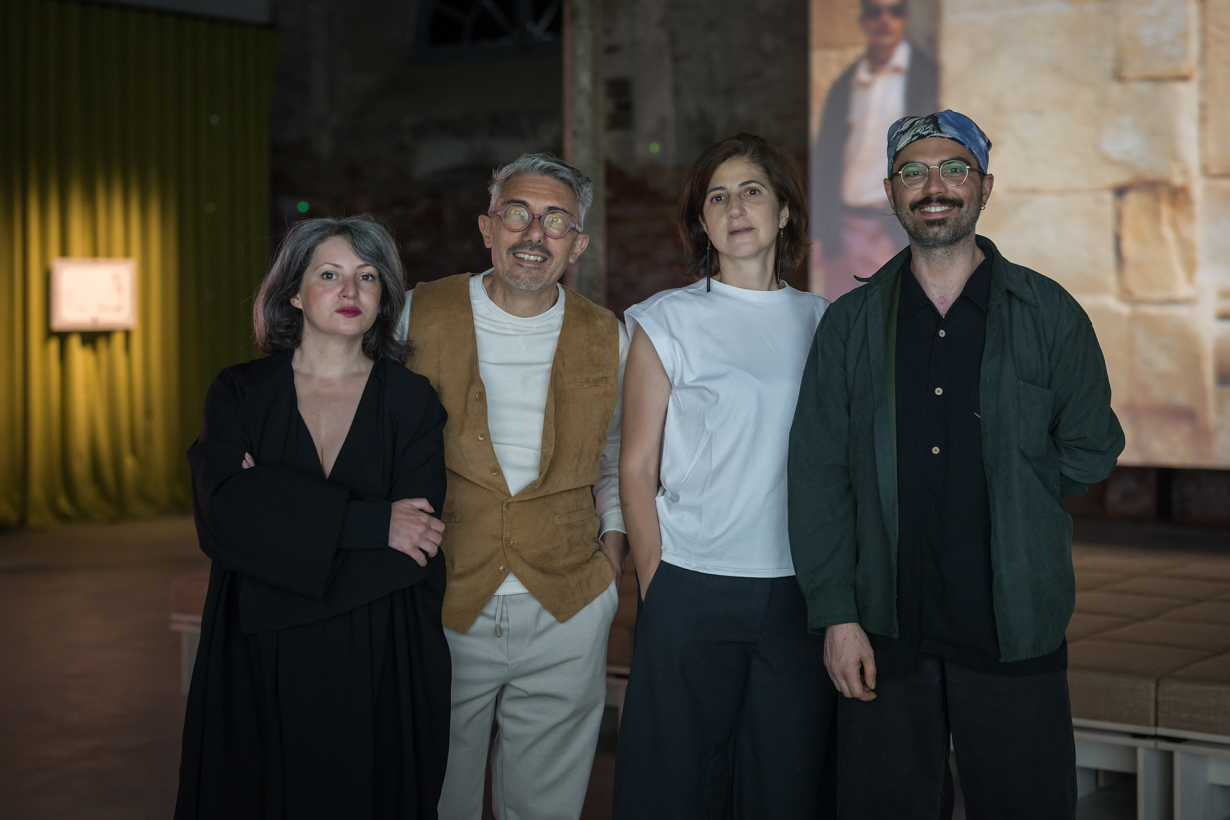
Adrian MM Abela, Charlie Cauchi and Raphael Vella are representing Malta, curated by Margerita Pulè; the pavilion is in the Arsenale.
Celebrating Visions. Versace partners with ArtReview to share stories from the 2026 Venice Biennale.
ArtReview Tell ArtReview what you plan to exhibit in Venice. What has influenced or inspired you?
Margerita Pulè I conceived the pavilion, No Need To Sparkle: Experiments in Love and Revolution, as a space that allows truth to reposition itself in the world; as a triangulation that casts doubt on our convictions, and introduces ‘doubt’ as a way of understanding the world with openness and empathy.
The screen-based works within the pavilion augment this feeling of instability; moving-image in particular has the ability to manipulate or liquefy time and space, so that our sense of reality is diminished as we pass within its orbit.
The three artists in the pavilion have created separate works, but their triangulation within the space allows their shared preoccupations to surface; preoccupations around autonomy, embodiment, authenticity versus artifice, as well as histories and mythmaking.
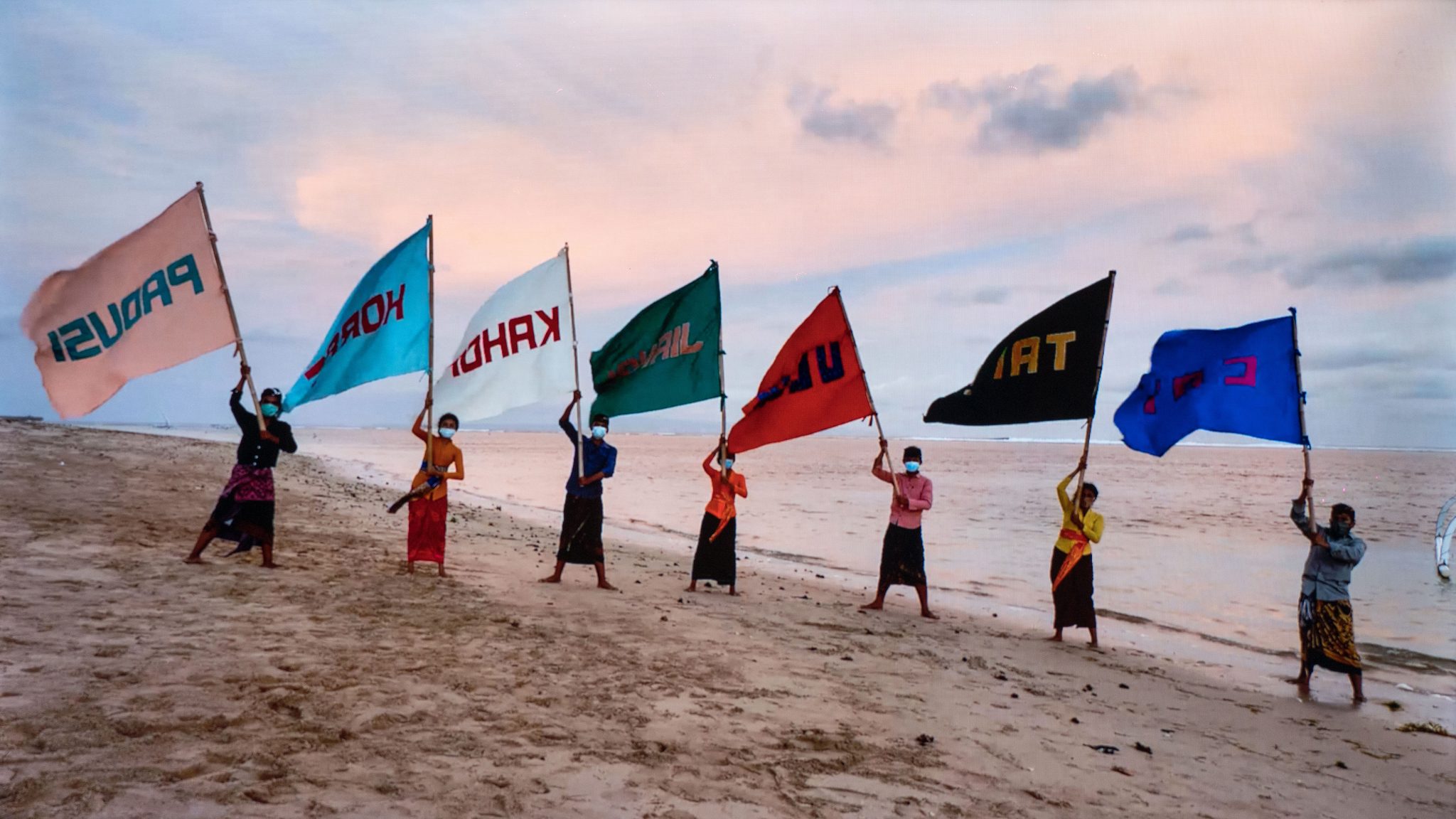
Adrian MM Abela I am showing a work called Declaration of Dependence, a game of surrender that expands on a project I started in 2023. The work is presented as a stage divided into three temporal zones: past, present and future. When the curator first approached me, I felt compelled to propose a work that questions the structure of a Biennale organised through national pavilions, and that worked with her holistic curatorial vision. I also wanted to include work that most people will simply walk past, creating different levels of engagement depending on attention and curiosity, which will exist outside of social media and the spectacle of such an opportunity.
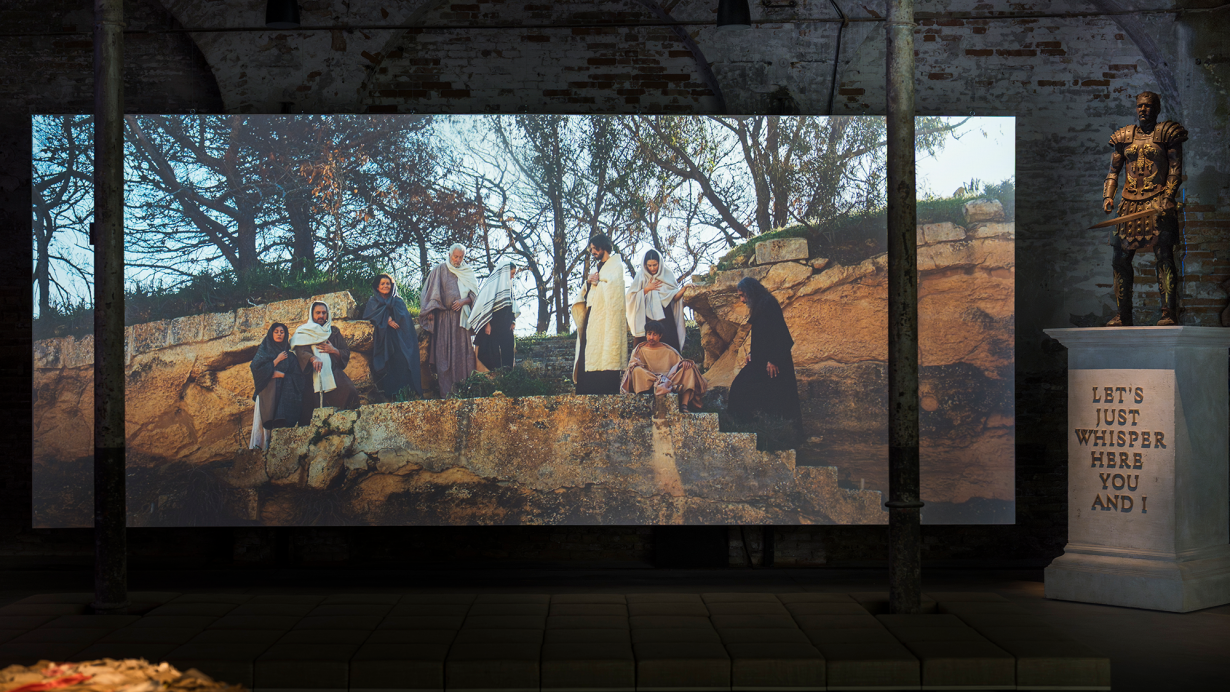
Charlie Cauchi Dolce is a video and sculptural work that engages directly with cinema’s illusions, Malta’s multiple identities and the material realities behind narrative construction. Productions and genres collapse into one another, and actors and locations repeatedly shift roles. Referencing La Dolce Vita and Fellini, the work exposes the illusion‑making machinery of cinema. Dolce interrogates authenticity, identity and labour, revealing Malta not as a passive backdrop but as a historically layered crossroads shaped by migration, global image‑making and the power dynamics of the film industry.
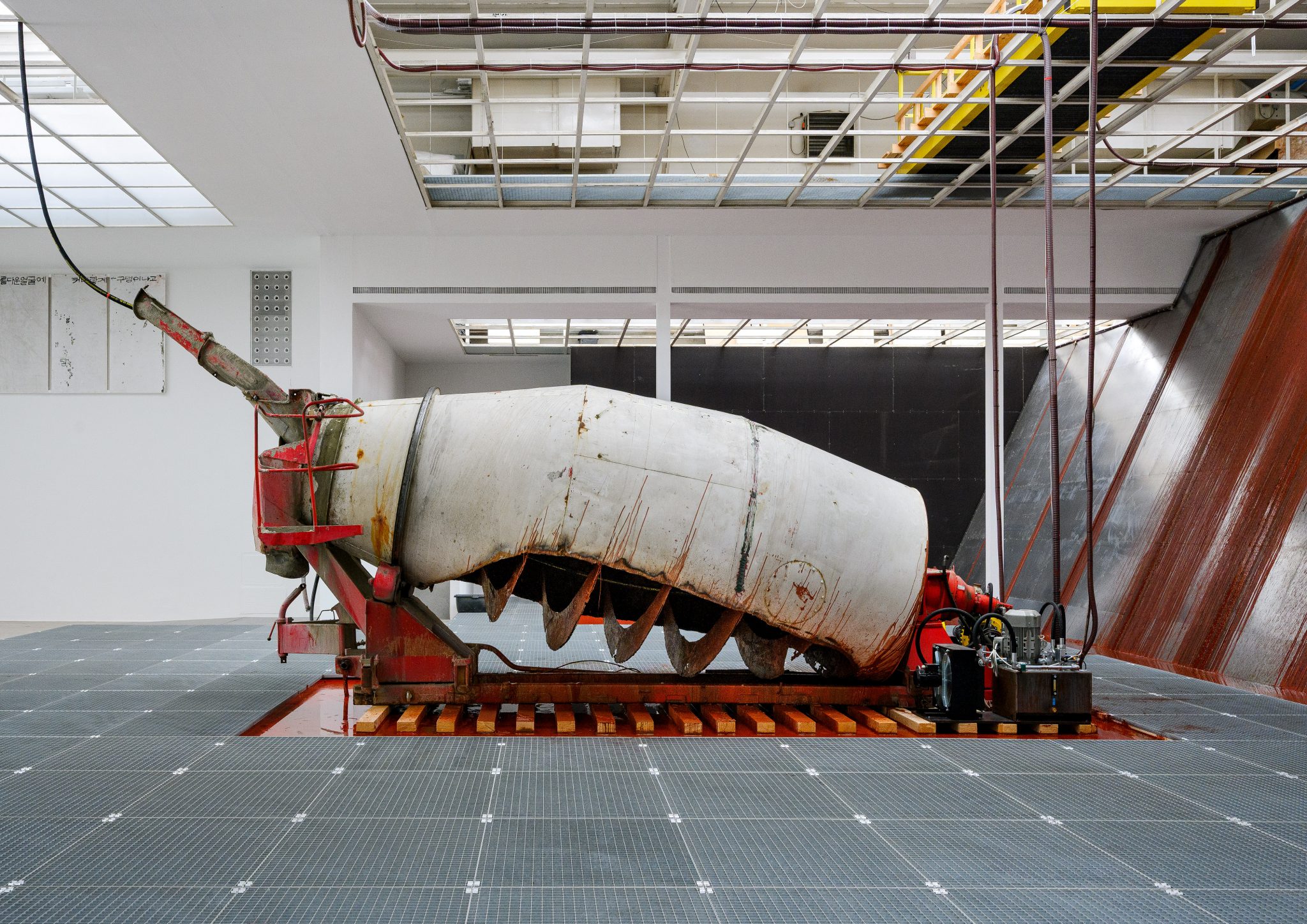
Raphael Vella In Praying for a Revolution That Will Never Come, I look at a century of collective dissent in Malta: from the riots against the British rulers in 1919 to the massive street protests that took place in Valletta following the murder of journalist Daphne Caruana Galizia around a century later. Ultimately, political desire exists in an unreachable future tense, while the unrelenting act of drawing is transformed into an act of resistance.
AR In what ways (if at all) does your work relate to the theme of the Biennale exhibition, In Minor Keys?
All The Biennale’s curatorial text refers to ‘a reservoir of art that acts deeply on the soul and mind’. While the works within the Malta Pavilion are political and intellectual, they are also personal, emotive and almost visceral in their presence. So this ‘reservoir’ is present in our pavilion; in the many layers and depth of meaning that the artists bring to it.
We also see a strong resonance between the Biennale’s reference to ‘enchantment in the face of cynicism about what art can do’, and our pavilion’s title, No Need To Sparkle.
A Maltese perspective is perpetually a ‘minor’ perspective. How one either struggles against this reality or learns to live with it is part of what it means to be Maltese. The inflated ego of some of those who prefer not to present themselves ‘in minor keys’ was perhaps one of the inspirations behind our own pavilion’s title. The artists’ individual works also focus on realities and myths that fall apart, or dreams that appear, only to disappear after a short while.
Within the pavilion, Malta’s minor status comes into focus; frequently pushed to the margins, the island is often perceived as peripheral, but the works resist this framing, instead positioning Malta as a polyphonic place marked by layered histories and a rich, entangled ecology.
Koyo Kouoh’s curatorial text begins with an invitation to slow down, and the pavilion mirrors this gesture in a few ways, through time-based works, and through its proposal to sit within it, and spend time with others.
AR Why is the Venice Biennale still important, if at all?
CC The Biennale needs to be constantly reexamined, and we must be aware of the mechanisms that allow it to evolve rather than stagnate. From the perspective of someone living and working in a small, peripheral context, its importance also lies in visibility and duration. So yes, I still think that the Biennale manages to capture a moment and is a place that continues to generate conversations, shaping the artworld on a global scale.
RV One of the great things about an event like this is the possibility of coming across a broad diversity of themes, artists, curatorial positions and so on, in a context that remains mesmerising every time I visit it.
MP Working from the Mediterranean, and in a small island state, we find ourselves physically on the periphery of contemporary art centres. In this regard, the Venice Biennale represents a moment where we can present our work in a global context. Having said this, I agree that mechanisms of centrality, instrumentalisation and speculation should be challenged within a greater context, and that the value of multiple and peripheral viewpoints should be recognised.
AR What role does a national pavilion play at a time of increasing confrontational nationalisms? Is it about expressing difference or commonality?
RV In the work I am showing in Venice, difference and commonality coexist. Protests exist in all democracies, yet each protest carries unique characteristics that pertain to a specific context, set of experiences and political relations, and so on. The work is not representative of a nation but deliberately brings together multiple voices in a restricted space, where they surface temporarily only to be submerged by the sheer weight and momentum of history.
MP Ultimately there is a tension between participation in the Biennale as an exercise in soft power, and it being a space to produce and show contemporary art; the two do not sit well together. Contemporary art often speaks truth to power, and uncovers elements that diplomacy would rather gloss over, leading to a possible contradiction between the commissioning body’s aims and those of the exhibiting artists.
Having said that, our pavilion speaks about the specificities of certain elements of Malta, but many of these elements are universal, or at least can be related to many other postcolonial countries in the world. Therefore I don’t see difference and commonality as mutually exclusive in this case; we can speak about our specific contexts while still speaking about the human experience.
AR Who, for you, is the most important artist (in any discipline) that your country has produced?
AMMA It is difficult for me to measure importance in art, or to think that the artist was produced by a country, but I could say that the most important art that happens in Malta is made by the artists that work on the production of Catholic feasts or the Carnival floats, as they keep the island alive and are somewhat specific to the history and amalgam of the island, which in turn I feed off of for my work.
MP I think here I’d like to reflect something of Adrian’s reply and mention those who created the Sleeping Lady 5,000 years ago, the builders of Neolithic Ġgantija temples in Gozo, the bakers of the Maltese sourdough ħobża, and the boatbuilders who still make the Maltese luzzu among others. But then I’d also like to look to the future with some of the young Maltese artists that I can see emerging from art schools at the moment who show enormous dedication to their practice, and bode well for the future.
CC I struggle with superlatives in most things, especially art. And particularly when I am surrounded by talent and continually discovering both past and present works.
AR What is something you want people to know about your nation that they might not know already?
AMMA That it does not truly exist as a nation, but is a construct of other powers. Yet Malta as a place, as a Mediterranean island, is pregnant with potential, and I cannot wait to see what the future holds.
AR Given that you are exhibiting in a national pavilion, is there something (a quality or an issue or attitude) that distinguishes the art of that nation from that of others? That makes it particular? Are there specific contexts that it responds to? Or do you think that art is a universal language that goes beyond social, political or geographic boundaries?
CC I think the pavilion deliberately sits between national specificity and universality. Rather than identifying a singular quality that distinguishes the art of one nation from another. Instead we ask what kind of work can emerge from a place shaped by a complex colonial history and ongoing forms of projection. Malta’s history, alongside my own personal history (born in London to Maltese parents with an Italian grandfather), complicates any straightforward notion of national identity. In this sense, the work responds to specific social and historical contexts without treating them as fixed or self-contained. What matters to me is not how art can represent a nation, but how restrictive the demand for representation can be, and how those limits might be exposed rather than resolved.
AMMA When my friends from LA visit Malta with me, they all point out how my work is actually very ‘Maltese’. I admit that I am not trying to be original or unique. I probably make this kind of work because I am trying to recreate a state from my childhood, and that happened with ‘Maltese’ aesthetics around me that keep showing up as imagery or objects in my work. My aim is to elicit that uncorrupted view of the world, before language gave us a lens through which to look. I believe that people are the same everywhere and nations are just current notions. If there is anything that one can point out as a distinction, it is most probably just because they haven’t looked deep enough.
AR What, other than art, are you looking forward to seeing – or doing – while you are in Venice?
All The last six months have been such a whirlwind of plans, renders, messages, emails, online meetings and Gantt charts that I think we’re looking forward to spending time physically together with the rest of the team in the Arsenale, and feeling part of something bigger than us. Essentially, meeting as many artists and other people as possible, and talking about our and others’ pavilions, and about the crazy world we are currently living in.
AR Could you give us a brief overview of your average working day while creating your presentation in Venice?
All For the whole team, every day is different, and there has been no ‘average working day’ in this project – we have been working across time zones while juggling other projects and demands. Adrian wakes up early and checks up on messages that have come in during the night, then checks in with his collaborators in LA to follow the development of his work. Raphael regularly puts in a few hours of drawing every day before the rest of Malta wakes up. And Charlie’s days have been intense, with work progressing from the filmset to postproduction. The curator’s role, on the other hand, is very broad, with elements of curating and thought, but also creative production, combined with production, writing, administration, fundraising, care and some diplomacy thrown in.
All of the works, as well as the pavilion itself, have been deeply collaborative, involving constant planning, correspondence, and problem-solving around the limitations of the presentation. The chorus of voices, the perspectives and the element of chance or mystery that is allowed in.
AR Can art really change the world?
AMMA Art cannot change the world – the world changes on its own. But art can give us new lenses through which we understand those changes and perhaps adapt to them more consciously.
RV Actually, most of my work as an artist deals with institutions like education, medicine and politics, all of which explicitly aim to change people’s lives in one way or another. But artists should not be expected to change the world. As an artist, I feel drawn to engaging with issues that affect people’s lives and experiences of living in specific contexts with other people. But engagement does not necessarily mean that I feel I am initiating some sort of positive change in the world.
CC That’s a big claim to make. What art can do is change how we understand the world, ourselves and how we relate to one another. If you are a person open to this, of course, it can shift perception.
MP There is a strength in engaging with artistic practice (whether as artist, curator or viewer); the creative process itself is one that demands sensitivity, focus, and thought – all things that the world seems to be missing right now. The decision to engage with purpose in something that is creative rather than destructive, and aesthetic rather than utilitarian is, intrinsically, a step away from how the world functions at the moment.
The 61st Venice Biennale runs 9 May through 22 November 2026