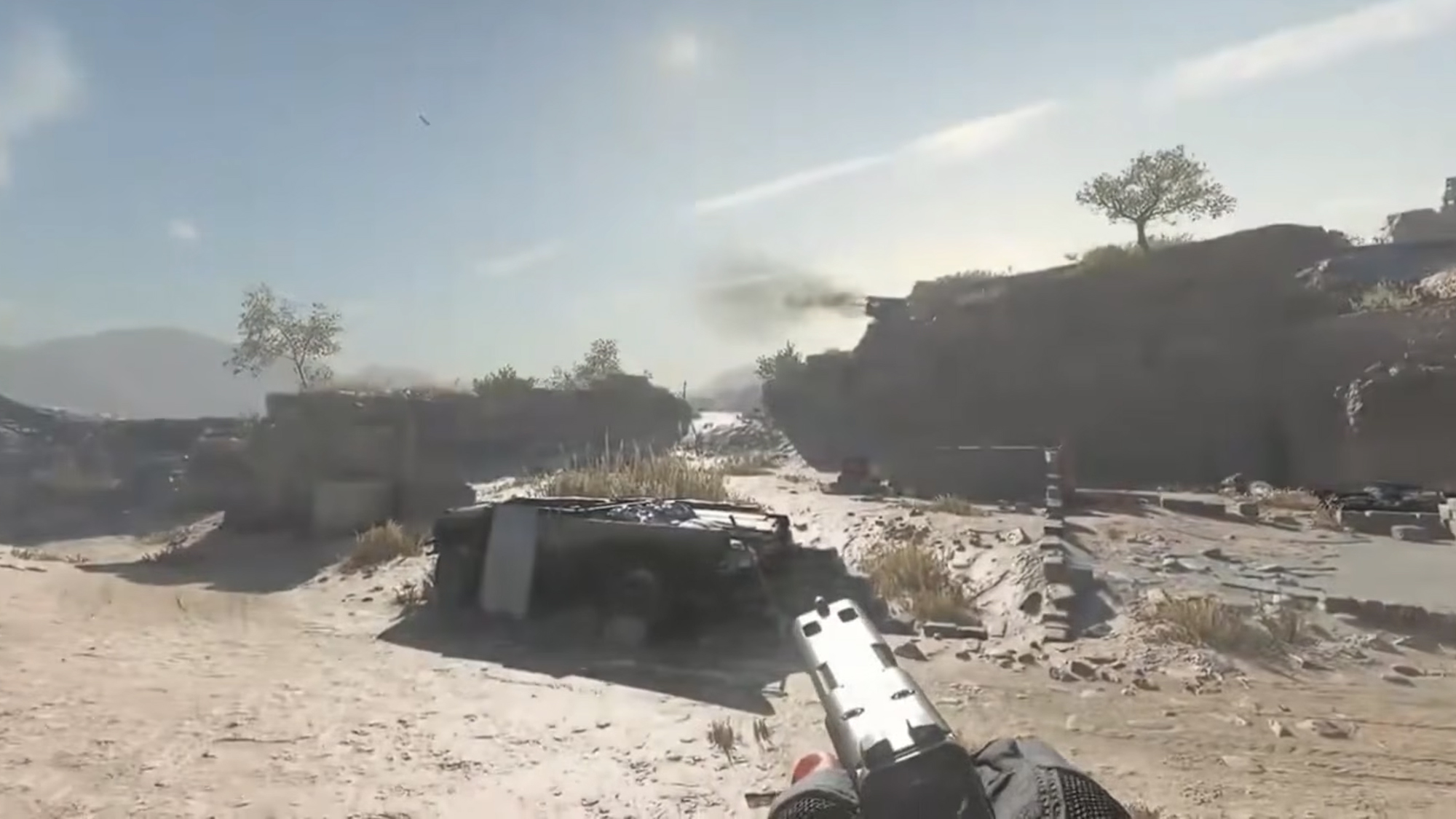
What’s happening is less the corruption of a sacrosanct form of play than the interactive medium’s return to, and reentanglement with, its military roots, says Lewis Gordon
Scientific research is fairly definitive: playing violent videogames does not make you more likely to harm your fellow human beings. For the past 30 years, psychologists have expended much energy proving this point, pushing back on the alarmist arguments of US politicians like Joe Lieberman and Leland Yee. There is an almost cosy reassurance to this idea: it seems to suggest that these digital playthings are siloed from the real world – that their influence is unlikely to cross the threshold from screen- to meat-space.
Yet it’s clear now that the greater risk posed to the world was not 1990s and 2000s teens enticed by the pleasures of first-person shooters like Doom (1993) but the modern billionaires, politicians and even videogame companies using the interactive medium for their own means. In March this year, the White House posted shameless propaganda mixing Call of Duty (2003–present) footage with American missile strikes hitting Iran; in October 2025, Donald Trump was depicted as an AI sloppified Master Chief from the hit sci-fi shooter series, Halo (2001–present). More chilling, if no less surprising, is the chummying up of videogame companies to warmongering governments and military contractors. Microsoft provides the Israel Defense Forces with Azure cloud and AI services, and in 2020 saw one of its Xbox controllers being used to maneuver an Israeli tank, thus simplifying and streamlining the act of exploding human bodies. The latest example is stranger yet: real-world locations captured by Pokémon Go (2016) players on their mobile phones (per opting in) have been used to train an AI model that may help US military drones and robots navigate warzones.

Like much of today’s tech, from GPS to the internet, the roots of videogames lie in the army research centres of the mid-twentieth century. Spacewar! (1962), for example, widely considered to be the first videogame, was developed by graduate students on an early Pentagon-funded computer at the Massachusetts Institute of Technology. What’s happening is less the corruption of a sacrosanct form of play than the interactive medium’s return to, and reentanglement with, the war machine. Pokémon Go also makes clear a more fundamental shift: the way reality itself is seen by war-minded technologists as something to be gamified – a subject to cast an algorithmic net over.

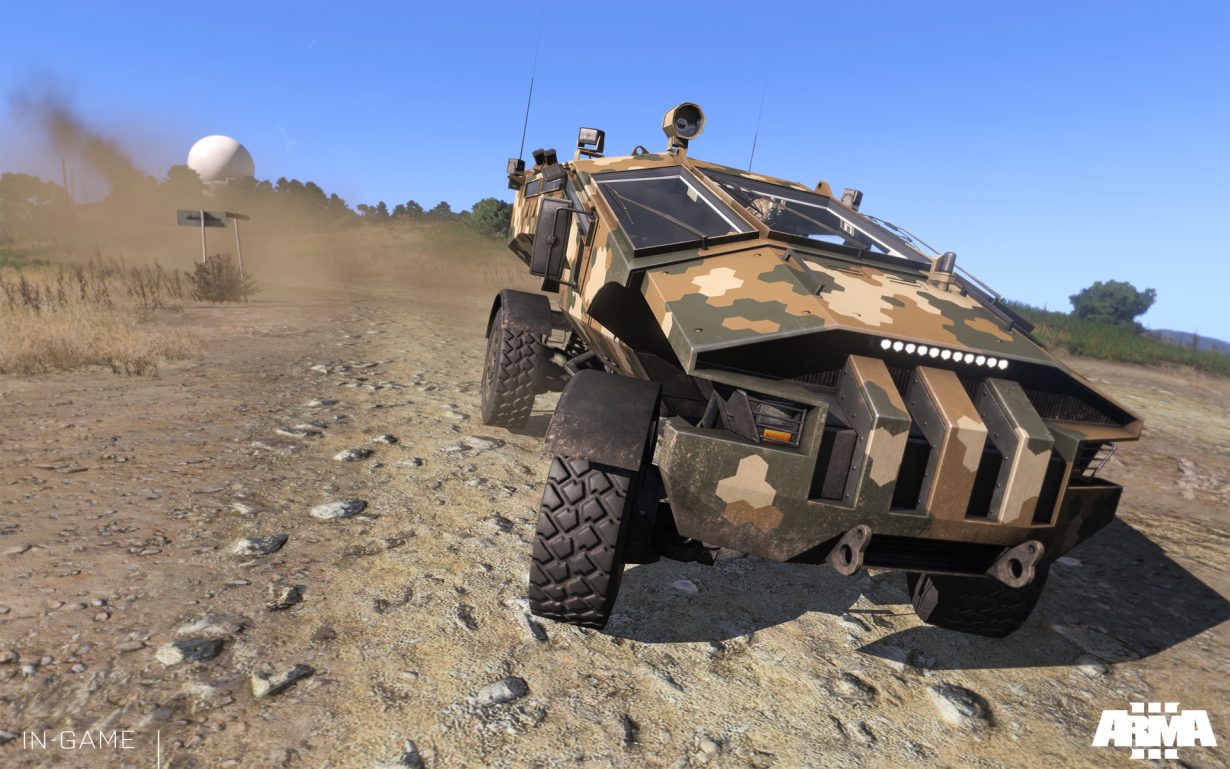
But the mixing up of videogames, warzone, digital combat and actual combat often occurs in cruder fashion (Adam Curtis would likely groan at the lack of subtext). The hardcore military shooter Arma 3 (2013) is often misidentified as war footage. The recent ‘You Belong Here’ advertising campaign for the British Army, meanwhile, actively aims to capture the intensive first-person perspective of precisely this kind of hardcore military experience. The military personnel in each photo – soldiers on the battlefield, in a control room and on a makeshift football pitch – appear to stare down the lens of the camera, orienting the image around the perceptual point of the viewer, transposing the tunnel-vision experience of first-person shooter to jingoistic ad boards across the UK.
And earlier this year, Call of Duty appeared on the streets of Minneapolis after armed federal agents, wearing masks and tactical vests, wrestled thirty-seven-year-old Alex Pretti to the ground and shot him dead. “It’s like Call of Duty,” one agent could be heard saying via a TV mic, referring to a first-person shooter military videogame. “So cool, huh?”

We might, then, think of Call of Duty as a kind of outsourced bootcamp for Trump’s technofascist US administration, one that offers a decidedly more gung-ho experience than the sober training simulations otherwise used by military forces. The German filmmaker and artist Harun Farocki gave us a peek into these simulations in a series of films titled Serious Games I-IV (2009–10). In the first of them, a squad of tank operators avoid explosive devices in a virtual desert using laptops. Watching today, the simulation appears basic: the graphics are conspicuously flat. The broader atmosphere is oddly airless. Also noticeable: the trainee soldiers are practically serene, hardly breaking a sweat. But the film is unnerving, still, as we the viewers make a mental leap to the future: imagining these young soldiers in an actual warzone driving an actual tank, thinking of the shaking panic they would feel in their bodies if they were confronted with real explosives and bullets.
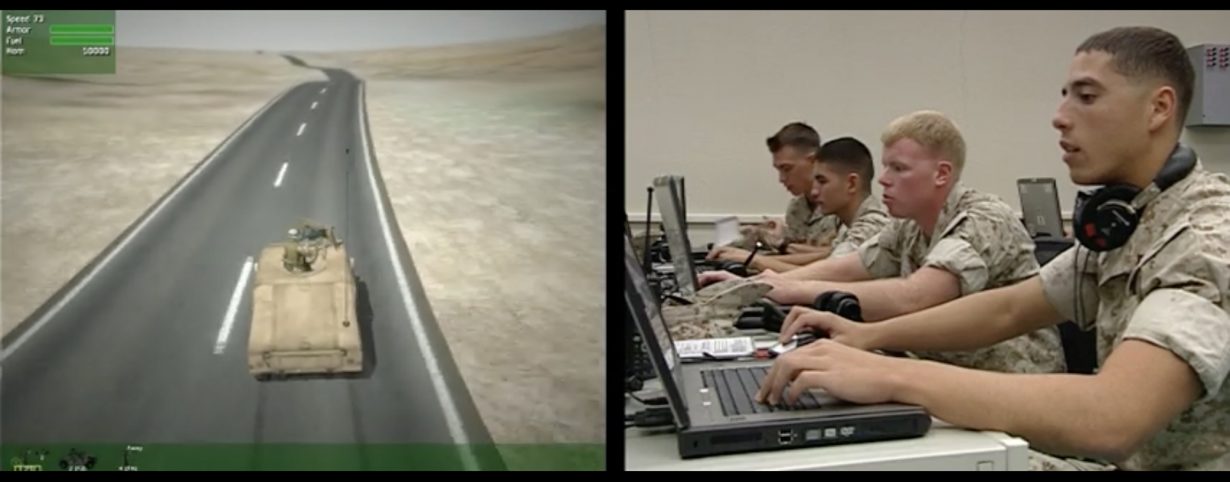
In the preparatory combat moment that Farocki documents, the videogame doesn’t just simulate a given scenario but the idea of control. Control is at the heart of an experience that videogame companies have long marketed to players, and appears to be at the centre of their pitches to military departments. The Pokémon Go-trained AI models could theoretically enable drones to zip about environments with greater accuracy. The videogame software company Unity became the ‘preferred real-time 3D platform’ of the US government in 2022, parlaying years of videogame R&D into a software stack that promises to ‘reduce risk, accelerate innovation’. At the level of individual soldier, former VR game developer Palmer Luckey is leading development of a new ‘visual augmentation’ headset for the US Army. The puffed-up marketing spiel on his blog is pure videogame sales-speak, boasting of turning ‘warfighters into technomancers’ through an ‘idealised interactive real-time composite of past, present, and future’. The vision of the gamified warzone is clear: data from top to bottom overseen by a general posing as a kind of remote dungeon master. Who cares that the infrastructure carrying that data is liable to get blown up.
How seductive it must be for these military departments to believe that they can conceive of the world as an airtight, controllable space, one that can be parsed according to a digitised, programmatic logic and which can be rendered as a virtual facsimile. For them, the world is increasingly a videogame and the rest of us are just subsumed within it: as numbers, variables, NPCs – wrinkles in gameplay.