The artist’s deconstructed experience of airline travel tells us something about the way objects hold memory, or the ways in which we like to think they do
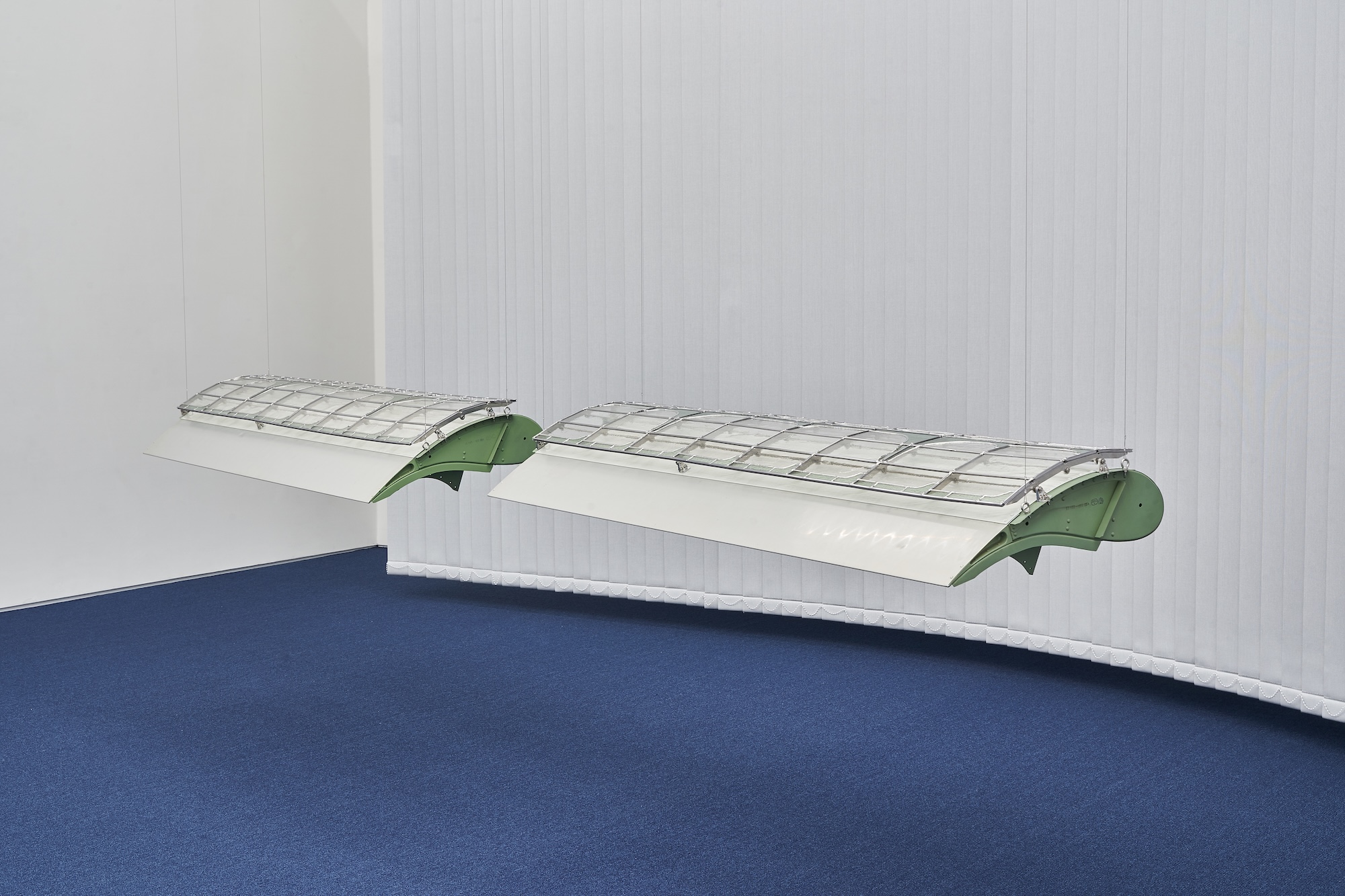
Ju Young Kim’s exhibition is a collection of seemingly discrete objects that persistently insist that they are part of a larger narrative whole. The fact that the two largest objects in the show were clearly once a pair of flaps from an aircraft wing, and that you’ll have passed underneath an aircraft exit sign, albeit with stained glass embellishments, to get to them should tell you that the narrative concerns commercial airliners. Albeit airliners that have been atomised and transformed by the artist. In the gallery’s street-facing front window there’s a seatback tray-table (In the morning I wish you a good night; 2026) turned into the top of an actual table, set on spindly, arcing, metal, plantlike art-nouveau legs. The wing flaps (The skin remembers the air; 2026), meanwhile, have inset stained-glass panels that seem both to reveal their structure (in a Leonardo-da-Vinci-ornithopter-sketch type fashion) and to add a superficial, decorative gloss. Suspended in the centre of the space they hover between meanings and functions – which might, obviously, be one reading of the exhibition’s title, Holding Room. But there’s a suggestion (which follows from the title of this particular work) too that any sense of inbetweenness might result from the fact that objects hold memory just as much as does the eye of their beholder. But even if you might be wondering who started it, this isn’t about a blame game.
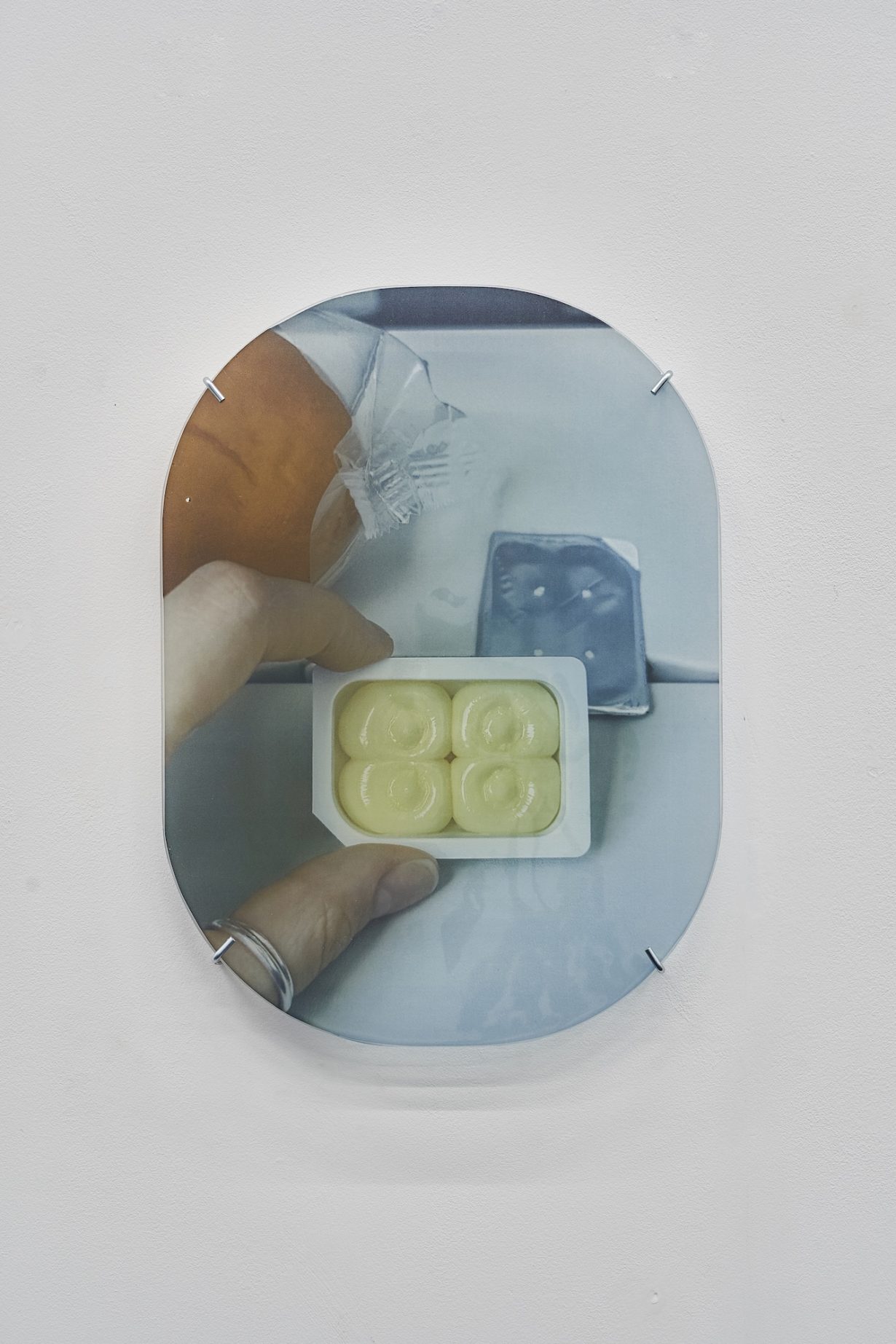
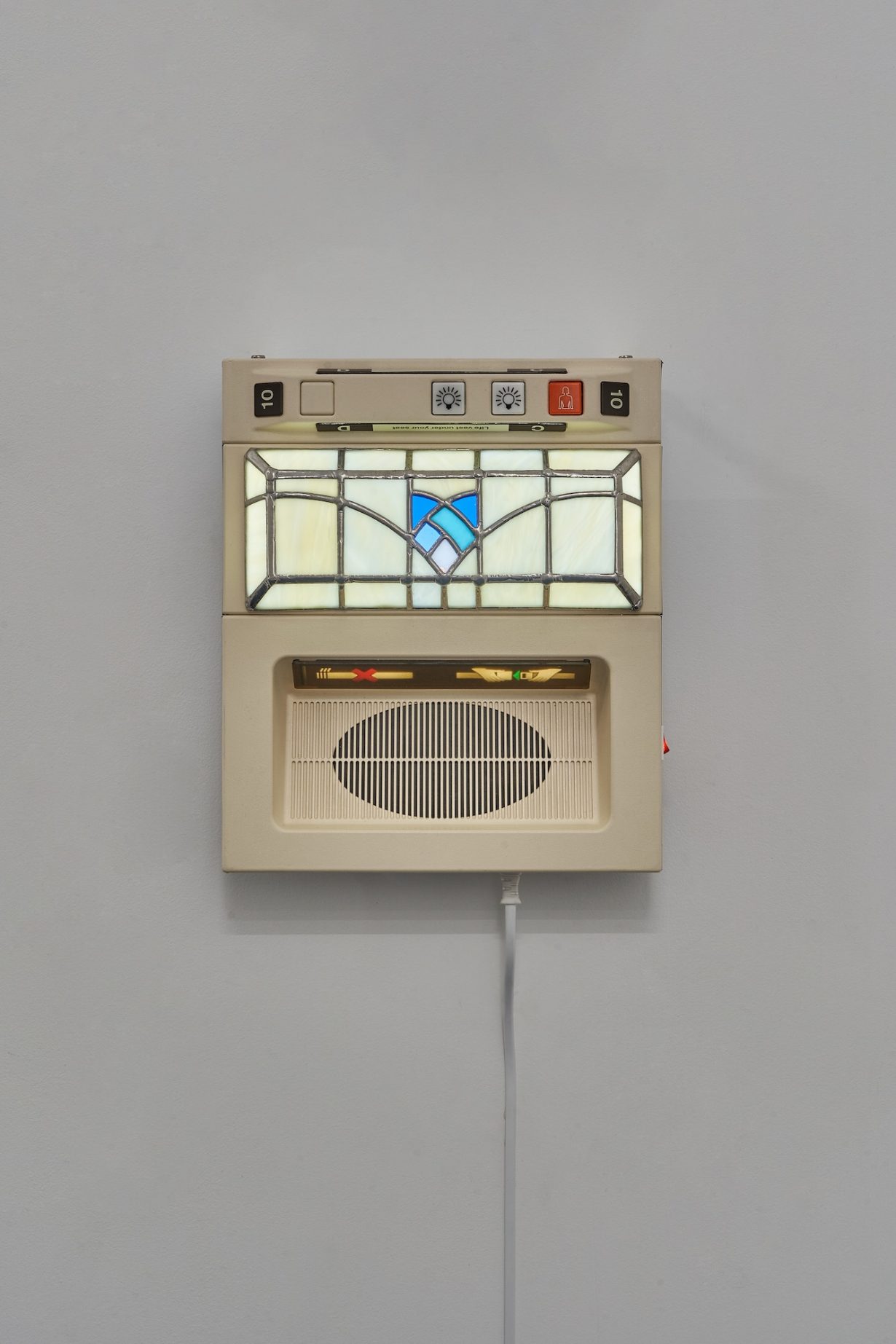
A series of works on glass, Cabin temperature (2025–26), shaped as if aircraft windows, features photographs of various views from the perspective of an airline passenger: the emergency exit instructions; the plastic-wrapped pad of butter in an airline meal; the above-seat climate controls; a view of an aircraft wing. Collectively they convey the feeling of being in flight, but also of being somewhere but nowhere. Nearby is an actual passenger service unit (of the type that would normally be located above a passenger seat in a commercial aircraft), fixed flat to the wall and incorporating an art-nouveau stained glass light fitting sandwiched between the ‘fasten seatbelt’ signs and the cabin-attendant call button (Under the reading light 10C and D, 2026, is the flat description offered by its title). There’s no attendant to call here though. Unless you’re making an enquiry about buying the work.
Their redundancy provokes a Kantian enquiry (of the type the German philosopher offered in his Critique of Judgment, 1790) about ‘purposiveness without purpose’ (looking like you’re supposed to do something but not actually doing anything) being the fundamental quality of art. Here you recognise standard bits of airplanes and might be fascinated by their engineering. You appreciate the relatively slight gestures that have transformed them into works of art. Is this upcycling or downcycling? Would the answer to that question depend on what value you place on art? Or what value you place on an airplane? And, given that the entire space has been carpeted a corporate blue and a logo for ‘Aeroplastics’ (presumably an invented corporation) slapped behind the gallery reception, where are you exactly? Or where is it that the artist wants you to think you are? Before you know it, a simple questioning of what’s in front of you and why you see things in simple ways descends into a very contemporary artlover’s paranoia about not landing at the ‘correct’ destination.
Ju Young Kim: Holding Lounge at P21, Seoul, 21 March – 24 April
From the Summer 2026 issue of ArtReview Asia – get your copy.