What can a biennial realistically achieve by temporarily corralling defunct churches and activating ‘creative mediation’?
“Deep in the West, where the sun gathers dust! It’s better, much better, than you might think!” sings German rock legend Herbert Grönemeyer in Bochum, the 1984 hymn to his hometown in Germany’s Ruhr area, a region of urban clusters built around the coal and steel industries that powered West Germany’s postwar ‘economic miracle’. His lyrics strike a more affectionate tone than the city’s own tongue-in-cheek saying: ‘Why live in Bochum? It’s shit elsewhere, too!’ At the press conference opening the 16th edition of the nomadic European biennial Manifesta, taking place in Bochum and nearby Duisburg, Essen and Gelsenkirchen, the SPD’s Frank Dudda, who is chair of the RVR Ruhr Parliament, delivered a speech full of Grönemeyeresque regional pride, but also peppered with talk of “tensions”. In June, Gelsenkirchen’s far-right AfD politicians filmed themselves handing out brooms and cleaning products to residents with migrant backgrounds, demanding they clean the streets and their front doors. The AfD is tied with the SPD on Gelsenkirchen’s council, reflecting a broader shift across the region, and indeed Germany, where the AfD now leads national polling.
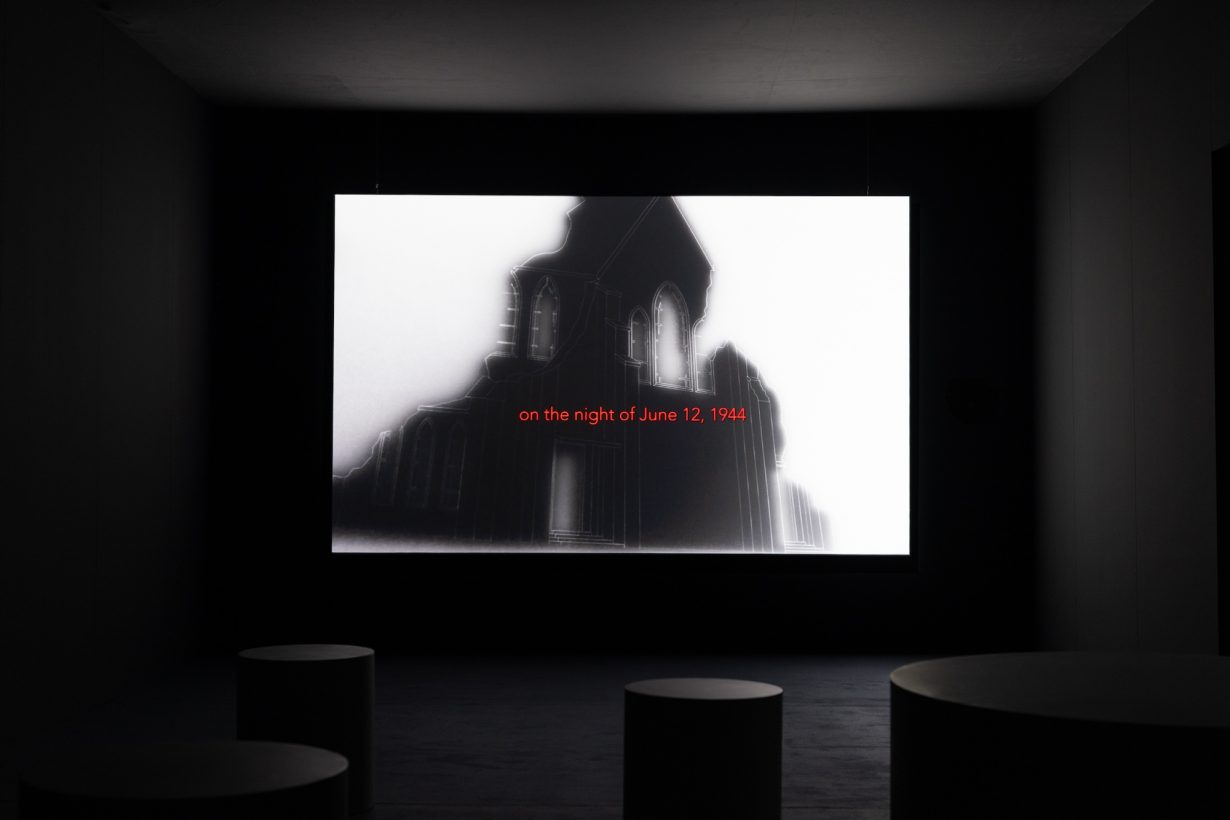
An emboldened far right is one of many interconnected phenomena the ‘Ruhrpott’ shares with other regions across Europe that have faced economic decline. (‘Pott’ stems from the slang word for a cooking pot, a metaphor reflecting the valley’s bowllike shape, its industrial crucibles and its history as a working-class melting pot.) Another is the changing use of space in postindustrial landscapes. Subtitled This is not a church, the 106-artist biennial occupies 12 deconsecrated or underused churches across the four cities, again reflecting a Europe-wide trend towards secularisation. Most are modernist gems, and much has been said about how postwar church-building was propelled by ambitions of renewal and rebirth after the devastation of the Second World War. This resonates with Manifesta’s founding principle to catalyse ‘positive social change… through art, architecture and urbanism’ across a more open Europe after the Cold War. But what can a biennial realistically achieve by temporarily corralling defunct churches and activating ‘creative mediation’ (Manifesta does not have curators, rather ‘creative mediators’, which enforces the ambition of social bonds). A popular basketball court installed at Gelsenkirchen’s St Josef by community project Social BallerZ e.V. has received calls for it to remain post-Manifesta, suggesting that an intervention with no artistic pretensions might have the biggest impact. But in the age of a globalised economy dictated by the gods of techno-feudalism, the art here largely does what art should: illustrate the situation. At the Kulturkirche Liebfrauen in Duisburg – curated by Michael Kurtz and Henry Meyer-Hughes, and free to enter, like all the presentations – Elizabeth Price continues her film series investigating postwar churches, which she describes as an architectural ‘expression of postwar trauma’, with WHERE ARE YOU WHERE ARE YOU (2026), in which she compares a modernist church in London’s Bermondsey with Essen’s Marienkirche, built on the ruins of its nineteenth-century predecessor. Price’s work is representative of many artworks in this Manifesta, which generally function, to borrow her phrase, as an ‘expression of postwar trauma’, or the fallacy that we are ever ‘postwar’.
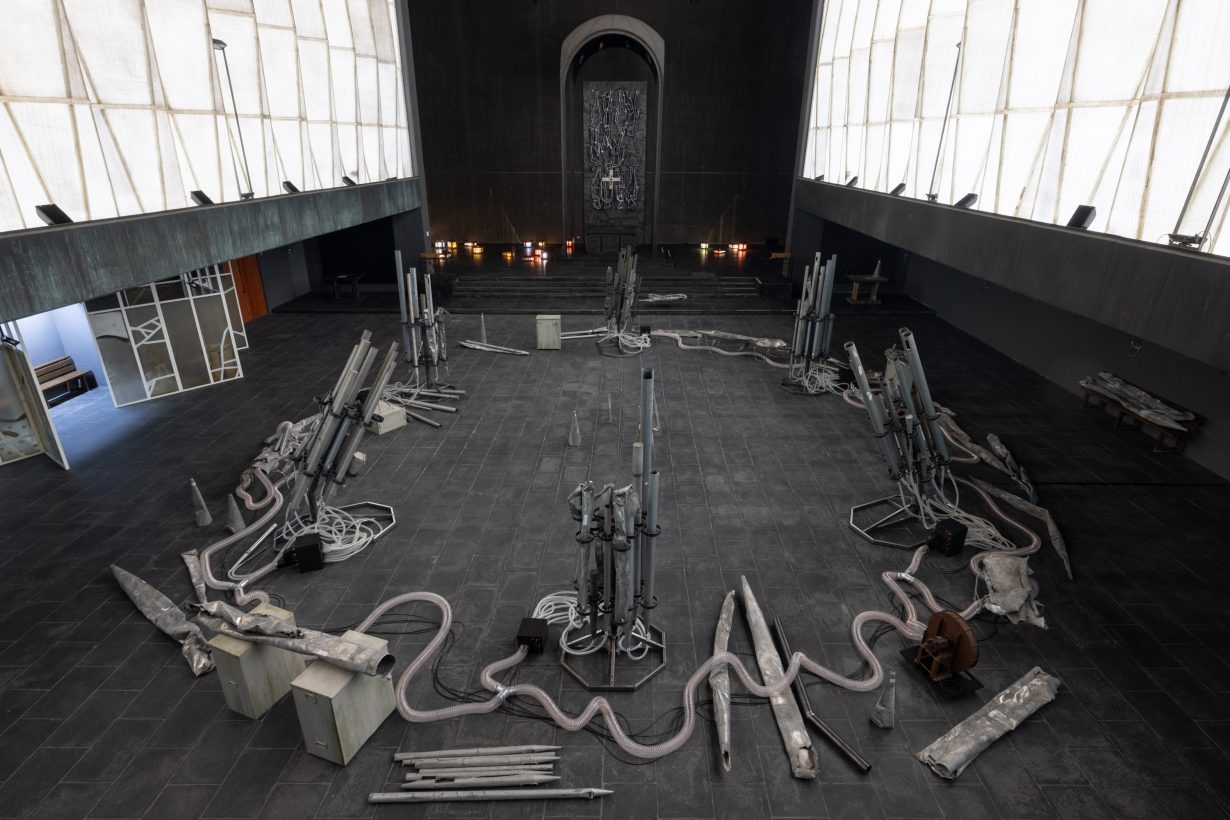
At Bochum’s Christ-König Church, built in 1932 when the Nazis were ascendent in the Reichstag, Luc Tuymans’s KINO (2026) is a gargantuan pleated-textile frieze spanning the length of the nave. In this work, which is printed with colourised scenes from Leni Riefenstahl’s propaganda film Triumph of the Will (1935), Tuymans switches the red of the flags to blue and removes the swastikas, arguing that the ‘sacralised status of the church and the imagery, stripped of both the holy and ideological power, leaves behind a vacuum’. Back at Kulturkirche Liebfrauen, Abbas Zahedi’s similarly arresting Ouranophobia 47051 (2026) is a sprawling sound installation formed of ‘orphan pipes’ from disused or damaged organs across Europe, pointedly some from Kyiv’s Church of St Nicholas. Like KINO, Ouranophobia 47051 not only addresses a ‘vacuum’ – that of silenced organs, which are, to quote Zahedi, ‘symbolic of the disappearance of communal faith and shared experience’ – but similarly evokes war in the installation’s resemblance to a dieselpunk set of missile launchers.
Buried narratives of ‘guest worker’ miners are extracted through a deep dive into the Ruhr Museum Photography Archive in Pınar Öğrenci’s film Glück auf in Deutschland (Good Luck in Germany) (2024) at Bochum’s St Anna. A particular moment shows the miners, their families and other migrant workers wearing white clothing at demonstrations to prove their ‘cleanliness’, with sinister echoes in the AfD’s aforementioned broom-handing stunt. Brutal industries such as coal-mining required faith; workers focused on God (rather than their bosses) to keep them safe from daily danger (as Öğrenci exposes, the Muslim faith was not so easily accommodated). In the postwar years, the Ruhr area saw the mass construction of Catholic ‘Pantoffelkirchen’, literally churches you could walk to in your slippers, nestled deep in neighbourhoods. As sites of ‘renewal’ and community, they also strategically anchored the model of residential dispersal, considered more resilient to aerial bombing.
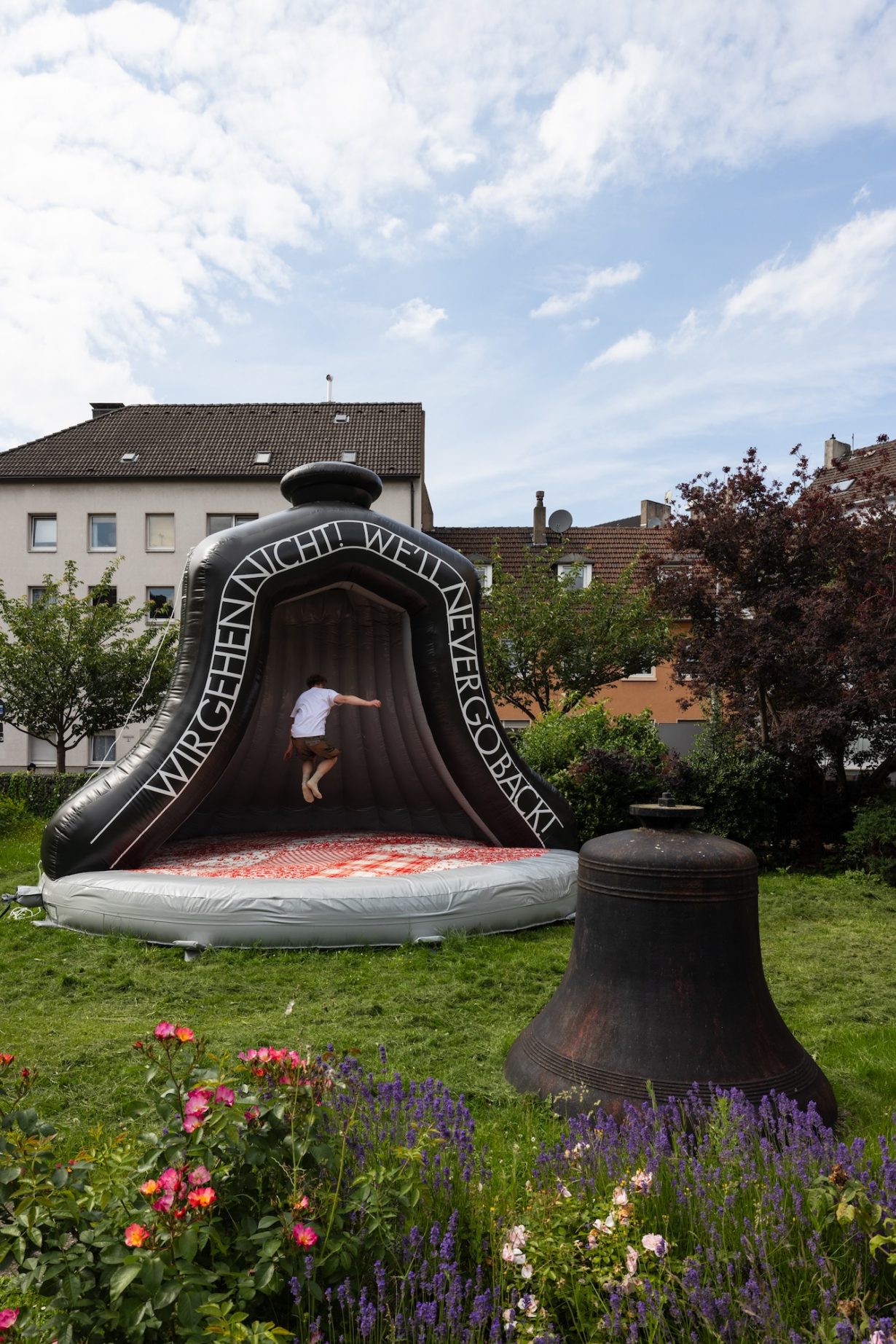
The Pantoffelkirchen were certainly used by Catholic workers from Poland, who’d been immigrating to the labour-rich region since the nineteenth century. Marking the historic Polish presence, curators Krzystof Kościuczuk and Anda Rottenberg were invited to lead exhibitions in Bochum, featuring a strong showing from Poland, including Zuza Golińska’s sculptural ‘upcycling’ from the Gdańsk shipyards and Małgorzata Mirga-Tas’s wax sculptures based on her monument, vandalised in 2016, to a Roma group massacred by German and Polish police in 1942. In front of Gethsemane Church, Belarusian artist Marina Naprushkina’s ‘bouncy castle’ Kein Geläut (No Chime, 2026) takes the form of a cut-in-half bell. Recalling Auschwitz’s infamous gates, a slogan curves along the cross section of the bell in a typeface that cements the ‘Arbeit macht frei’ association, and says in German and English, ‘We’ll never go back!’. Is this the retort of migrants in the region, or those currently affected by the Belarus–European Union border crisis, who are, as the bouncing is supposed to imply, in a state of suspension between the artist’s homeland and Poland? When a participant bounces, they become the bell’s clapper as they hit its sides; no chime sounds, but you do hear their inevitable, euphoric laughter.
In Gelsenkirchen, creative mediator Gürsoy Doğtaş, a child of ‘guest worker’ parents, considers canonisation by augmenting churches’ names. St Bonifatius becomes St Bonifatius – Ferdane Satır Tea Garden, for the beloved Duisburg resident murdered in a racist arson attack in 1984. At Thomaskirche – Hava Güleç Living Room, Güleç’s dough-scraper, brought from Turkey to her new home, presents evidence of ‘a woman, a worker, a bearer of knowledge that no system recognises’, to quote the exhibition text. Nearby, untitled photographs by Asimina Paradissa, taken between 1965 and 75, as she arrived in West Germany from Greece, provide a glimpse of everyday joyful moments in the women’s dormitory of her factory hostel. Paradissa’s dynamic snapshots of women dressing up, dancing and eating together offer some humanity, even revolutionary optimism, amid a surfeit of gods and machines, and as such become, almost accidentally, some of the most stirring images from Manifesta 16.
Manifesta 16 Ruhr: This is not a church, Various venues, Ruhr, through 4 October
From the September 2026 issue of ArtReview – get your copy.