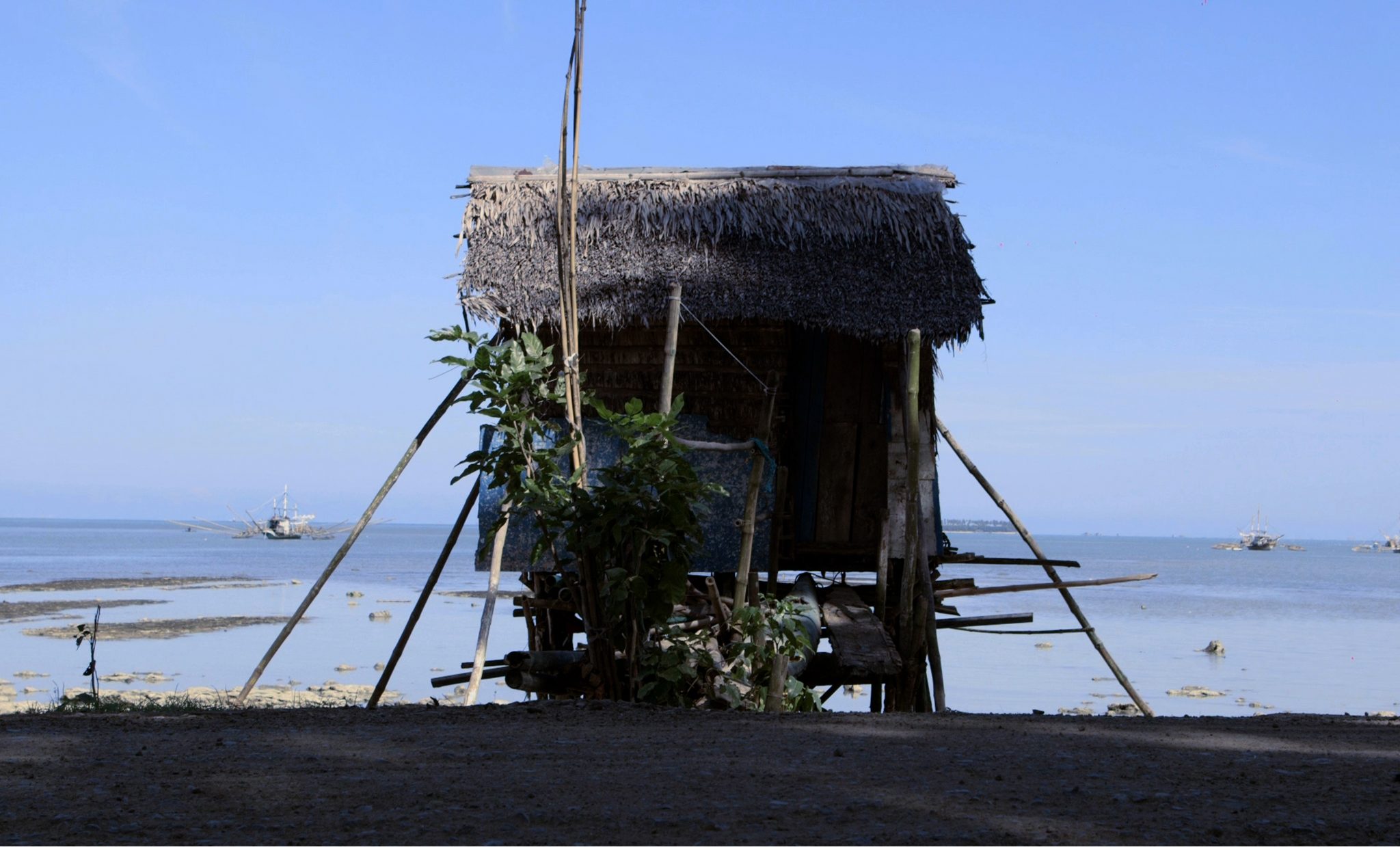
“In a moment of renewed debates about sovereignty, borders and strategic infrastructure, it feels urgent to bring Panama’s Canal histories, and the communities displaced around it, into a global frame”
ArtReview sent a questionnaire to artists and curators exhibiting in and curating the various national pavilions of the 2026 Venice Biennale, the responses to which will be published daily in the leadup to and during the Venice Biennale, which runs from 9 May through 22 November.
Antonio José Guzmán and Iva Jankovic (Messengers of the Sun) are representing Panama. The Panama Pavilion is in the Arsenale.
Celebrating Visions. Versace partners with ArtReview to share stories from the 2026 Venice Biennale.
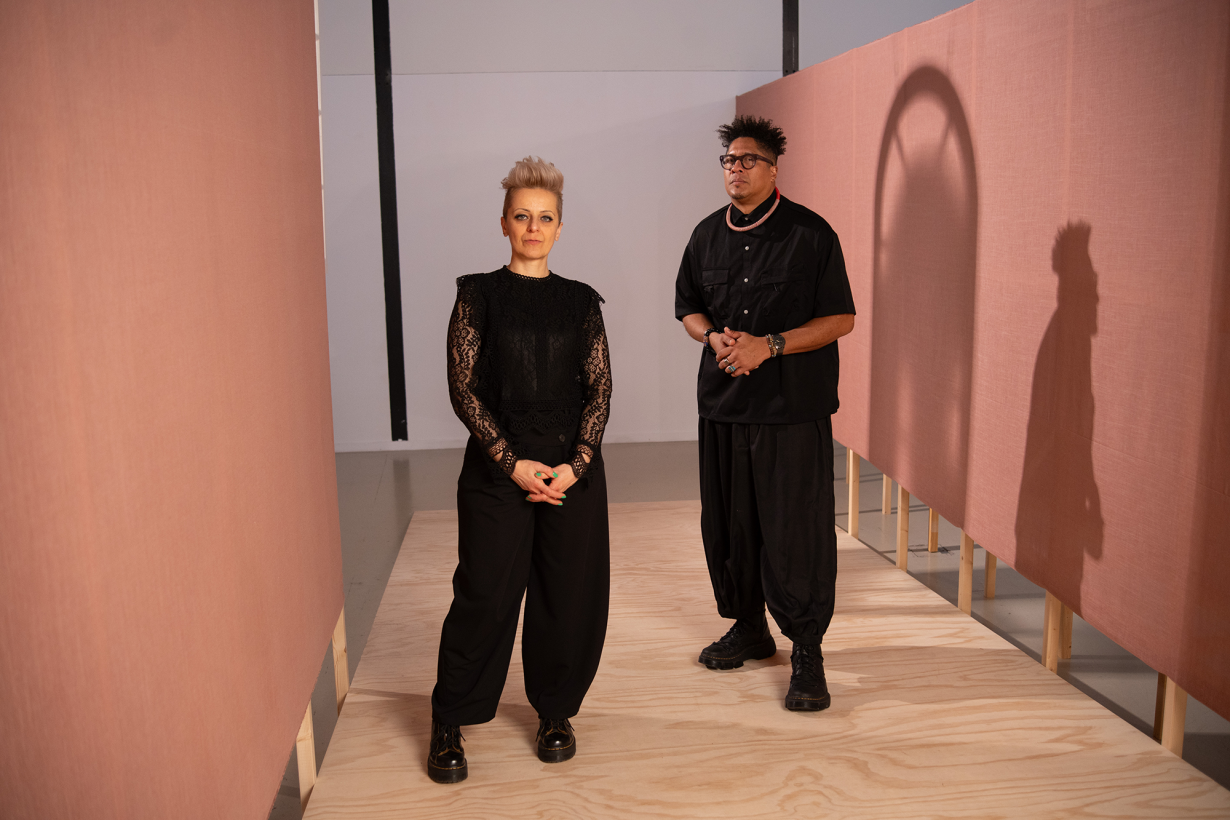
ArtReview Tell ArtReview what you plan to exhibit in Venice. What has influenced or inspired you? Our project is shaped by personal and collective experiences of structural injustice.
Antonio José Guzmán & Iva Jankovic Our project is shaped by personal and collective experiences of structural injustice, grounded in Panama’s Canal Zone history. Both of us were raised within social systems marked by colonial legacies. Panama, in this sense, is not only a prism for broader global histories of dispossession and exploitation, but a very specific site where those forces reorganized land, labour and everyday life. We are presenting Tropical Hyperstition, an installation and performance piece that narrates the history of the forced displacement and segregation of Panamanians and immigrants during and following the construction of the Panama Canal and the creation of the Canal Zone, a U.S.-governed enclave within Panama where entire communities were evicted under segregationist and racialized visions of ‘progress’ and public order. The work engages these geopolitical histories to examine how land, labour and bodies were reorganized through imperial and white supremacist extractive logics.
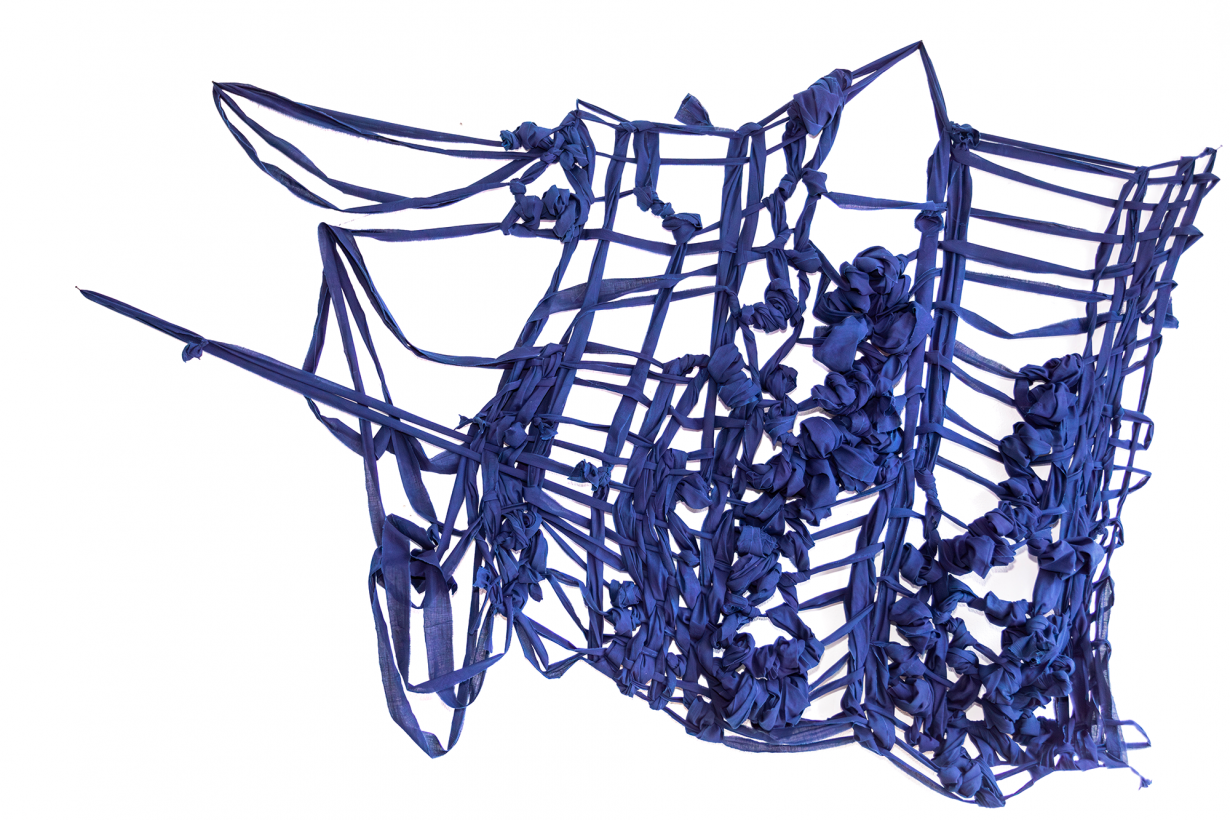
At the heart of the installation hangs a twenty meters long suspended hammock, handwoven from indigo-dyed fabric. The hammock carries multiple genealogies, tracing its origins to ancestral practices across the Americas, where elevation from the ground is associated with protection and life cycles. The hammock was also embedded in the domestic material culture of workers from the Antilles who migrated to Panama to build the Canal. In the Panama pavilion, the hammock is transformed into a monumental architecture of refuge, a structure of peacefulness, memory and survival.
On the second floor, patchwork textiles made from hand block–printed fabrics with genetic and geometric motifs are combined with archival photographs of the communities that once inhabited the territories displaced by the creation of the Panama Canal Zone. These textile compositions function as visual archives, weaving together memory, material and historical documentation to foreground the lives and cultures erased by infrastructural and colonial transformation.
AR In what ways does your work relate to the theme of the Biennale exhibition, In Minor Keys?
AJG & IJ Tropical Hyperstition resonates with In Minor Keys through its fibre and sonic installation and its emphasis on sensory immersion and affective experience. Through textiles, sound, and performance, we construct environments that operate as ‘minor’ emotional and perceptual counter sites-spaces of attention and relationality, rooted in Panama’s Canal Zone histories of displacement and cultural survival. These spaces function as what curator Koyo Kouoh describes as ‘oases’ or ‘minor islands’, generating moments of joy, hope and collectivity within dominant structures of representation.
Our indigo-dyed works trace histories of colonial extraction, plantations, trade routes and the economies that shaped the modern world, while also echoing Panama’s own entanglement with imperial infrastructure and labour regimes around the Canal. For us, sustainability is both future-oriented and a window to ancestral knowledge: we work with natural materials and processes, avoiding synthetic fibres, as an ethical and aesthetic commitment to repair and continuity.
The technique we use is a textile printing tradition called Ajrakh block printing, rooted in arithmetical lines and geometry, which we bring into dialogue with Panama’s layered histories of migration, craft and transcultural exchange. Ajrakh is, for us, a rigorous visual language with cosmological resonances, a way to hold pattern, memory and time. In this sense, In Minor Keys is carried by cloth, rhythm and atmosphere: what persists when official narratives erase.
Ajrakh is a traditional, intricate form of block printing native to Sindh (Pakistan) and Kutch (India), renowned for its deep indigo and crimson geometric patterns.
AR Why is the Venice Biennale still important, if at all?
AJG & IJ The Venice Biennale remains one of the most influential platforms for contemporary art, with the capacity to shape artistic trajectories and institutional visibility. For Panama, participation is especially meaningful because it helps make visible a region that has long been underrepresented within the Biennale’s national pavilions structures, particularly Central America. We participated in the Biennale in 2024 (Foreigners Everywhere, curated by Adriano Pedrosa), but representing Panama this year is significant on a personal level and symbolic for the region: it expands who is heard, and which histories are legible, within global art discourse. Our presence also foregrounds the marginalization of Central American, Balkan and Afro-Latin perspectives within the international contemporary art conversation. In a moment of renewed debates about sovereignty, borders and strategic infrastructure, it feels urgent to bring Panama’s Canal histories, and the communities displaced around it, into a global frame.
AR What role does a national pavilion play at a time of increasing confrontational nationalisms? Is it about expressing difference or commonality?
AJG & IJ While we resist narrow nationalism, we approach this pavilion with pride, honour and responsibility as Panama’s national representation. Panama has historically been an important site of interconnectivity and immigration in the region. The country embodies complex intersections of ethnicity, language and migration, forming transcultural networks shaped by movement and exchange, and by the geopolitical forces that formed the Canal Zone as a ‘country within a country.’
The Panamanian pavilion is therefore a critical reflection on colonial histories in the Global South, addressing land appropriation, capital accumulation, and segregation, while also affirming the cultural resilience and plurality that make Panama what it is. In that sense, the pavilion becomes a place to face colonial infrastructures and to hold commonality through lived history: how communities survive, adapt and keep cultural memory alive.
AR Who, for you, is the most important artist (in any discipline) that your country has produced?
AJG & IJ For us, this figure is Lord Cobra, a Panamanian calypsonian whose cultural impact extends across the Caribbean. He was among the early artists to bring calypso across languages, including into Spanish, creating a bridge between linguistic and musical traditions. His work exemplifies what Paul Gilroy theorized as the Black Atlantic, and his music, in some ways like Sun Ra’s compositions, can be heard as Afro-futurist visions rooted in Pan-African identities and diasporic modernity. Lord Cobra’s music is inseparable from the arrival of workers from Barbados and Trinidad during the construction of the Panama Canal. In 2010, filmmaker Gerardo Maloney produced a documentary on Lord Cobra, which offers a compelling account of his life and artistic legacy.
As a child growing up in Panama City in the 1970s, I was also deeply influenced by the musical work of Tropico de Cancer and the artworks of Panamanian muralist Olowaidi, particularly his public works from the 1970s and 1980s. These murals asserted dignity within urban space and demonstrated art’s capacity to function as a form of social and political activation.
AR What is something you want people to know about your nation that they might not know already?
AJG & IJ That Panama is not only a passage between oceans, it is also a dense cultural territory shaped by multiple diasporas and deep Indigenous histories. Panama is fundamentally a product of cultural hybridity and resilience, a crossroads of the world. The coexistence of Guna mola textiles, Calypso, Congos of Portobelo festivals, Bullerengue, Pindín (Cumbia y Mejorana), and Plena, as well as Reggae en español and Reggaeton, articulates a complex sonic and visual landscape. This hybridity also shaped the emergence of artists such as Nando Boom, Chicho Man and El General, who pioneered reggae en español, helping lay foundations for musical lineages that later evolved into reggaeton, a sound now heard globally through artists like Bad Bunny and Karol G. Panama’s cultural identity is inseparable from this historical process of mixture, anti-colonialism and cultural translation.
AR Given that you are exhibiting in a national pavilion, is there something that distinguishes the art of that nation from others?
AJG & IJ Panamanian art carries a distinctive tension between vibrancy and historical trauma. Its formal language is marked by colour and vitality, as in the works of Panamanian painter Alfredo Sinclair. The country’s palette emerges from histories of immigration, economic disparity, US military interventions, like the invasion of 1989, and racialized segregation.
Panamanian art is also deeply connected to Abya Yala (the Americas as named by Indigenous peoples), Guna textile Molas and to African narratives, as seen in the work of Portobelo visual artists, connections that are frequently overlooked within broader Global South curatorial frames. Panama is not only part of Central America, but also part of a broader African diaspora and of the creolization processes that define the Americas.
AR What, other than art, are you looking forward to seeing or doing while you are in Venice?
AJG & IJ We’re looking forward to the conversations that happen in Venice, reconnecting with colleagues and meeting artists and thinkers whose work expands what an exhibition can do. We’re also excited to gather with the Panama Pavilion team and our curators, Ana Elizabeth González and Monica Kupfer, as this project has been built through intense collective work across Panama and Venice. Our dear friend and mentor Koyo Kouoh has brought together a constellation of artists and intellectuals whose work we deeply admire, and participating in this context can feel like a Pan-African biennial unfolding within Venice, recalling the spirit of Dakar’s cultural philosophy of gathering, exchange, and affirmation. Above all, we’re looking forward to the reunions: friends and colleagues from all corners of the world coming together, moments of unity and reconnection.
AR Could you give us a brief overview of your average working day while creating your presentation in Venice?
AJG & IJ Our working process unfolds continuously across different time zones. We produce our indigo-dyed, sustainable, block-printed textiles at the Sufiyan Khatri Atelier in Gujarat, India, while coordinating production, assembling works and weaving textiles in our Amsterdam studio. In parallel, we coordinate work between Panama and Venice with performers, musicians, curators, producers and architects, and we work closely with the Panama Pavilion team and the Museo del Canal to access archival materials and historical research that inform the textile collages and the project’s narrative. The project functions as a sustained, collective labour structure, moving between making, research and logistics for long days across the week as we bring the installation, sound and performative elements into alignment.
AR Can art really change the world?
AJG & IJ Art can transform the world insofar as it produces strategies for survival and forms of collective imagination. In projects such as Tropical Hyperstition, artistic practice becomes a space where communities can hold memory, translate trauma and rehearse different ways of relating, through cultural production, social engagement and spiritual practice. In this sense, art is not merely representational but relational: it can make erased geographies perceptible again, through sound, cloth and shared attention, so that the histories of displacement around the Panama Canal and Canal Zone regain presence. When that presence returns, art can open room for responsibility, repair and new forms of belonging.
The 61st Venice Biennale runs 9 May through 22 November 2026