The Uzbek filmmaker’s work explores how present realities are shaped by the ever-shifting relationships between humans, nonhumans and the landscapes they haunt
“They say the earth changes every 50 years,” a retired elderly fisherman says in Saodat Ismailova’s film Aral, Fishing in an Invisible Sea (2004). He mends a broken fishing net, his fingers moving slowly across the threads illuminated by sunlight streaming through an open window in his living room. It looks out onto a dusty compound; beyond that, a desert landscape. “It is the wisdom of our ancestors. Maybe the sea will come back in 50 years. I will not see it.”
The dynamics of disappearance haunt the work of the Uzbek filmmaker and artist: landscapes erode, coastlines retreat, species vanish, ancient belief-systems are written over. Across a more-than-two-decade career, Ismailova has consistently turned her lens towards the cultures, ecology and suppressed histories of Central Asia – a region profoundly reshaped by Soviet industrialisation, secularisation and the environmental devastation caused by intensive agricultural and mining practices. Her films return repeatedly to what remains after environments, bodies and inherited forms of knowledge disappear. And what occurs to beings, cultures and geographies that are still, in the aftermath of the Soviet Union’s collapse, undergoing a process of erosion.
Aral, Fishing in an Invisible Sea is shot in a documentary style, its visual austerity reflecting both the environment and the harsh realities of what it is like to exist and maintain a livelihood in a dying landscape. Up until the early twentieth century, Karakalpak, Kazakh and Uzbek fishing communities moved around the Aral Sea, following routes and seasonal rhythms that paid little attention to the territorial divisions later imposed across Central Asia under Soviet rule. As well as humans, the sea’s surrounding wetlands and river deltas supported dense ecosystems of fish, migratory birds and wild animals.
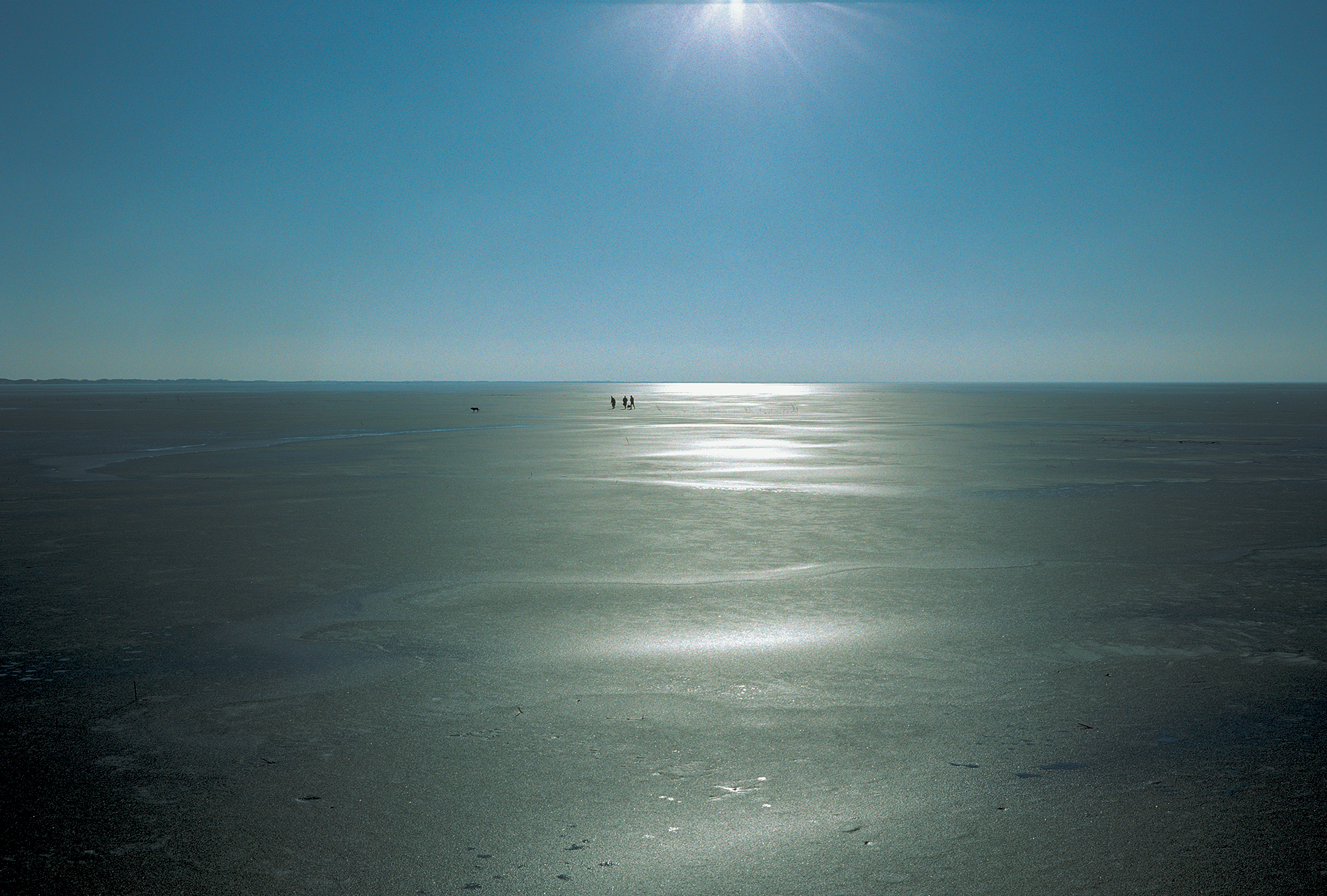
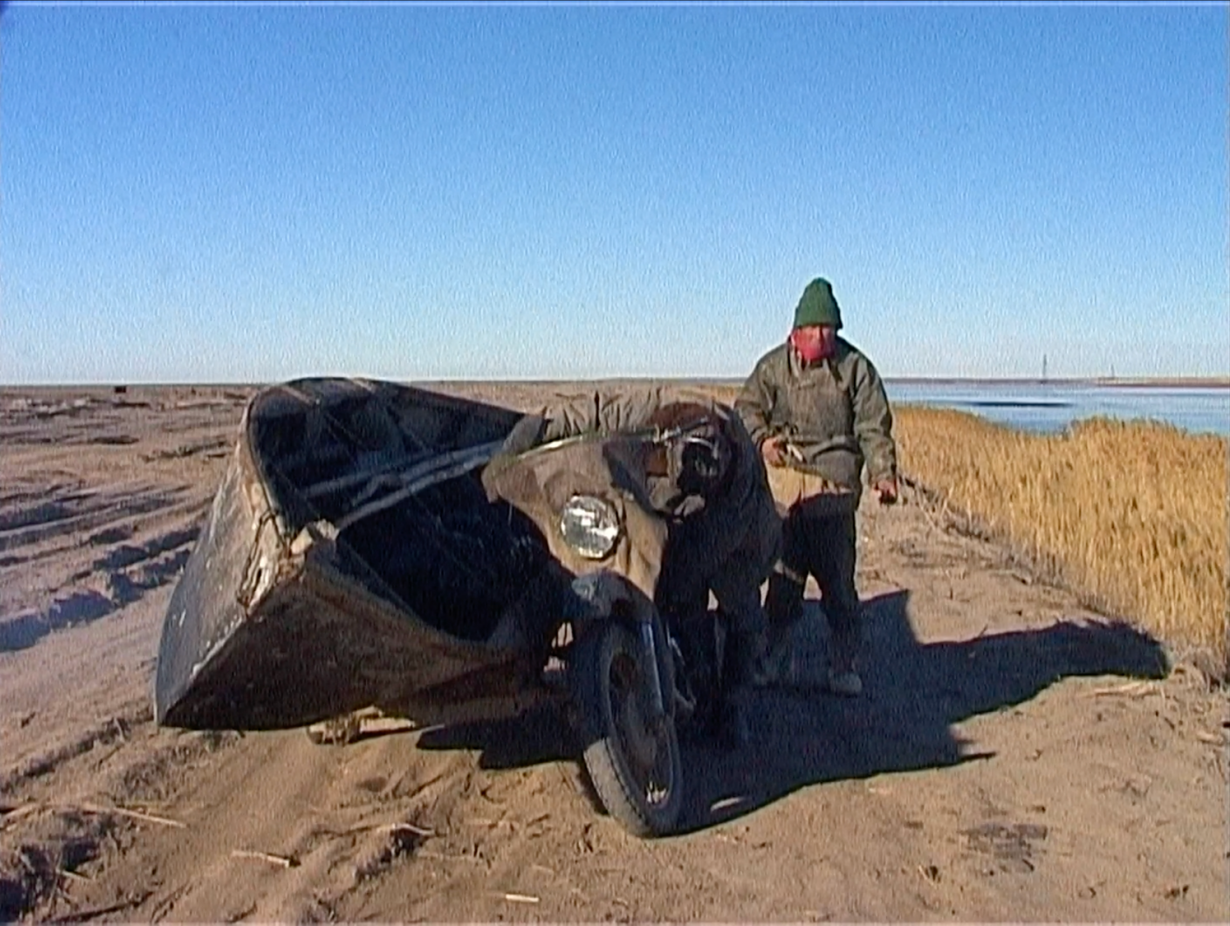
During the 1960s the Soviet Union diverted the Amu Darya and Syr Darya rivers to intensify cotton production across the region, transforming the Aral – then one of the world’s largest endorheic salt lakes – into a site of manmade ecological catastrophe spanning modern-day Uzbekistan and Kazakhstan. As the Aral Sea began to dry out, its surrounding fishing towns were stranded in a desertified landscape. The film’s opening scene features shots of abandoned fishing boats rusted a dried-blood red and lying like so many carcasses under a glaring sun. Around the remaining South Aral Sea, in Uzbekistan, almost all of the towns ceased functioning as fishing communities; Aral documents the day-to-day lives of three generations of a fishing family left. From behind her lens Ismailova follows the men who set off in the early morning to try to catch from what little fish stock remains; she watches a mother collect water from a well, a grandmother weave thread for fishnets and a child doing homework while listening to pop music. While other families have found forms of land-based employment, the last of the fishermen refuse to move away or work elsewhere, proudly claiming that this land and work is part of their heritage. They are hopeful that the Aral will replenish. We are told that salt and pesticide-filled dust from the exposed seabed, dispersed by the wind, carries disease and contaminates farmland with particles of evaporated agricultural runoff. Toxic dust storms remain an issue today.
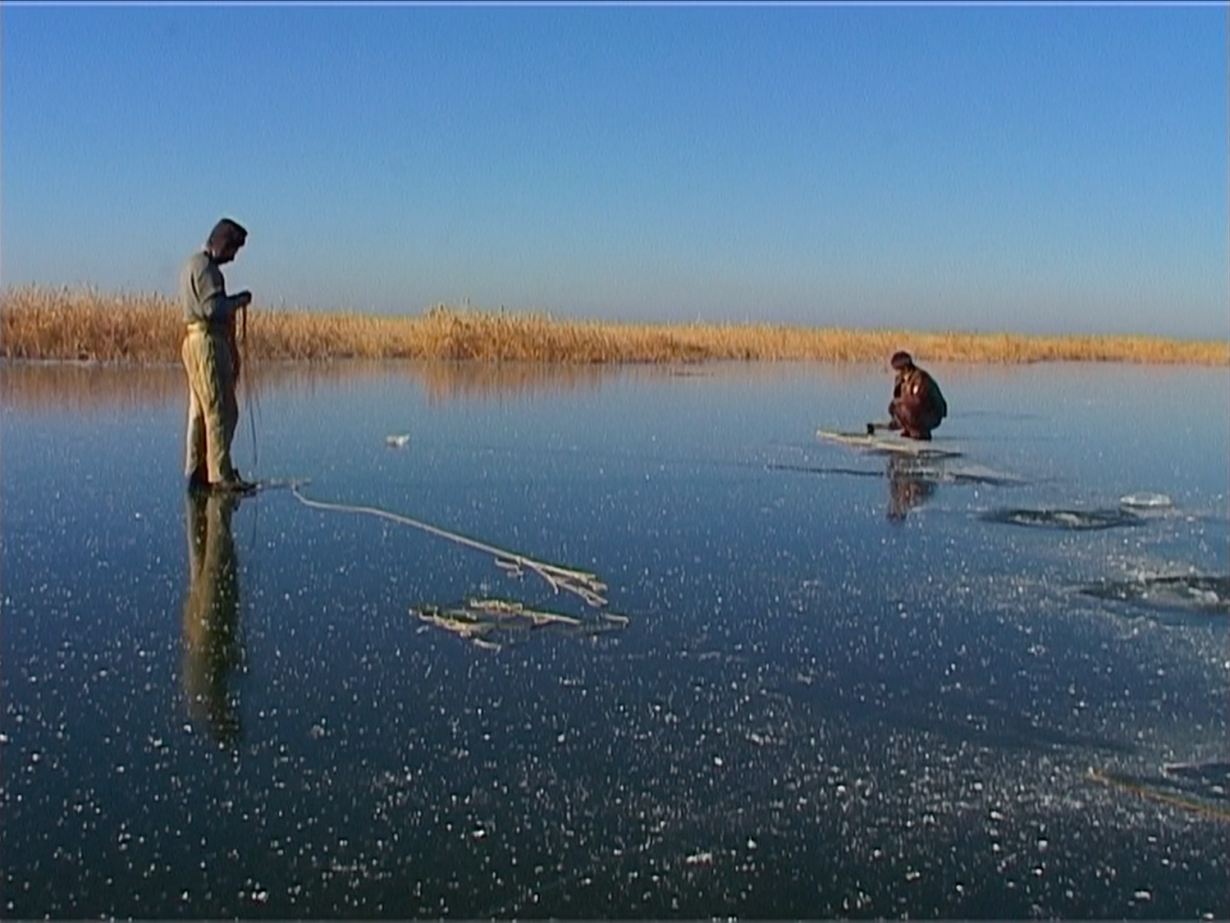
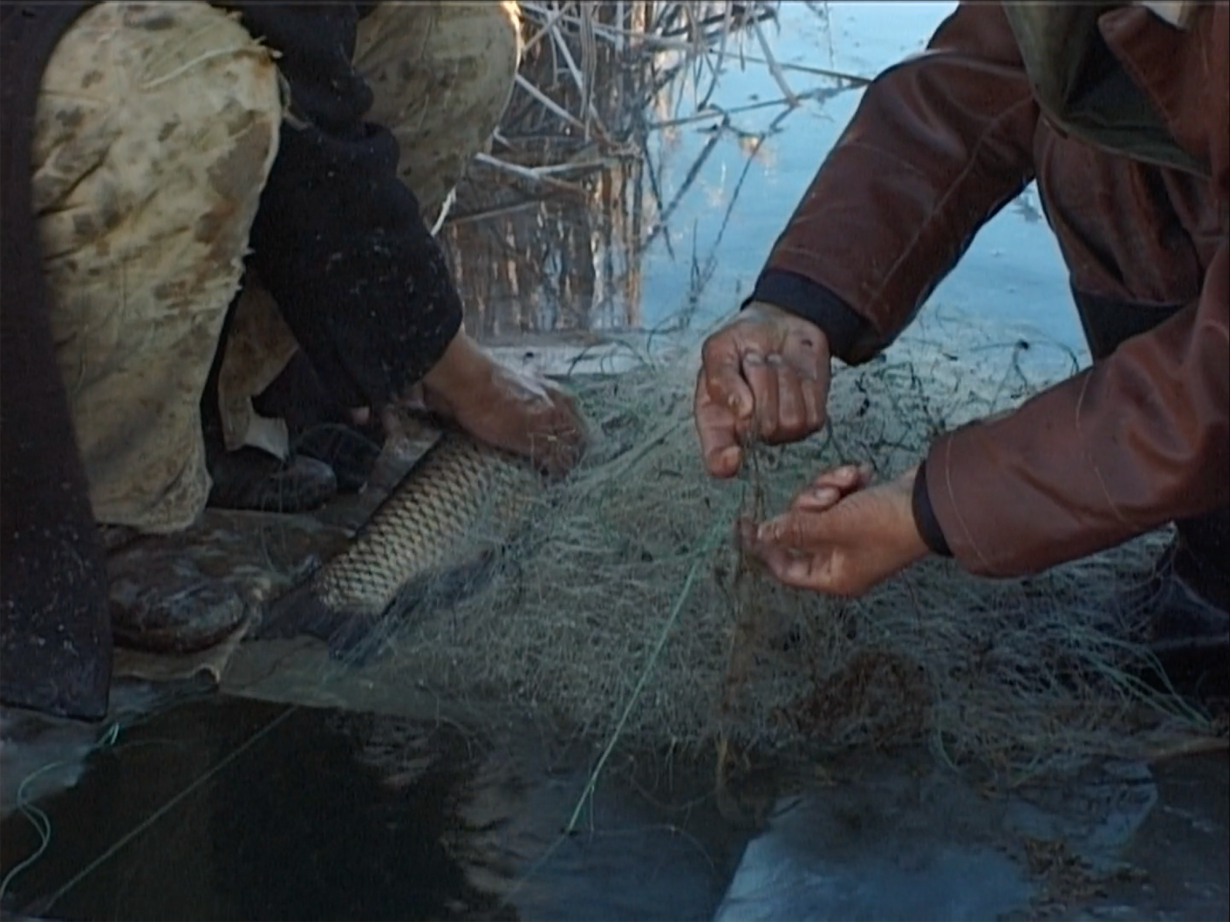
In Aral the social effects of such environmental transformation are not approached via spectacle, but through the repetitive labour required to continue living there. In one scene, two fishermen hack holes into thick ice in order to lower their nets into the water below. It looks bitterly cold. One man recalls falling through the ice: “I fell up to my neck… all my clothes were frozen… the next day I went fishing again.” In another scene, the fishermen strap a boat to the sidecar of a motorbike and drive away from a shoreline edged with yellowing reeds, across a vast stretch of desert. One man returns home triumphantly carrying a huge dead carp, handing it to his wife. Residual energy stored in its nervous system causes the fish to jerk while it is scaled and filleted.
The film continuously highlights the gap between what once existed and what remains. The elderly man, repairing the fishnets now used by his sons, recalls how “the sea was wide, defiantly arriving to Akkala” when he was young. (The town of Akkala is now roughly 150km from the South Aral’s shoreline.) “During the 60 years of my life,” he says, “the sea has become dead earth.”
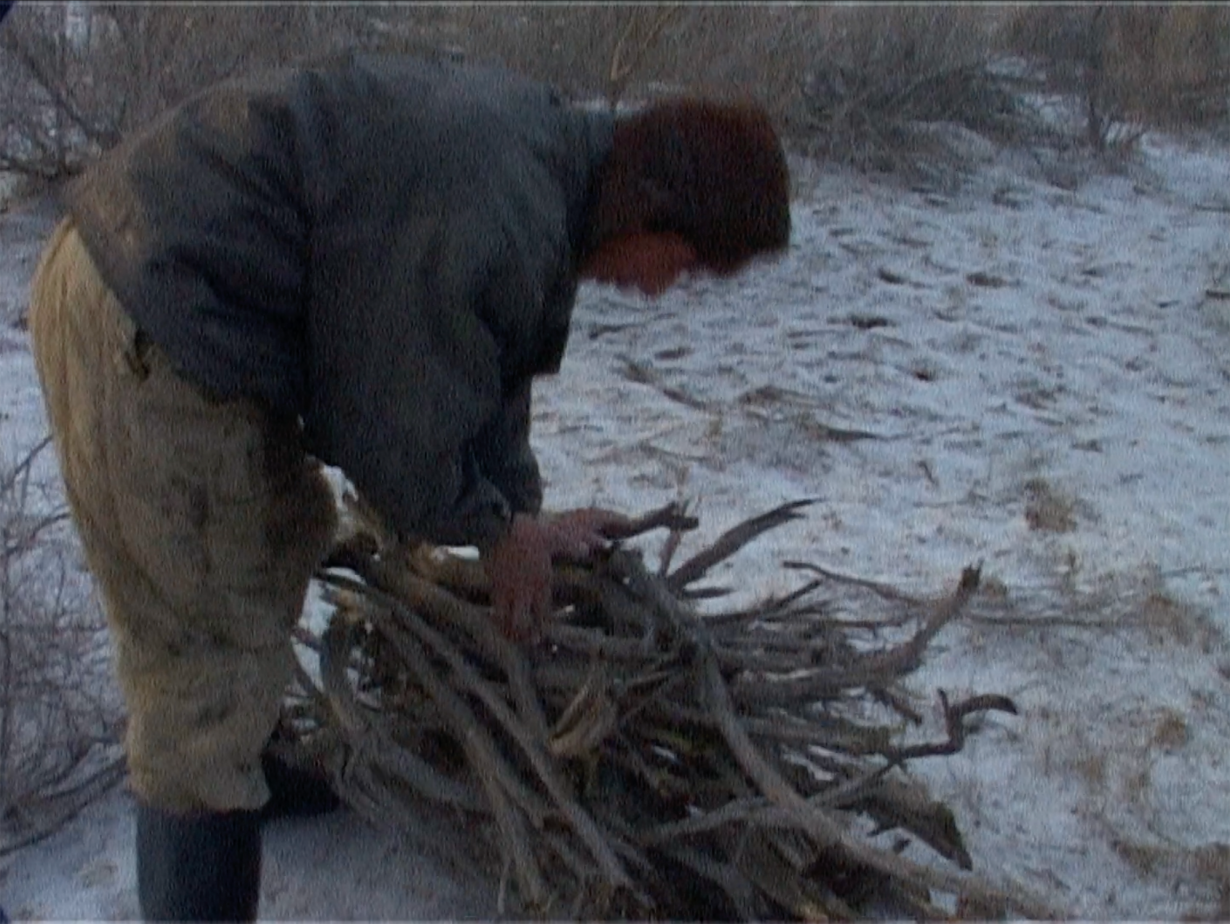
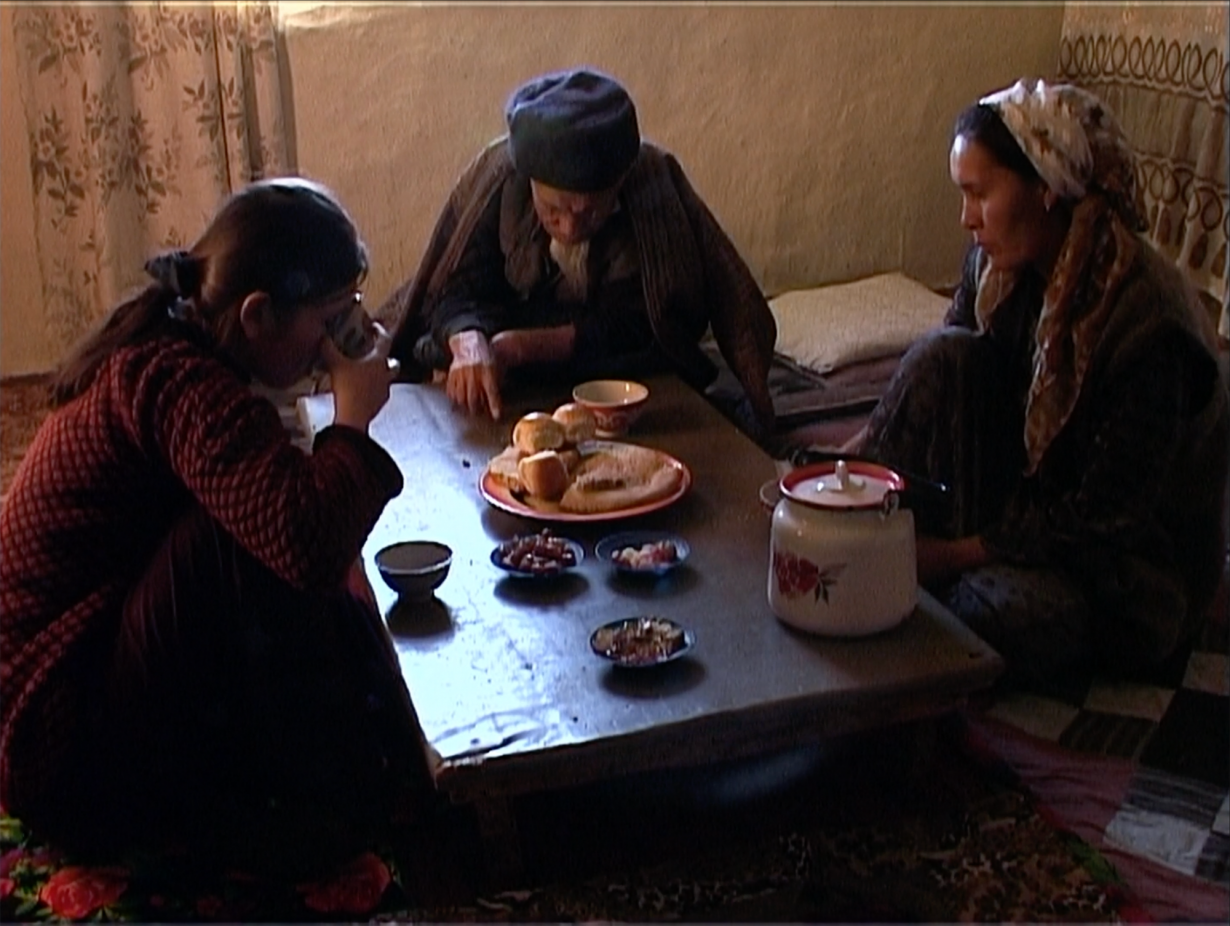
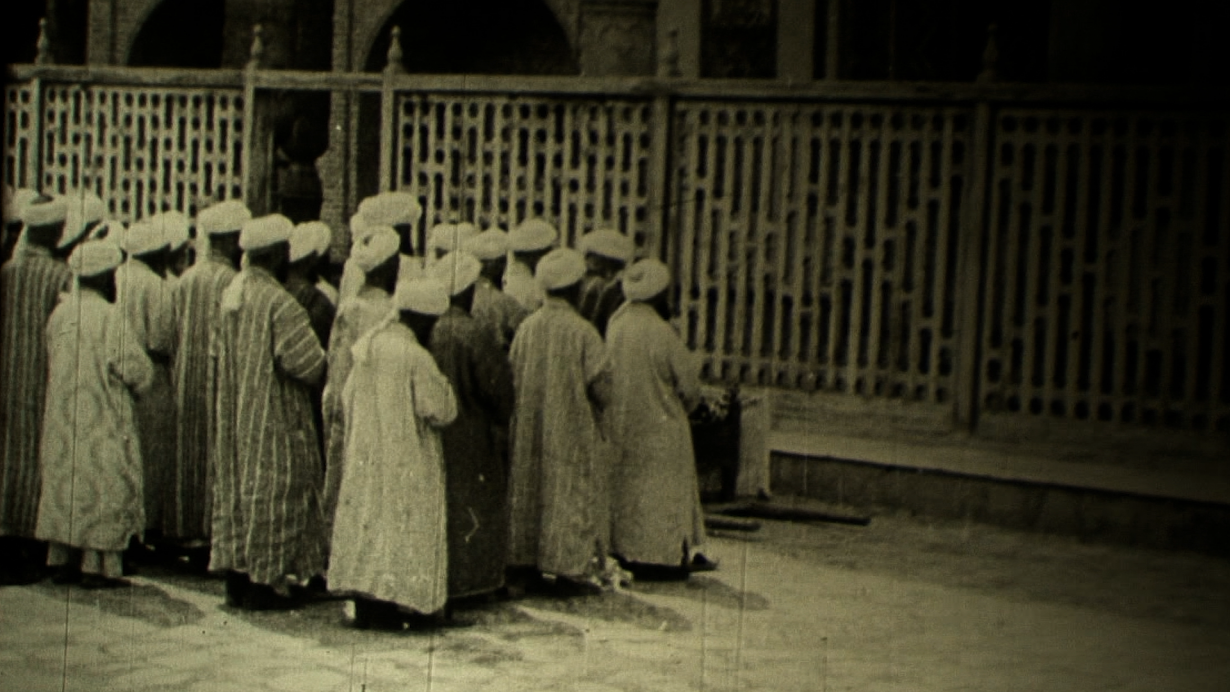
Yet the film is not centred entirely around the physical grind of survival. In one scene, the same elder drinks tea with his friend, who is seemingly the same age, beneath flickering lights in his living room. They shout over one another because they are both hard of hearing. They gossip about marriages and pensions until the electricity cuts out completely. They laugh, thank Allah for their meeting and continue shouting to each other in the dark. The effect is comical, tender. And the scene serves as a reminder that despite the Soviet Union’s suppression of Islam across Central Asia – when mosques were closed, religious education dismantled and public worship heavily monitored – such practices did not disappear. Instead, belief persisted in the domestic space. It is a dynamic that still carried political tension in Uzbekistan when Aral was made in 2004, during President Islam Karimov’s increasingly repressive rule. Elsewhere in the home, an elderly woman rocks a baby in a covered cot while quietly singing a lullaby; in an adjacent room, a man performs his evening prayers. These are the moments by which the film seeks not to reduce the region to ecological tragedy alone. Life continues, however unevenly. Ismailova’s later films move towards allegory and myth, as though certain forms of rupture exceed straightforward documentation. History isn’t presented as a series of events arranged in a timeline or a fixed chronology. Instead it’s made up of memory (in all its mutability and instability), ancestral knowledge and ancient rituals and belief systems – and it is dispersed across these films via landscapes, bodies both human and nonhuman, and whispered speech that sits somewhere between incantation and narration.
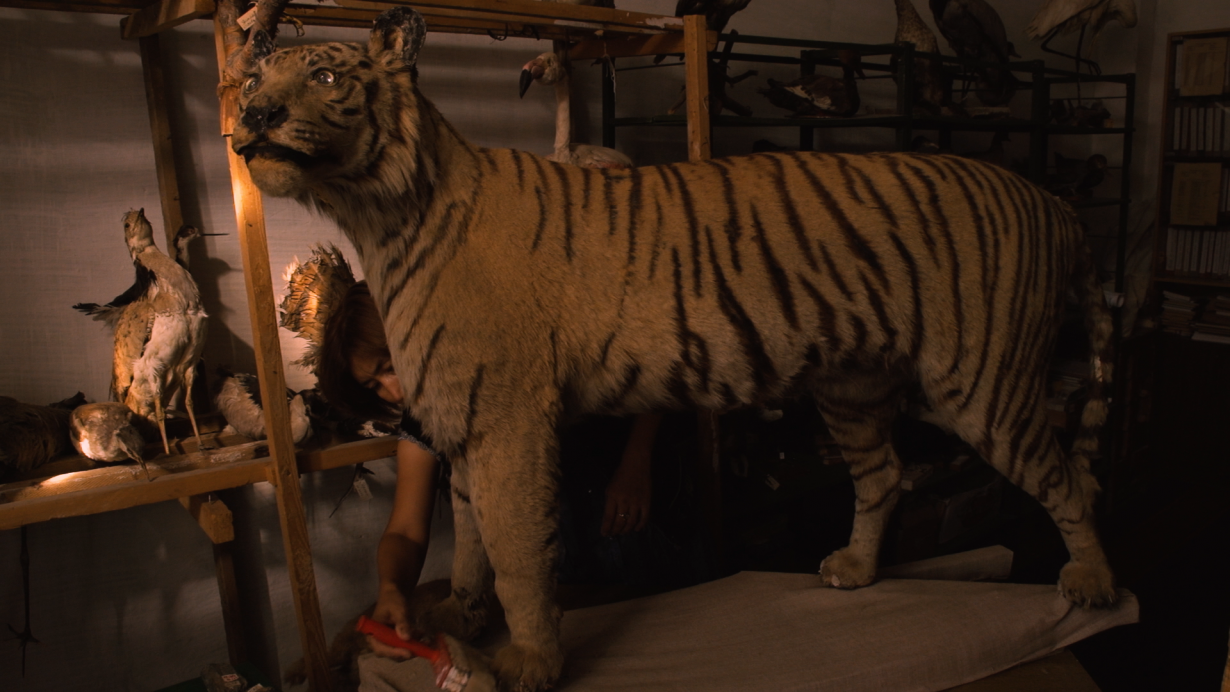
If Aral documents the material aftermath of environmental collapse, The Haunted (2017) approaches erosion and disappearance through species destruction and the unstable boundary between preservation and decay. The film’s central subject is the now extinct Turanian tiger, which once inhabited the wetlands and reedbeds of the Aral Sea until hunting, habitat destruction and waning prey led to its demise: here, Ismailova cuts footage of ruined human settlements and vast sweeping views of the Aral Sea with closeup shots of a living tiger, partially lit in the half-shadows of an unidentifiable space. It sits quietly, paces and breathes softly in sleep. Gunfire abruptly tears through the soundtrack of wind and running water – and then Ismailova’s camera takes us into a dusty taxidermy workshop. The source of a dry scraping sound is revealed when the camera pans a corner and makes visible a woman who is gently brushing the toes of a poorly preserved Turanian tiger. An absurd expression is fixed to its face, as though a taxidermist has captured the tiger’s indignation at being the subject of this unwanted manicure.
At one point, the camera lingers on a crudely stitched section of the tiger’s skin, pulled together with strips resembling reeds. Long dried open, it is a wound that cannot be closed. Throughout the film, a female voice speaks gently to the tiger and conflates the plight of the extinct species and the region’s loss of cultural and spiritual heritage. “Give me back my inherited knowledge,” she pleads, “so I can read secret writings printed on your skin.” At other points it’s hard to know whether the voice speaks from the perspective of the human who has become disconnected from their heritage or the tiger that no longer exists – and yet which remains alive within a lost cultural memory: “When you disappeared they began dissecting me… along the veins, cutting the ligaments, fiercely breaking the bones.”
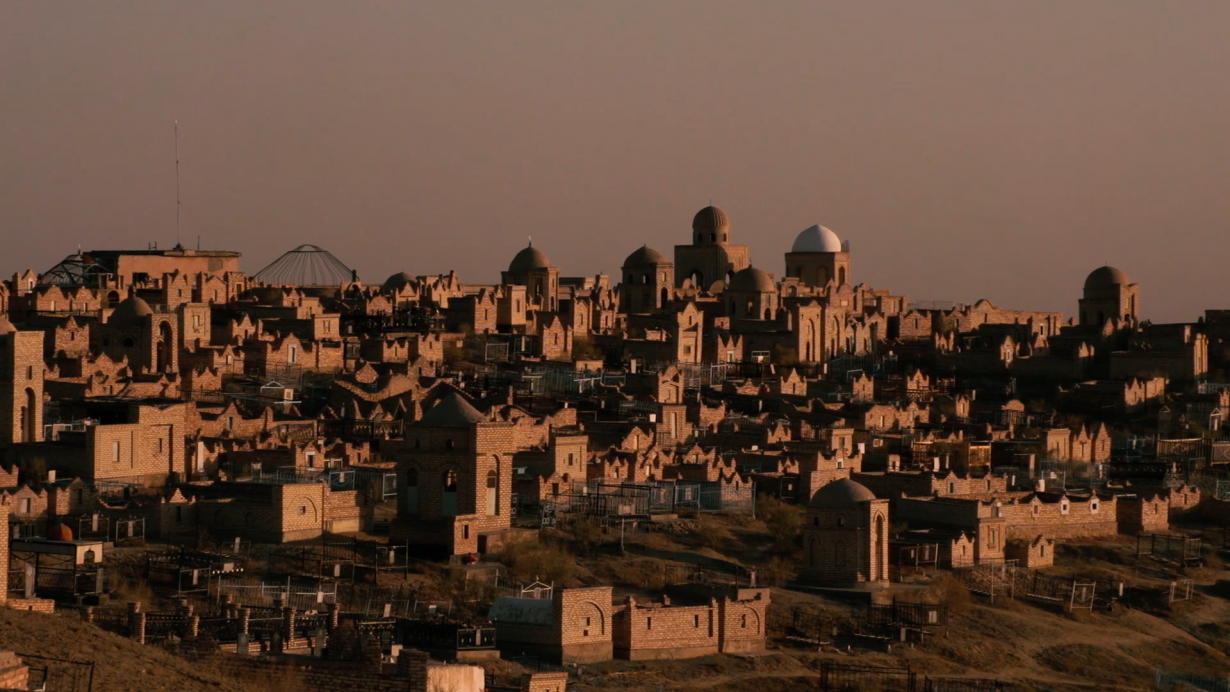
There is a pervasive sense that time doesn’t quite work the way it is taught in the linear Western form: there are the cyclical ecological shifts spoken of in Aral, and here the experience of time is considered on a spiritual and, later, cosmological level. In one of The Haunted’s final scenes, ghostly, semitransparent human figures wander around a dusty, sun-bleached ruin of a building. It turns out to be located on the site of Mizdakhan Necropolis, believed locally to be the burial place of Adam (it’s also thought to be the tomb of Gayomard, the first person) and where Zoroastrian, Islamic (it is also the final resting place of Erezhep, an early Muslim preacher) and older practices historically converged. As a result, over centuries on this site, Islamic pilgrimage traditions gradually settled into an already sacred Zoroastrian funerary landscape, absorbing older cosmologies and rituals rather than entirely replacing them.
At Mizdakhan Necropolis, hundreds of small stacks of bricks are carefully arranged around the remains of the tomb of Khalifa Erezhep. Legend has it that a brick falls from this mausoleum’s wall every year, and that when the wall finally collapses the world will end. Pilgrims stack seven bricks (in Islam, a number symbolic of completion) into small towers to preserve time.
Two decades after the making of Aral, time in Melted into the Sun (2024) no longer operates in rhythms, nor does it feel like it can be contained. Instead, it is accelerated, unstable. “Each new cycle seems shorter than its predecessor,” a distorted, unidentified female voice says near the film’s beginning, referring to the same earth shifts as the elderly fisherman in Aral. “The eternal has become temporary, and the temporary has become our heritage.”
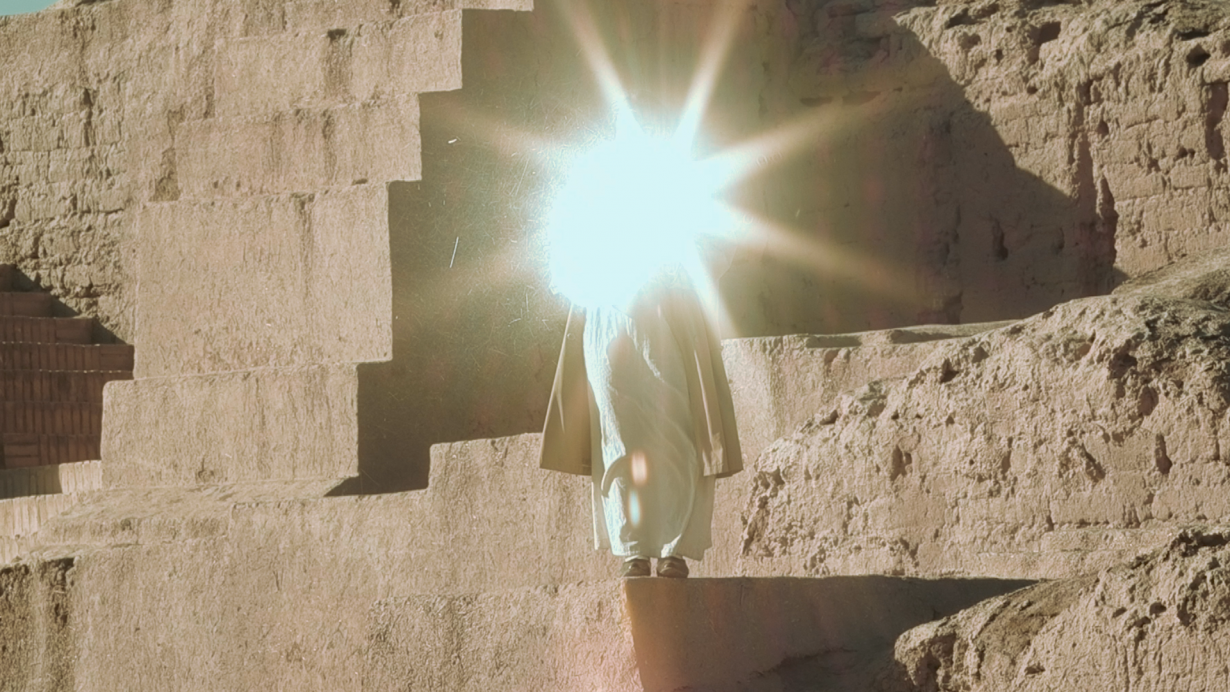
The film opens with the premise that it is a reimagining of the eighth-century Islamic figure al-Muqanna – ‘The Veiled One’ – who led a revolt against the Abbasid Caliphate across parts of Central Asia. But there is no visible uprising here. The camera pans through deserts, wetlands, ruins and industrial landscapes across Uzbekistan, Kyrgyzstan and Kazakhstan, with cuts between the sites collapsing distinctions between historical myth, political ideology and environmental transformation. The elements repeatedly appear throughout the film as forces of nature that, despite human industrial and technological endeavour, cannot be fully contained or controlled: a body of water glows beneath the setting sun like molten gold; sunlight struggles through the murky, polluted air of a cityscape; wind howls across desert scenes, whipping up dust, whose presence behaves as both material and metaphor – the residue of ecological collapse, political violence and disappearing forms of knowledge. Dust blows across dried seabeds, ruined infrastructures and exposed landscapes, the product of erosion as much as it is itself erosive.
Al-Muqanna drifts through these landscapes. He ponders humanity’s loss of connection to nature. At first he is dressed in white fabrics; later he wears black, adorned with coins. His partially painted fingers glint like oxidised silver beneath beams of reflected sunlight. He speaks softly to his disciples in a bleak, windswept desert landscape: “Emerging from nature, why did we become separated from it? Can a tamed wolf survive in the wild? Can a bird with clipped wings fly to the sky?” He falls silent while his hands continue gesturing as though still speaking. In other scenes he whispers without subtitles entirely. Some things remain deliberately obscured.
These scenes are cut with wide-angle shots of the Kirov Reservoir, along with its dam, into the side of which has been carved a giant head of Lenin. His symbolic presence functions as a reminder of how such infrastructures continue to express ideological influence – ones that reshape the landscape – long after the systems that built them have collapsed. There is a sense of thinning boundaries, too: al-Muqanna’s face is at first concealed by heavy cloth, but at times this changes to a lightweight material, his features just about discernible from beneath, suggesting a tension between enlightenment and destruction, truth and fabrication. “Who determined where is East and where is West?” the distorted female voice asks over the sound of running water. This voice, which returns occasionally throughout the film, remains an enigma; it is an omniscient presence, one that, unlike al-Muqanna, requires no devotees, and is less concerned with creating a system than observing its long-term universal effects. “Who determined what is truth and what is a lie?” she asks. Later, a reflection of two moons ripples on black water.
The film’s imagery repeatedly highlights exposure to larger elemental forces. “We conceive to construct, but end up destroying,” says al-Muqanna. Seated around a fire among his disciples, whose faces are now blurred, he promises to lead his followers “into the throat of the Sun”. Dressed in white earlier, al-Muqanna now appears veiled in black – a transformation that, in later legend, came to symbolise his movement’s slide from revolutionary liberation into authoritarianism. His voice has taken a menacing turn; while he is convinced he is a divine incarnation, al-Muqanna’s now shadowy presence signals the corruptive nature of power in the hands of humans. Later he stands silhouetted atop a hill, reaching out to the sun, letting its rays break through his fingers.
The film continues to move between ancient sites, cityscapes and infrastructure projects accompanied by an increasingly intense soundtrack of desert winds, drones, whispers, running water and beats that mimic a racing heart. In one of the film’s final scenes, the camera pans across the shifting glare of a Soviet-built solar furnace, whose mirrored panels endlessly track the movement of the sun itself. The furnace, once a symbol of Soviet technological mastery over nature, is used to test how materials behave under extreme heat conditions and develop heat-resistant materials. Towards the end of Melted into the Sun, however, and moving far beyond the particularities of the geographic locale, there is a sense that humanity’s heritage and history begin to feel less like something that ought to be preserved and more like a physical and psychic burden that should be left to burn away.
Saodat Ismailova: Melted into the Sun is on show at the National Museum of Asian Art, Washington, DC, from 13 June to 29 November. Ismailova’s Amanat, The Sacred Forest is at LUMA Arles from 4 July to 10 January
From the Summer 2026 issue of ArtReview – get your copy.